Talat: AI meeting notes stay on your device, not in the cloud
Talat is a new AI tool for automated meeting notes. The key difference: everything works locally, with no subscription and no cloud. Transcription and AI…
AI-processed from TechCrunch; edited by Hamidun News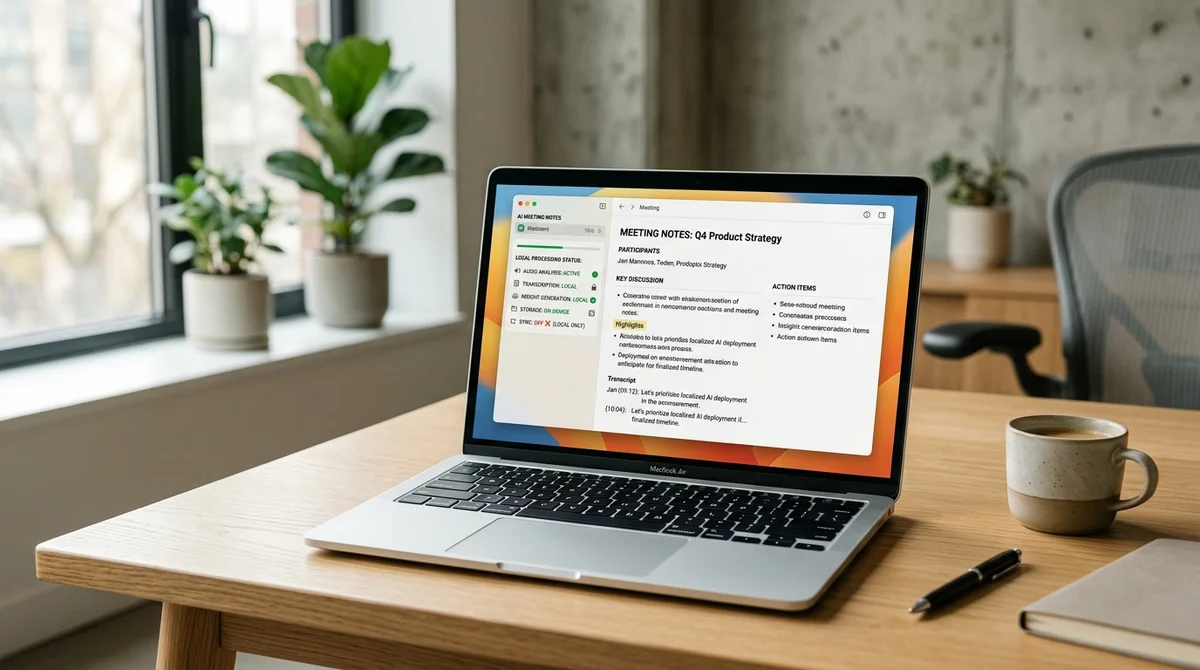
The AI meeting tools market is overflowing with cloud services — Granola, Otter.ai, Fireflies, Read.ai.
All of them record, transcribe, and summarize meetings using artificial intelligence, but the data is stored on the developers' servers. Startup Talat offers a fundamentally different model: everything is processed and stored locally, on the user's device, without cloud intermediaries and without a monthly subscription. The application works simply: it listens to a call or offline meeting in real time, builds a transcript, and upon completion provides structured notes with key points and a task list.
The entire process happens without requests to external servers — the internet is only needed for initial setup. This starkly contrasts with competitors: Granola costs from $18 per month and requires constant cloud connectivity, Otter.ai — from $16, Fireflies.
ai — from $10. And all of them de facto store their users' business negotiations in their own databases. The "local-first" concept has proven itself in adjacent niches.
Text editors Obsidian and Logseq gained millions of users precisely because data never leaves the owner's device. Now this approach has reached the market for automatic meeting notes. Developers and entrepreneurs increasingly feel subscription fatigue: the combined payments for dozens of SaaS tools in small teams easily reach $500–1000 per month.
Talat positions itself as a way out of this trap — without subscriber fees and without dependence on foreign infrastructure. For corporate users, the privacy argument is even more compelling. Deal negotiations, strategic board discussions, personnel decisions — all of this should not accumulate on the servers of American startups with opaque data storage policies.
European companies operating under GDPR are especially sensitive to this issue: a fine for violation can reach 4% of global annual turnover. Japanese and Korean corporations face similar requirements under national legislation. Local processing eliminates much of the regulatory risk and simplifies compliance auditing.
Technically, the application relies on locally run language models. For transcription, OpenAI's Whisper is apparently used — an open-source model that accurately recognizes speech in dozens of languages without sending audio to third-party servers. Summarization and note structuring is handled by a compact LLM — Llama, Mistral, or similar distillates.
Such a stack is quite realistic on modern consumer hardware today: a MacBook Pro with Apple Silicon or a Windows laptop with a discrete graphics card can handle the task in real time without any cloud support. Competitor Granola is not standing still: the service has attracted investment, added team features, and integration with corporate calendars. But its architecture is fundamentally cloud-based — this is built into the business model.
Talat occupies a niche that Granola physically cannot occupy without completely rewriting the product. The new player attacks not on the field of feature richness, but on the field of architecture and trust — a proven strategy in competitive niches. Law firms, medical organizations, investment banks, and any company for which recording business negotiations is a legally sensitive matter will finally get a practical alternative to cloud services.
As local language models become more powerful and regulatory requirements for data storage tighten, local-first tools like Talat will only grow in popularity. The absence of a monthly subscription removes the final barrier to adoption.
Want to stop reading about AI and start using it?
AI News is a curated feed of AI/tech news. Hamidun Academy teaches you to use AI systematically in your work.