Deccan AI raises $25M in the data labeling market with a focus on specialists in India
Deccan AI, a Mercor competitor in the AI training market, has raised $25M. The startup is concentrating specialists in India — not through crowdsourcing, but…
AI-processed from TechCrunch; edited by Hamidun News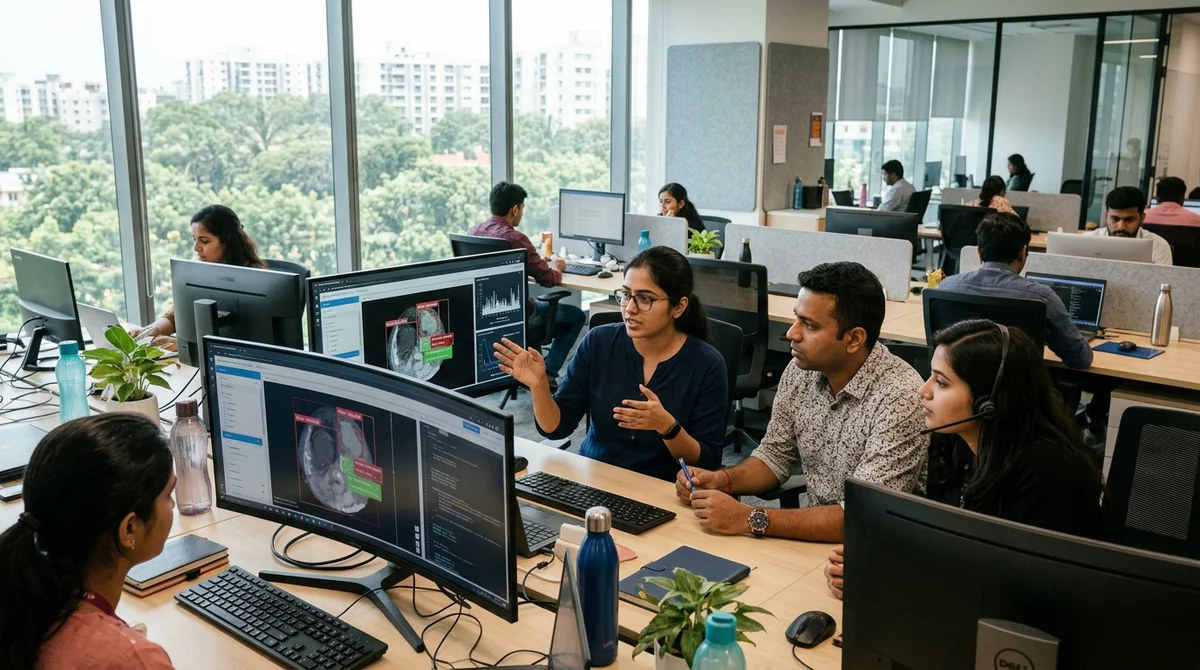
Deccan AI closed a $25 million funding round, positioning itself as a systemic player in the data labeling market for AI model training. The company is a direct competitor to Mercor — one of the leading platforms in the AI training talent segment — and builds its competitive advantage on a fundamentally different organizational model: not a distributed marketplace of freelancers, but managed teams of specialists concentrated in India. The market in which Deccan AI operates is experiencing explosive growth, but suffers from a systemic problem.
Demand for AI model training services is growing every quarter: the largest laboratories — OpenAI, Anthropic, Google DeepMind, Meta AI — continuously scale up RLHF annotations, training dataset formation, red-teaming, and model safety evaluation. According to various forecasts by analytical agencies, by 2028 the AI training data market size will exceed $10 billion. At the same time, the industry chronically suffers from a quality problem: the vast majority of contractors work through crowdsourcing platforms with minimal oversight, which systematically leads to low annotation quality, inconsistent results, and as a consequence, degraded quality of trained models.
This is where Deccan AI sees its growth opportunity. Unlike competitors who aggregate freelancers from dozens of countries through a single platform, the startup builds managed teams directly in India. Employees undergo specialized training tailored to specific client requirements, work in a structured environment with multi-level quality control, and operational processes can be standardized in a way that is impossible with decentralized outsourcing.
Such a model allows guaranteeing uniform results at scale — a key requirement for large AI laboratories that cannot tolerate variability in training data. The choice of India as an operational hub is not accidental and not new, but Deccan AI has specific arguments in its favor. The country has one of the world's largest concentrations of technically skilled personnel — over a million engineering and IT graduates are produced annually.
English language proficiency is significantly higher than in other popular outsourcing regions, which is critical for working with text data. Labor costs remain an order of magnitude lower than Western markets. Scale AI, Surge AI, and a number of other sector leaders follow the same path, but most of them rely on scale through a platform aggregator.
Deccan AI consciously chooses smaller scale, but higher quality and predictability. The competitive environment is becoming increasingly intense. Mercor is aggressively expanding beyond engineering recruitment into AI training.
Traditional providers — Appen, Lionbridge, Telus International — are actively reorienting their portfolios toward generative AI needs. The major laboratories themselves are investing in their own internal teams of annotators, seeking to reduce dependence on external partners. In this competitive dynamic, Deccan AI will have to constantly prove that a premium model with managed teams delivers real ROI compared to cheap crowdsourced platforms.
The attracted $25 million will allow the company to accelerate specialist recruitment in India, expand its client base among AI laboratories and technology startups, and invest in its own tools for quality control, workflow automation, and team productivity analytics. This round fits into a broader investment trend: venture capital is increasingly moving toward the infrastructure layer of the AI industry — not to frontier models themselves, but to what ensures their reliable operation. High-quality training data, RLHF annotators, and human evaluators are becoming a strategically scarce resource around which intensifying competition is unfolding.
Decentralized crowdsourcing with demands for systemic quality cannot meet the challenge. A managed, structured, geographically concentrated team can.
Want to stop reading about AI and start using it?
AI News is a curated feed of AI/tech news. Hamidun Academy teaches you to use AI systematically in your work.