War over generative AI erupts at CalArts and other US art schools
US art schools face sharp divisions over generative AI. At California Institute of the Arts CalArts, students staged a protest against AI-generated art in…
AI-processed from The Verge; edited by Hamidun News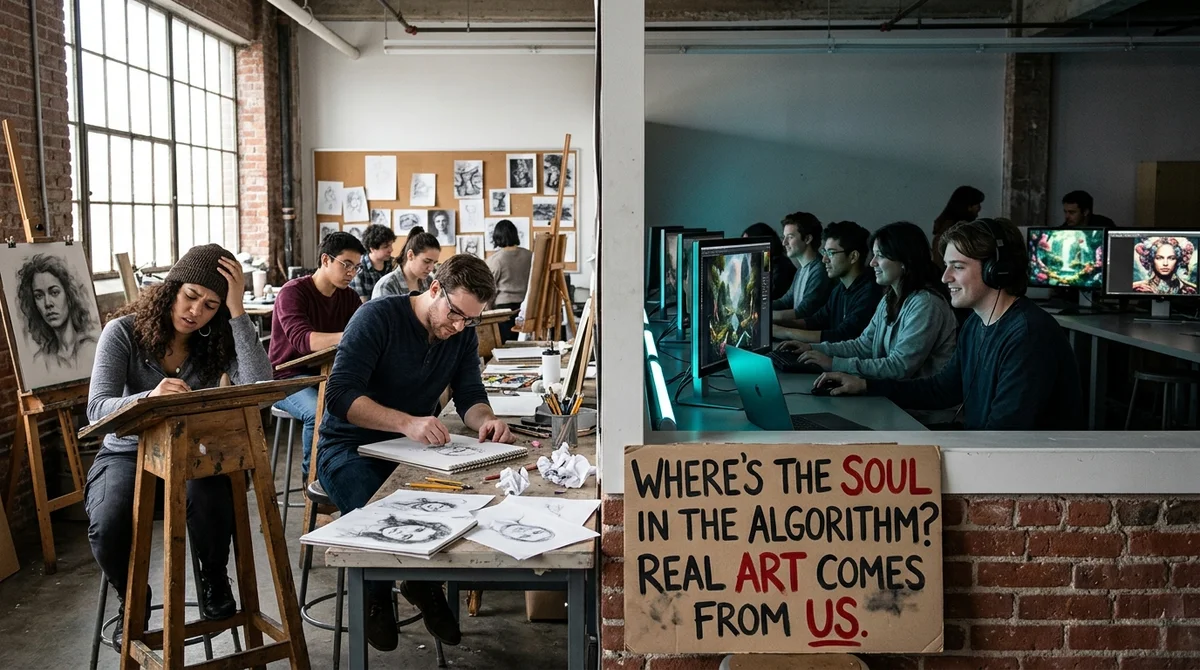
American art schools found themselves at the epicenter of a confrontation between traditional creative education and rapidly developing generative AI tools. Students fear for their professional future, teachers debate the boundaries of acceptable practice, and educational institutions are forced to rewrite their curricula without understanding what the job market will look like in four years. The situation reached a boiling point in early this year at the California Institute of the Arts, CalArts.
Students organized a protest: on placards calling for AI artists to be involved in diploma work, there appeared handwritten corrections from the discontented—no one wanted algorithms to replace genuine creative contribution. This episode exposed a contradiction that is tearing creative universities apart around the world today. Students' fears are well-founded.
Specialties that seemed reliable just a few years ago—3D modeling, animation, illustration, motion design—today face direct threats. Generative models can create concept art, generate textures, animate characters, and assemble storyboards faster than any graduate. Employers increasingly demand proficiency in AI tools, and the barrier to entry for those who know how to work with prompts has dropped sharply.
A student who spent three years mastering traditional techniques risks losing out in speed to someone skillfully working with Midjourney or Runway. The reactions of educational institutions vary dramatically. Some have started incorporating generative tools into mandatory programs—the logic is simple: the market demands these skills, so we need to teach them.
Others introduce bans, fearing that students will stop developing fundamental skills and understanding of their craft. Still others maintain a compromise: AI is acceptable for seeking ideas and references, but the final work must be entirely original. The problem runs deeper than a dispute about tools.
At its core lies an existential question: what is creative education if its main product—hands, eye, and imagination—starts to compete with an algorithm? Teachers who have devoted their careers to passing on mastery now face the reality of their discipline being devalued—not because of poor students, but because of technological progress. Students pay enormous sums for education without knowing which specific skills will actually be in demand by the time they graduate.
The split is growing even within institutions themselves. Some teachers actively explore AI and see in it an expansion of creative space. Others believe that accepting these tools is a capitulation to forces that will ultimately destroy the profession.
Students find themselves caught in the middle: fear of being left without work if you don't master AI, and fear of losing creative identity if you trust it completely. What is happening in art schools is not an isolated crisis of the educational system, but an early symptom of broad-scale restructuring. The creative job market is transforming at a pace that leaves no time for gradual adaptation.
The decisions universities make today—whether to include AI in curricula, how to teach critical thinking in the age of generation, what to prioritize—will determine the face of the next generation of creative professionals. For now, there are far more questions than answers.
Want to stop reading about AI and start using it?
AI News is a curated feed of AI/tech news. Hamidun Academy teaches you to use AI systematically in your work.