Meta, Microsoft, and Google are building gas-fired power plants for AI data centers — what could go wrong
Meta, Microsoft, and Google are building their own gas-fired power plants next to new AI data centers. The grid cannot handle the load, nuclear reactors will…
AI-processed from TechCrunch; edited by Hamidun News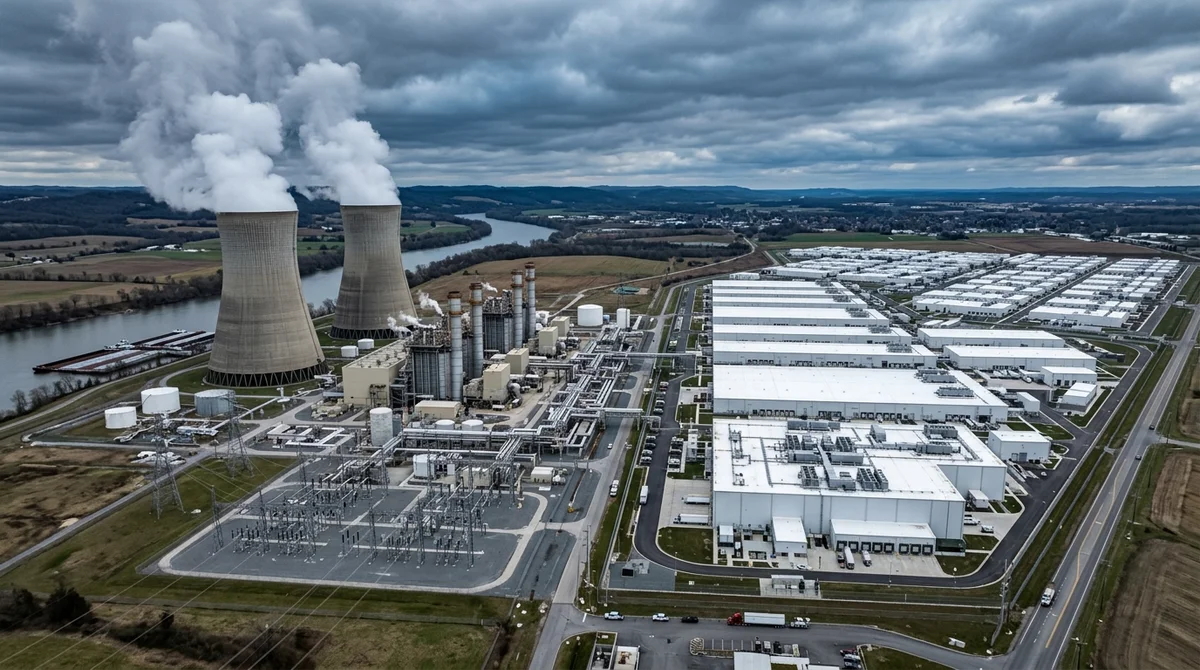
Three of the world's largest technology companies — Meta, Microsoft, and Google — are placing major bets on natural gas. This is not about buying green certificates or offsets: the companies are building their own gas power plants right next to new AI data centers. The scale is impressive, and the question "what could go wrong?" is sounding increasingly urgent.
The generative AI boom has created an almost vertical surge in electricity demand. Training and operating large language models consumes tens of times more electricity than standard server racks. According to Goldman Sachs estimates, by 2030, total electricity consumption by data centers in the USA could increase by 160% relative to 2023 levels. Power grids cannot handle this: in a number of American states, new technology connections to the grid are waiting three to five years. Hence the logic: take energy generation into their own hands.
Meta, Microsoft, and Google have announced or are already building gas facilities with capacity ranging from several hundred megawatts to the gigawatt range. Natural gas looks like an obvious choice: it is reliable, relatively cheap, and a station can be launched in two to three years — incomparably faster than a nuclear reactor or a major wind farm. Solar and wind installations have a fundamental flaw when applied to AI infrastructure: they work not when needed, but when the sun shines or the wind blows.
AI data centers require constant 24/7 loads, and battery storage capacity at the required scale simply does not exist. Nuclear energy is attractive — all three companies are investing in small modular reactors — but the first commercial projects will not come online before the end of the 2030s. Gas fills the gap here and now.
Gas power plants are assets with a 30-year lifespan. A decision made today locks in dependence on fossil fuels for at least the 2050s. The risks fall into three categories.
Regulatory: climate policy is tightening, carbon taxes in the EU are already in effect, and similar mechanisms are being discussed in the USA. If in ten years CO₂ emissions start costing $100–200 per ton, the economics of gas stations will change radically — companies will be left with expensive "stranded assets."
Reputational: all three companies have made ambitious climate commitments — Microsoft set a goal to become carbon negative by 2030, Google declared 100% renewable energy operations back in 2017. Building gas generation directly contradicts these statements, and ESG investors and climate organizations have already noticed.
Price: the natural gas market is volatile by nature — the 2021–2022 crisis showed that prices can rise five to six times over several months amid geopolitical upheavals.
There is a deep paradox: companies selling AI as a tool for solving global problems are themselves becoming some of the largest corporate CO₂ emitters. The stakes in the AI race are so high that no one is prepared to stop. Gas stations are turning into a "temporary solution" that by scale of investment increasingly resembles a permanent one. When the hour of reckoning comes — through carbon taxes, regulatory fines, or shareholder lawsuits — it will prove to be quite costly.
Want to stop reading about AI and start using it?
AI News is a curated feed of AI/tech news. Hamidun Academy teaches you to use AI systematically in your work.