“Made by humans” labeling: a new idea to protect creators from AI
“This looks like AI” is a phrase artists, photographers, and writers are hearing more and more often. A The Verge journalist proposes a solution: label not…
AI-processed from The Verge; edited by Hamidun News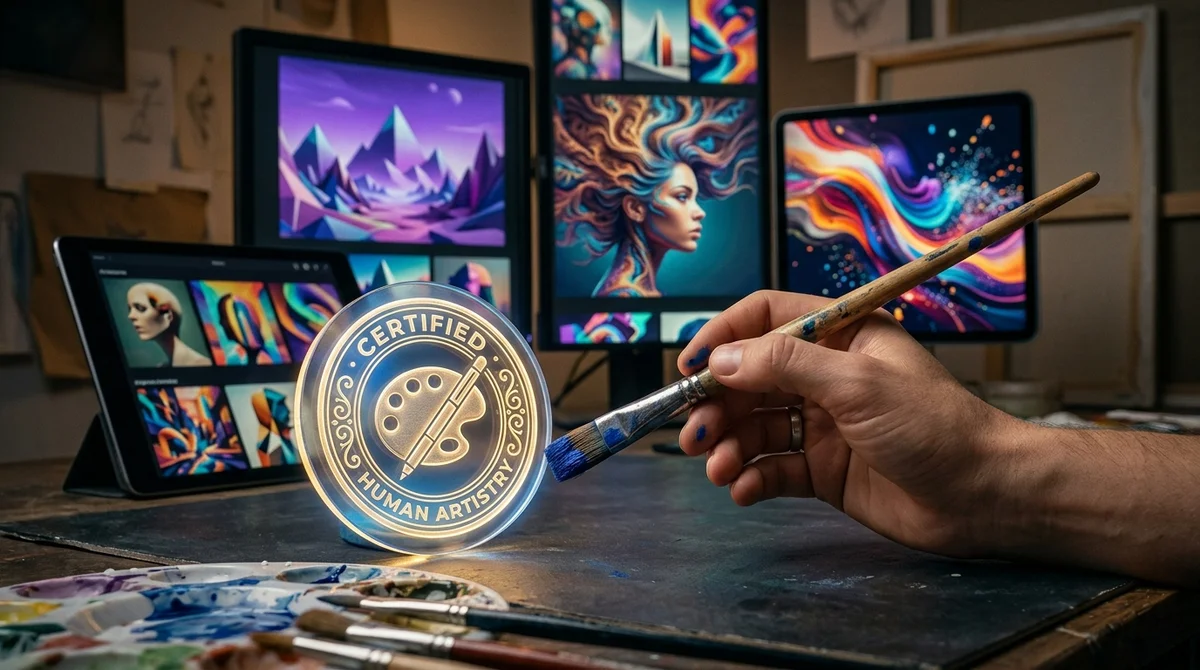
While platforms are in no hurry to mark even obviously generated content, authors face the opposite problem — their own work is mistaken for neural network output. This is no longer a private matter, but a systemic crisis of trust in any digital creativity. A journalist and amateur illustrator describes a situation familiar to many: you publish a photograph or drawing, and in the comments — "looks like AI."
Generative models have learned to imitate human style so convincingly that the audience has switched its default mode to suspicion. And this is rational: major platforms — Instagram, YouTube and others — still have not implemented reliable mandatory AI-content marking, despite the existing C2PA standard. The proposal discussed by the author of the material: instead of waiting for algorithms to honestly mark their own, create a universal sign for human creativity — something like a Fair Trade logo that consumers instantly recognize on the packaging.
The logic is simple: machines have no motivation to reveal their origin, but living authors do. Which means they should be the first to take the initiative. The idea is not new, but now it is acquiring practical dimension.
Several initiatives are already working on similar standards — from watermarks to cryptographically signed metadata that confirms human authorship. The problem is that none of these tools has yet achieved mass recognition and is not embedded in major platforms by default. Economic context is important: the generative AI market is growing, stock agencies, editorial offices and advertising budgets are flowing to cheap synthetic content.
Illustrators, photographers, copywriters are losing orders — not because their work is worse, but because it has become indistinguishable in the eyes of the buyer. If the "made by human" sign gets the same cultural weight as an organic certificate or craft production badge, it could change consumer behavior. Part of the audience is ready to pay a premium for authenticity — the question is whether infrastructure worthy of trust will appear.
For now, it does not exist, and each author is forced to prove their authorship manually — publishing drafts, process time-lapses, source files. This is tedious, but for now it is the only working way.
Want to stop reading about AI and start using it?
AI News is a curated feed of AI/tech news. Hamidun Academy teaches you to use AI systematically in your work.