Google launched "Notebooks" in Gemini — a personal knowledge base inside the chatbot
Google added "Notebooks" to Gemini — a feature similar to ChatGPT Projects. It is now possible to gather files, past chats, and custom instructions in one…
AI-processed from The Verge; edited by Hamidun News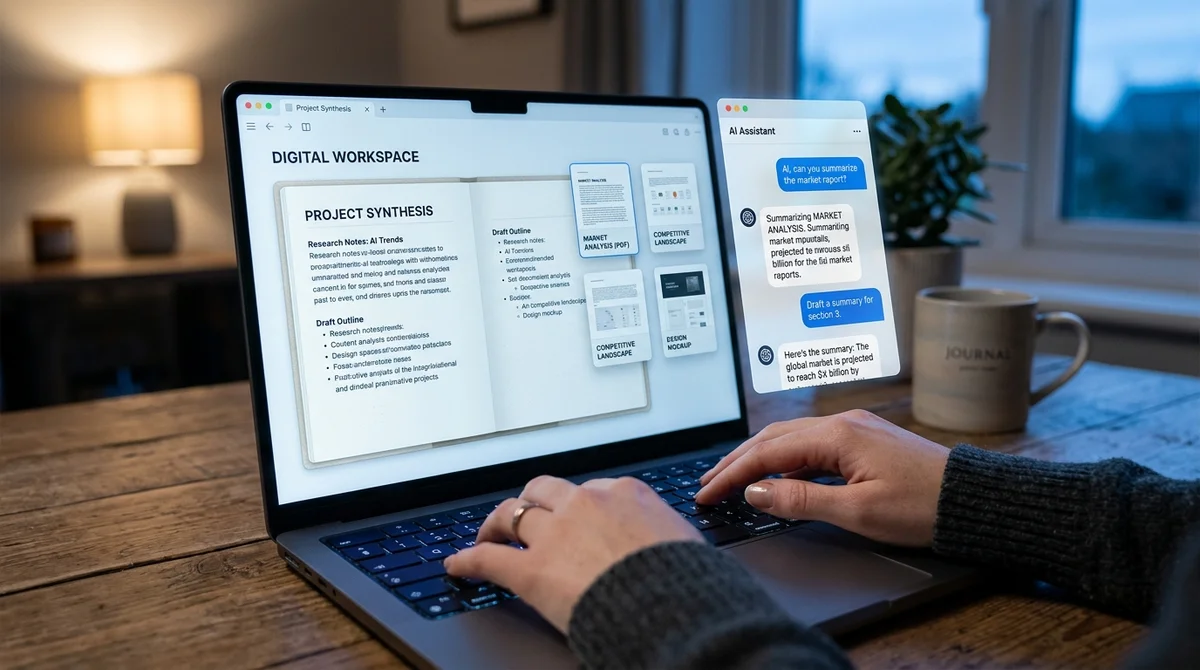
Google announced the launch of the "Notebooks" feature in Gemini — a tool that allows you to organize work with the chatbot by topics and projects. This is a direct response to ChatGPT Projects, which OpenAI launched back in 2024. The concept is simple: in each notebook, you can store files, past conversations with Gemini, and custom instructions — everything that relates to a specific topic or task.
When you open a notebook and start a dialogue, Gemini automatically uses the accumulated context. There's no need to explain to the model each time what project this is, who you are, and what the task is. Google positions notebooks as "personal knowledge bases" that work not only in Gemini itself, but also synchronize with other company products.
The exact list of integrations has not yet been disclosed, but given the ecosystem — Gmail, Drive, Docs, Calendar — the potential for integration is enormous. The company hints that this is just the beginning: "starting in Gemini". A comparison with ChatGPT Projects is natural.
OpenAI launched Projects in December 2024, and users quickly appreciated the ability to keep different projects in different "folders" — with separate history, instructions, and files. Google is following the same path, but with an important emphasis: synchronization across the entire Google ecosystem, not just within a single chatbot. Gemini already has NotebookLM — a separate tool for working with documents: you upload a PDF, audio, web pages, and ask questions about that material.
The new "Notebooks" partially overlap with this concept, but work at the level of the entire chatbot. Based on the announcement, Google sees this as a unified system: "Think of notebooks as personal knowledge bases shared across Google products". This is an important shift in how AI chatbots work.
Initially, all of them were stateless: every conversation started from scratch. Then "memory" appeared — first as a separate feature, then as a foundation. Now comes the next step: not just to remember, but to organize by semantic blocks — projects, topics, tasks.
For professional use, this is fundamentally important. If you're managing multiple parallel projects — work, personal affairs, learning — you don't need to mix contexts or explain everything from scratch. Each notebook lives its own life with a separate set of files and behavioral rules.
The main question is how deep the integration with Google products will be. If notebooks really start pulling data from Gmail, Drive, and Calendar, Gemini will become something significantly more than just a chatbot with memory. This would be an AI assistant that understands your context at the level of your entire digital life.
The feature began appearing for users this week.
Want to stop reading about AI and start using it?
AI News is a curated feed of AI/tech news. Hamidun Academy teaches you to use AI systematically in your work.