Canva updated its AI assistant: it now creates editable designs from text prompts
Canva updated its AI assistant: it can now call the platform's tools and assemble editable designs on its own from text prompts. Users only need to describe…
AI-processed from TechCrunch; edited by Hamidun News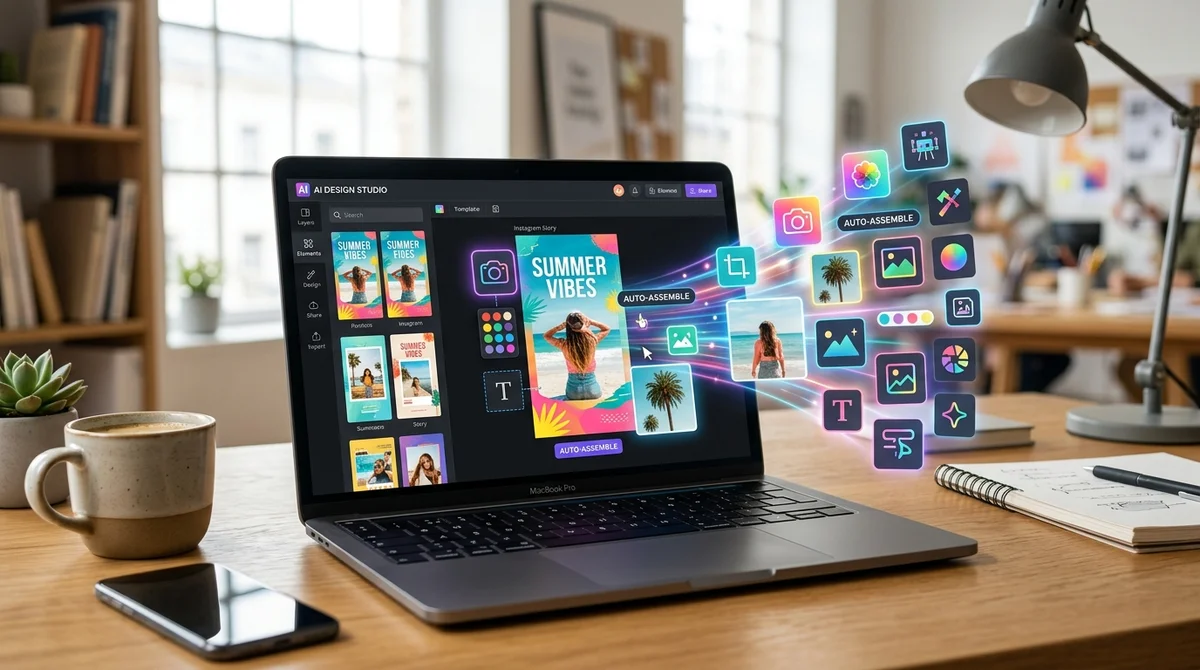
Canva has updated its AI assistant: it now knows how to call various platform tools and independently create editable designs from text commands. This is a shift from a chatbot offering advice to a real agent that takes action—acquiring the necessary tools and assembling results without manual steps from the user. Previously, Canva's AI assistant primarily answered questions, provided tips, and helped users navigate the platform's features.
The new version changes the operating principle: users describe what they need—for example, "create an Instagram post with a title about a summer sale in blue tones"—and the assistant itself calls the appropriate tools, selects a template, inserts text, and generates a finished design. The result remains fully editable: each element can be modified manually, just like in a regular project. This is a fundamentally different interaction model.
Most generative design tools—including Adobe Firefly and Figma AI—either create static images that can't be edited component-by-component, or offer separate automated actions, but don't combine them into an end-to-end pipeline. Canva is betting on an agentic architecture: the AI receives a task, plans steps, and executes them through the platform's tools. Canva is one of the world's largest design services with over 170 million users.
The platform has long invested in AI: Magic Design (template auto-generation), Magic Write (text), Magic Eraser (object removal), and other Magic series tools came first. The new assistant with tool-calling support is the next level of this strategy. If previously each Magic tool had to be launched manually, now the assistant combines them automatically in response to a single request.
Technically, the update relies on the concept of function calling or tool use—the same principle that language models use in large AI company ecosystems to connect external APIs. Applied to a design platform, this means the AI receives a set of available actions—create an element, select a font, apply a color scheme, add an image—and independently decides which one to call and in what order. For ordinary users—marketers, small businesses, freelancers—this lowers the barrier to entry even further.
Now you don't need to know how Canva works internally: it's enough to describe the desired result. For experienced designers, the update is a tool for drafts and quick prototypes: the AI generates the first version, the human does the final polish. This is part of a broader trend: large platforms—from Google Workspace to Notion and Microsoft 365—are turning their AI assistants into agents capable of executing multi-step tasks, not just answering questions.
In the design space, the race is just beginning, and Canva's update is a bid for the top position in the segment of mass AI design.
Want to stop reading about AI and start using it?
AI News is a curated feed of AI/tech news. Hamidun Academy teaches you to use AI systematically in your work.