Schematik — "Cursor for Hardware": Anthropic Considers Investment in Hardware Startup
Schematik is a tool that does for electrical engineers what Cursor did for programmers: it enables designing physical devices through AI dialogue without…
AI-processed from Wired; edited by Hamidun News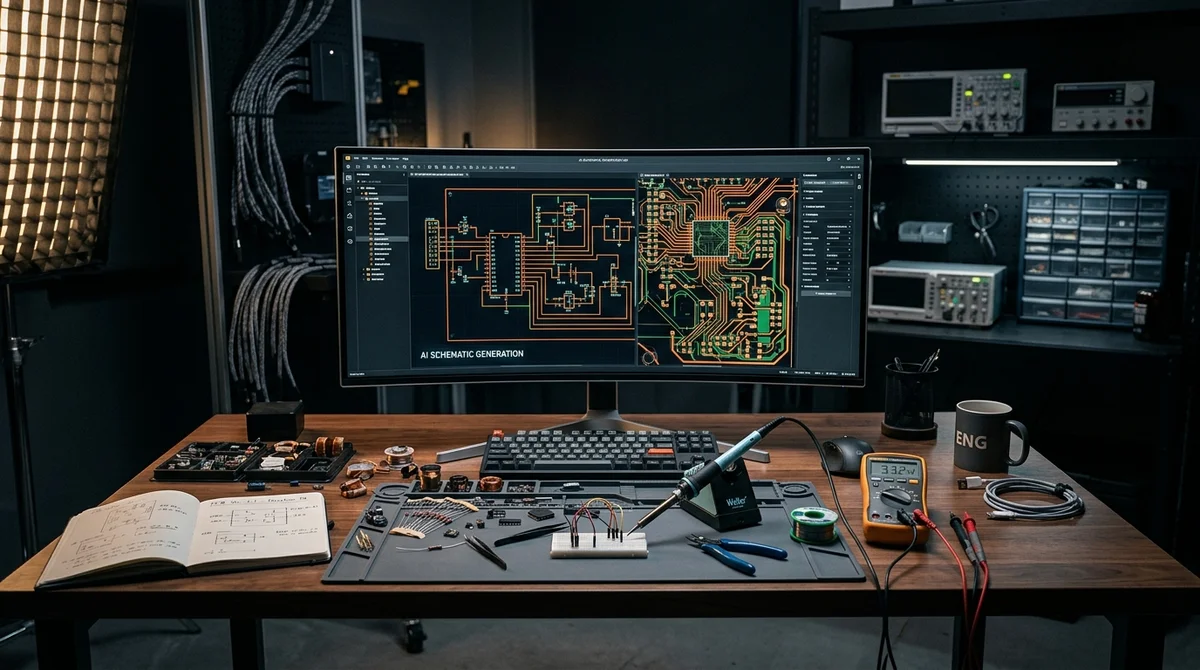
While programmers are getting used to the fact that AI writes code for them, the Schematik startup is going further: its tool allows designing physical devices in "vibe-coding" mode — describing the desired result in natural language instead of dealing with circuit design manually. According to Wired, Anthropic is interested in the possibility of investing in the company, which would be one of the first major bets on AI tools for hardware development. The analogy with Cursor is not accidental.
Cursor has become the main symbol of AI-assisted software development: the developer describes the task, the editor offers a solution, the code changes in real time. Schematik transfers the same model to the field of electronics — circuit board design, firmware writing, schematic creation. Everything that previously required an engineering education and specialized tools like KiCad or Altium should now, according to its creators, become accessible through dialogue with a neural network.
In fact, this means that a person without specialized knowledge will be able to describe the device they need and get a ready-made project. The concept of "vibe-coding" — a term introduced by researcher Andrey Karpathy in early 2025 — describes a process in which a person does not write code line by line, but sets an intention: "make an LED blink every second" or "add a temperature sensor with UART output". AI generates a technical solution, and the developer evaluates and adjusts it.
For software, this has already become the norm. For hardware — a fundamentally new step: the stakes are higher here, and the price of error is physical. Hardware development is traditionally considered a much more complex and risky field than software writing.
An error in code is a bug that can be fixed with an update. An error in a circuit or firmware is potentially a burnt-out controller, a smoking inductor, or a device requiring complete physical rework. This is precisely why the question of how much Schematik will "not blow up" the device — the Wired authors themselves mentioned this — is quite serious.
The reliability of a hardware AI assistant is critical: generating working circuits is harder than generating working Python scripts. Anthropic's interest in investing in the startup fits into the broader strategy of the company. Anthropic actively promotes Claude in tools for developers: IDE integrations, the MCP protocol for AI interaction with external systems, agent scenarios for complex workflows.
Support for Schematik would mean Claude's presence in the hardware developer ecosystem — a niche that no major AI player has yet occupied. OpenAI is betting on programming and content, Google — on enterprise solutions. The world of hardware development remains open.
The market for AI tools for electronics engineers is just beginning. Today, startups are trying to automate individual parts of the process: firmware generation in C/C++, component selection from catalogs, automatic circuit checking for errors. Schematik, judging by its positioning, aims for a more ambitious goal — to make the complete device design cycle accessible without deep specialization.
If it works, the potential audience is huge: makers, hardware startups, DIY enthusiasts, researchers, students of technical universities. The emergence of Schematik and Anthropic's interest is a signal that the boundary between software and hardware continues to blur. AI consistently masters increasingly physical layers of the technology stack: from code to circuits, from circuits to devices.
How quickly this transformation reaches mass production is an open question, but the direction is clear.
Want to stop reading about AI and start using it?
AI News is a curated feed of AI/tech news. Hamidun Academy teaches you to use AI systematically in your work.