OpenAI released GPT-5.4 mini and nano — compact models for agentic tasks and coding
OpenAI released GPT-5.4 mini and nano — compact versions of its flagship model for agentic systems, coding, and high-throughput APIs. GPT-5.4 nano is the…
AI-processed from OpenAI Blog; edited by Hamidun News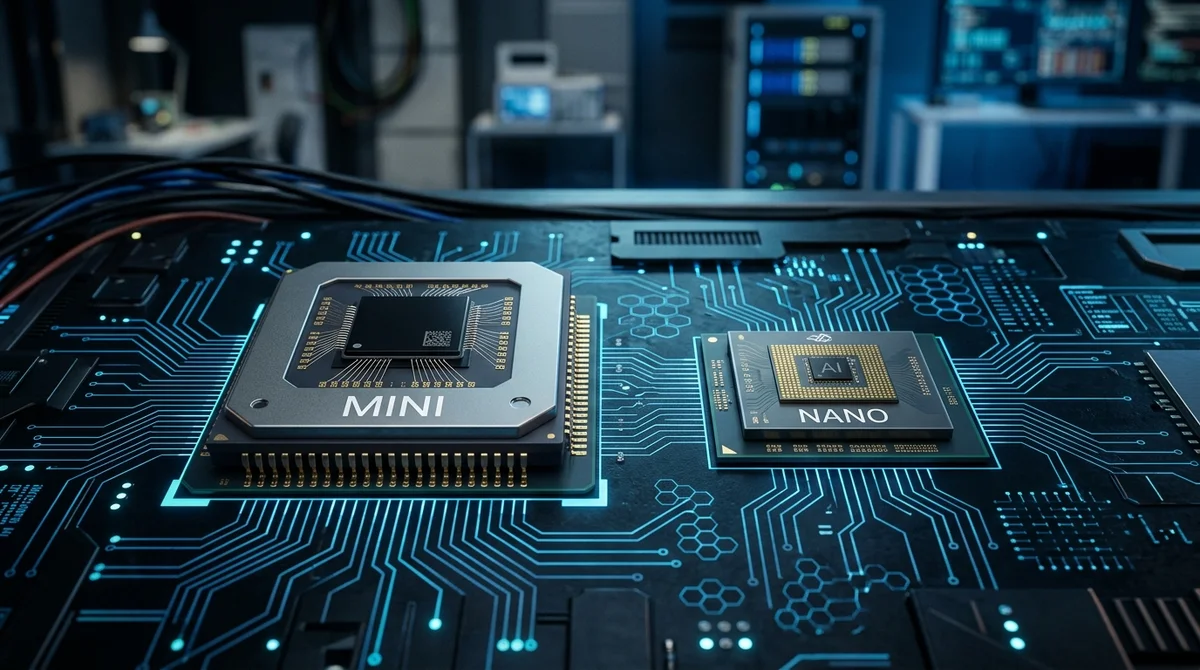
OpenAI has introduced GPT-5.4 mini and GPT-5.4 nano — two lightweight versions of the flagship GPT-5.
4 model, designed for high-performance tasks, agentic scenarios, and situations where response speed is more critical than maximum accuracy. The GPT-5.4 family has expanded with two compact variants, each occupying its own niche.
GPT-5.4 mini — the more capable of the two — retains the broad capabilities of the original, but runs faster and requires fewer computational resources. GPT-5.
4 nano — the lightest model in the lineup — is oriented toward scenarios with maximum high traffic, where every millisecond and every spent token matters. According to OpenAI's announcement, both models are optimized for coding, tool calling, and multimodal reasoning. They are not intended to replace the flagship, but rather complement it, occupying the niche of fast and cost-effective working tools in multi-layered AI systems.
The most obvious application area for mini and nano is agentic pipeline systems. In such an architecture, one user request spawns dozens, and sometimes hundreds of internal calls to the language model: the agent plans steps, calls external tools, verifies intermediate results, handles errors, and adjusts the plan on the fly. If each of these calls is directed to the flagship model, the total costs and latencies become unacceptable in production conditions with real loads.
Compact models solve this problem fundamentally: they are smart enough for routine pipeline operations, but work an order of magnitude faster and cheaper. OpenAI is clearly targeting developers building complex multi-agent systems who need a reliable and fast tool for background tasks. Multimodal support — another important characteristic specifically highlighted in the announcement.
Both models can work not only with text, but also with images, which distinguishes them from specialized text-only solutions. This opens up possibilities for application in systems of automated document analysis, computer vision, and interfaces combining textual and visual content. For agentic systems, multimodality is especially valuable: an agent capable of interpreting a screenshot, technical diagram, or PDF solves a significantly broader range of tasks compared to a purely textual counterpart.
The release of mini and nano fits into a sustained and clearly visible trend across the entire AI industry. Leading laboratories, in parallel with their flagships, are actively developing compact models: Anthropic — the Claude Haiku lineup, Google — Gemini Flash and Gemini Nano, Meta — lightweight variants of Llama of various sizes. Behind all these solutions lies the same logic: reduce cost and latency so much that developers can afford AI in real workloads, until recently economically unattainable.
Small models are not a compromise in quality, but a deliberate tool for expanding accessibility and increasing the number of products built on top of AI platforms. For teams working in the OpenAI ecosystem, the appearance of mini and nano opens a concrete opportunity: to choose a model for the task without rewriting integration code. Flagship GPT-5.
4 — for making complex decisions and generating the final answer to the user. GPT-5.4 mini — for intermediate steps requiring sound judgment.
GPT-5.4 nano — for high-frequency background operations, where speed is the determining factor. This multi-layered approach to model selection is quickly becoming the standard for mature AI products.
GPT-5.4 mini and nano are not stripped-down versions of the flagship, but specialized tools with clear positioning. OpenAI is betting that developers will build multi-model systems, where each architectural layer uses the most appropriate model: flagship for strategic decisions, mini for tactical ones, nano for operational ones.
Agentic systems are becoming the new norm of industrial development, and the release of compact GPT-5.4 confirms: the industry is seriously restructuring under this paradigm.
Want to stop reading about AI and start using it?
AI News is a curated feed of AI/tech news. Hamidun Academy teaches you to use AI systematically in your work.