Mind Robotics Raises $500M for Industrial AI Robots
Mind Robotics, a startup spun out of automaker Rivian, has raised $500 million to develop industrial AI robots. The company was founded by RJ Scaringe, the crea
AI-processed from TechCrunch; edited by Hamidun News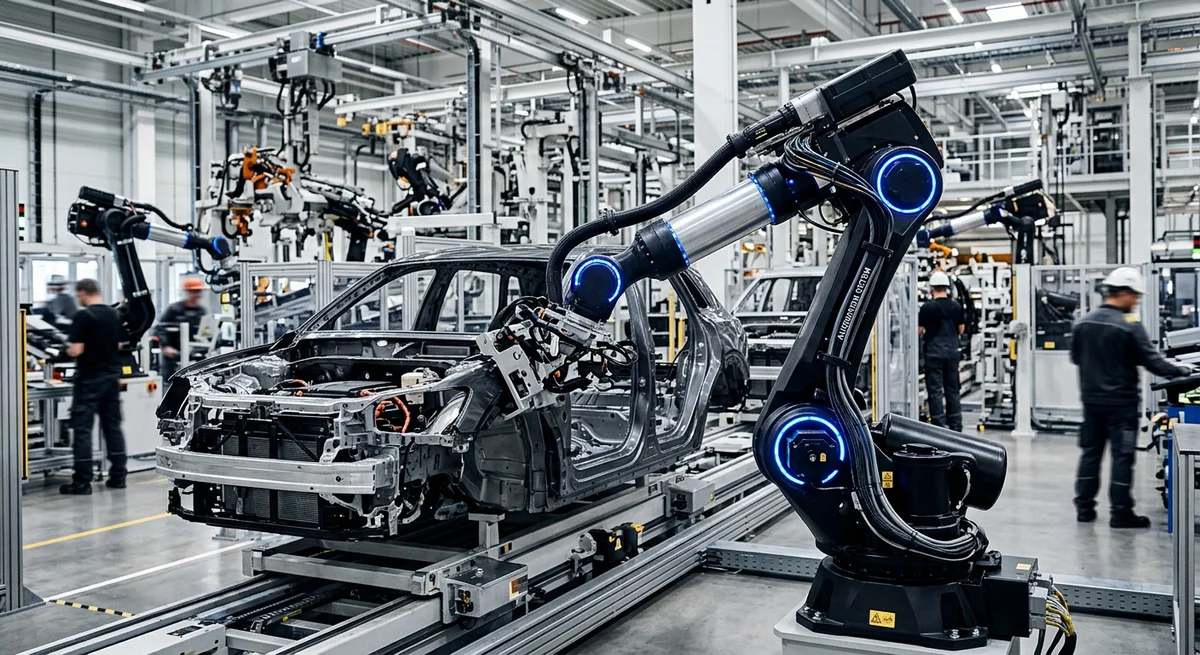
Industrial robotics is experiencing a genuine investment boom, and another striking confirmation of this came with the loud announcement by the startup Mind Robotics, which managed to raise half a billion dollars at the earliest stage of its existence. The sum, by any measure substantial, eloquently testifies to the fact that investors are seriously betting on a future in which factory floors will be populated not by people, but by intelligent machines.
Behind Mind Robotics stands a name well known to anyone following the electric vehicle industry. RJ Scaringe, founder and head of Rivian, a company that challenged Tesla and traditional auto giants in the electric truck and SUV market, decided to open a fundamentally new direction. His new startup is formally a spinoff of Rivian, which from the start endows it with a unique strategic advantage: access to real production data from an operating automobile factory. Few companies in the robotics sector can boast of such a starting capital in the form of information.
The essence of Mind Robotics' business model lies in the symbiosis of two directions. On the one hand, the company's robots will be trained directly on data generated by Rivian's production lines — this avoids the chronic problem of the robotics industry that specialists call a deficit of training data. Real production supplies an endless stream of situations the robot will face: non-standard parts, changes in the assembly process, unforeseen failures. On the other hand, ready-to-work machines are planned to be deployed directly on Rivian's factories, which creates both a built-in sales market and a live testing ground simultaneously. This is a closed loop in which each stage strengthens the next.
The raised $500 million is not just a large sum, it is a signal for the entire industry. Such a volume of financing at an early stage means that venture capitalists and strategic investors are ready to make large-scale bets on industrial automation using artificial intelligence. A few years ago, such money was delivered mainly to software developers or creators of consumer applications. Today, the physical world — factories, warehouses, logistics hubs — is becoming a new battleground for technological leadership. Mind Robotics finds itself at the epicenter of this transformation with a rare advantage: it has money, data, and a ready testing ground.
The consequences of this step extend far beyond a single startup. If Mind Robotics manages to realize its declared potential, it could change the very logic of implementing industrial automation. Traditionally, companies wishing to roboticize production faced a long and expensive integration process: each specific factory required individual configuration, and payback stretched over years. The Mind Robotics approach suggests that a robot trained in real production conditions is capable of adapting much faster. This potentially lowers the entry barrier for mid-sized manufacturers who previously could not afford full automation.
At the same time, the success of the enterprise is far from predetermined. Industrial robotics is a graveyard of ambitious projects that failed to bridge the gap between laboratory demonstrations and real production. Rivian itself went through a painful scaling experience and knows well what the price of an error on the assembly line is. That is why the connection between the two companies is both a strength and a test of durability. Any serious failure in the operation of the robots risks damaging the reputation of both the startup and its parent structure.
In a broader perspective, the Mind Robotics story fits into a global trend in which large industrial players stop being mere consumers of robotized solutions and begin to produce them themselves. The automotive industry, historically the most automated sector of the economy, is turning into an incubator of next-generation technologies. Half a billion dollars is a weighty argument in favor of the fact that this transition has already begun.
Want to stop reading about AI and start using it?
AI News is a curated feed of AI/tech news. Hamidun Academy teaches you to use AI systematically in your work.