Russian company builds AI factory with Nvidia chips banned for China
One of the pioneers of Russia’s speech recognition market — “Speech Technology Center” — plans to invest 210 million rubles in the purchase of five high-perform
AI-processed from CNews AI; edited by Hamidun News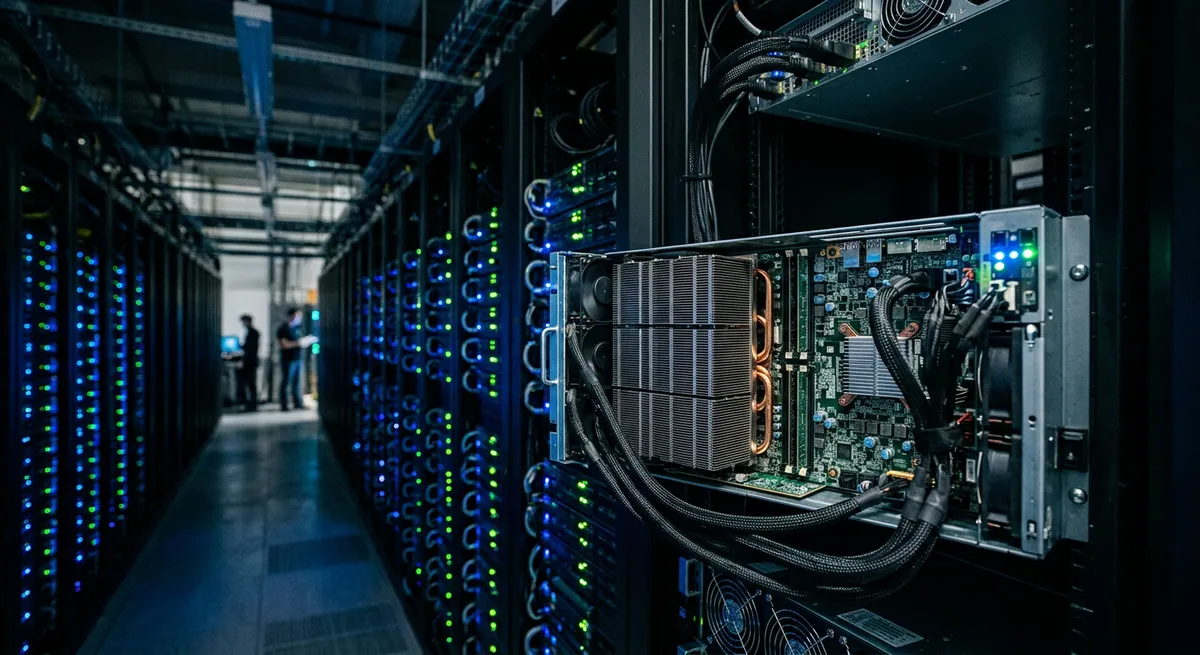
Russian Speech Technology Company Builds AI Factory on Nvidia Chips Banned for China
"Center for Speech Technologies," one of the oldest and most authoritative players in the Russian speech recognition market, has announced its intention to invest 210 million rubles in the acquisition of five high-performance server platforms based on Nvidia HGX H200. This step, according to expert community assessments, marks a qualitative transition by the company from a specialized developer of speech solutions to a full-fledged participant in the race for generative artificial intelligence — and does so on equipment whose export to China is officially banned by American legislation.
To understand the scale of what is happening, one must turn to context. Nvidia HGX H200 is not merely another update to the line of graphics accelerators. It is the pinnacle of modern computing architecture for machine learning tasks, a platform capable of processing enormous volumes of data with performance unattainable by previous generations of equipment. This is precisely why the U.S. Department of Commerce introduced export restrictions on H200 shipments to China — Washington openly views access to such chips as a strategic advantage in technological confrontation. Against this backdrop, the appearance of five server clusters based on H200 in Russian corporate infrastructure acquires a distinct geopolitical dimension.
The "Center for Speech Technologies" itself is a company with deep roots. Founded back in the Soviet era on the basis of academic research, it has for decades engaged in voice processing and speech analytics technologies, supplying banks, telecommunications companies, and security agencies with its solutions. This background is fundamentally important: the company not only has money for hardware purchases, but also possesses engineering culture, accumulated data, and an understanding of how to build productive language processing systems. The transition to training large language models for it is not an adventure, but a logical evolution.
Five servers on the HGX H200 platform represent precisely the threshold at which experts begin to speak of an AI factory, rather than simply a computing cluster. Each such platform combines several H200 accelerators with a high-speed NVLink bus, ensuring dense interconnection between nodes and allowing model training to be distributed across machines with minimal performance loss. In total, such infrastructure is capable of competing with serious research centers in terms of computing power available for training frontier models. This is no longer a tool for one company's tasks — this is a potential center of competence for a wide range of customers.
The consequences of this step extend far beyond one company's corporate strategy. First, the very fact of successful acquisition of equipment banned for export to China will raise painful questions for Western regulators: through what channels and jurisdictions did this equipment pass, and how effective are the existing export control mechanisms. Second, the Russian market gains a precedent for forming an independent computing infrastructure of a level sufficient for developing competitive language models — at a time when most analysts predicted inevitable technological lag for the country in the face of sanctions pressure.
Third, if the "Center for Speech Technologies" opens access to its capacities to external users under a cloud computing model, this will significantly change the balance of power in the Russian AI infrastructure market.
Separate attention deserves the question of what models are planned to be trained on this equipment. The company's specialization in speech technologies suggests the development of multimodal systems capable of working with audio and text simultaneously — a direction in which global competition is rapidly intensifying. However, the power of the infrastructure being acquired is clearly excessive for narrowly specialized speech tasks, which indirectly confirms ambitions of broader scope.
The story of the "Center for Speech Technologies" AI factory is not simply a corporate announcement. It is a symptom of a deeper process: an attempt to build a sovereign computing stack in conditions where international supply chains have become instruments of geopolitical pressure. Whether this attempt succeeds in full will be shown not by the sum of investments, but by the quality of the models that will be created on this hardware.
Want to stop reading about AI and start using it?
AI News is a curated feed of AI/tech news. Hamidun Academy teaches you to use AI systematically in your work.