Professors Push for Thinking Without AI
Generative AI is reshaping education faster than universities can adapt. Against this backdrop, humanities instructors are increasingly talking not only…
AI-processed from Guardian; edited by Hamidun News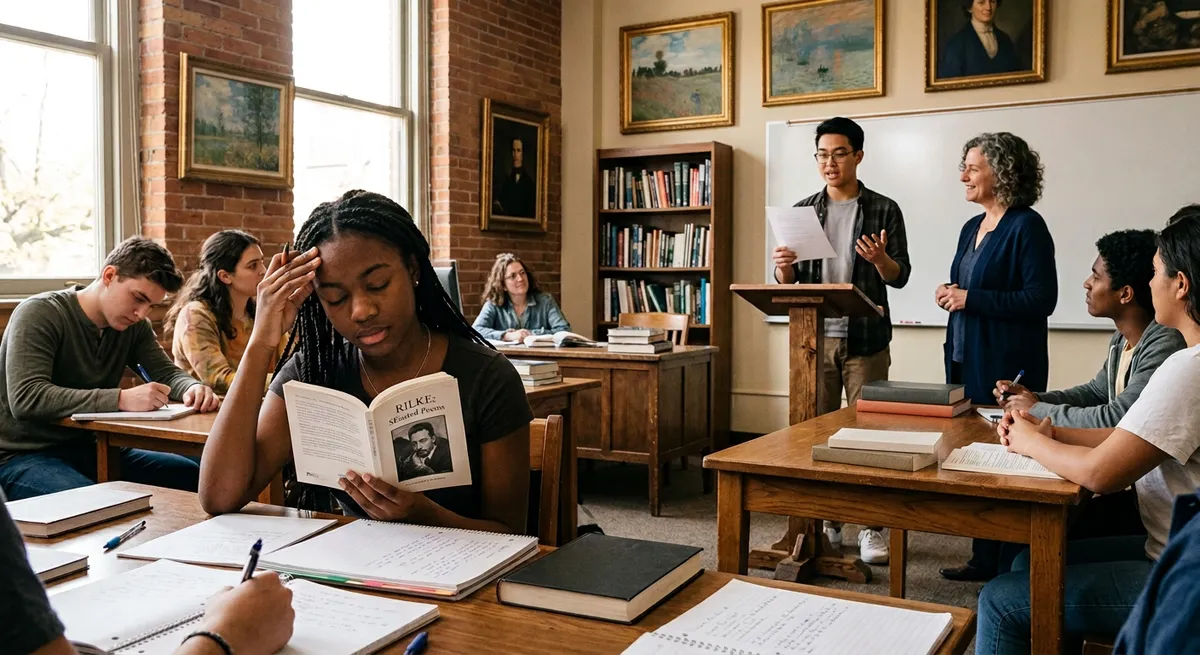
Teachers Fight for Thinking Without AI
Generative artificial intelligence has burst into universities not as another digital tool, but as a force transforming the very logic of the educational process. If previously we debated where the boundary lay between using a calculator and solving a problem independently, the question now stands sharper: what remains of education if a machine can write an essay in seconds, select arguments, summarize a book, and even imitate a student's "personal style"? This is why more and more educators, especially in the humanities, now speak not only of plagiarism.
They are troubled by a more fundamental problem: the risk of losing the habit of slow thinking, of the internal work of memory, of interpretation as personal effort rather than a service on request.
Against this backdrop, the experience of Stanford University professor Lee Pao is telling. She is trying to bring students back to an offline learning space. She proposes memorizing poetry, giving public readings, viewing artworks not through a screen but in person.
At first glance, such practices might seem archaic, almost deliberately outdated. But in reality, they contain an important pedagogical response to the age of AI. Pao proceeds from the assumption that protecting assignments from neural networks is almost futile: "AI-proof" formats do not exist.
This means the main task is not total control, but showing students the value of an experience that cannot be fully delegated to a machine because it is connected to physical presence, attention, emotion, memory, and personal interpretation.
This shift is particularly important for humanities disciplines, where the outcome of learning cannot be reduced to a set of correct answers. Literature, philosophy, art history, and cultural studies require not merely the reproduction of information, but the internal processing of text or image. Memorizing and reciting a poem is not a decorative practice from the past, but a way to literally "embed" language into one's own memory and rhythm of thought.
Public reading is not only a check of preparation, but a meeting with an audience in which words acquire intonation, pause, and vulnerability. When a student views a painting in a museum rather than in a digital reproduction, they encounter scale, texture, space, and the time of their own perception. All of this is difficult to accelerate, automate, or outsource to an algorithm.
And this is precisely why such practices today become not a conservative whim, but a form of intellectual resistance.
The problem, however, is broader than the university classroom. If students become accustomed to turning to AI not as an auxiliary tool, but as a constant substitute for intellectual effort, it changes the very culture of knowledge. There arises a temptation to perceive understanding as instantly generated text rather than as a process of doubt, error, rereading, and slow clarification of thought.
In the short term, this increases productivity: work is completed faster, formulations become smoother, arguments more orderly. But in the long term, there is a danger of intellectual atrophy. A person who increasingly rarely trains memory, attention, and the ability to independently connect ideas, loses not only academic skills but also civic competence—the ability to read critically, distinguish nuances, and resist ready-made forms of persuasion.
Thus the current reaction of educators is not nostalgia for a pre-digital era, but an attempt to redefine what exactly the university should protect. It is clear that a complete ban on AI is hardly realistic: technologies are already embedded in everyday life, and students will use them regardless of formal restrictions. But precisely because of this, the struggle shifts from the level of prohibition to the level of pedagogical design.
A good course must now not only convey content, but also create such forms of experience in which independent thinking is felt as a value, not as a waste of time. This means more oral discussions, more assignments related to observation and presence, more work where the process matters, not just the final text.
In this sense, Lee Pao's words sound symptomatic of an entire epoch. Behind the frustration with ChatGPT stands not simply a teacher's fatigue with technological fashion, but a fear of a society that is gradually forgetting how to think without an intermediary. Universities today find themselves at the forefront of this change precisely because it is there most evident how easily an intellectual journey can be replaced by its plausible imitation.
The answer offered by many humanists is not flight from technology, but a return to those forms of education where thought passes through voice, body, memory, and personal risk. It is quite possible that the future of education will be determined not by how sophisticatedly it integrates AI, but by whether it manages to preserve a space where humans still learn to think for themselves.
Want to stop reading about AI and start using it?
AI News is a curated feed of AI/tech news. Hamidun Academy teaches you to use AI systematically in your work.