Italian startup raises $4.2M for autonomous vessels
Italian startup Mirai Robotics, based in Apulia, has completed a $4.2 million pre-seed funding round. The company was founded by the creator of aircraft maker B
AI-processed from TNW; edited by Hamidun News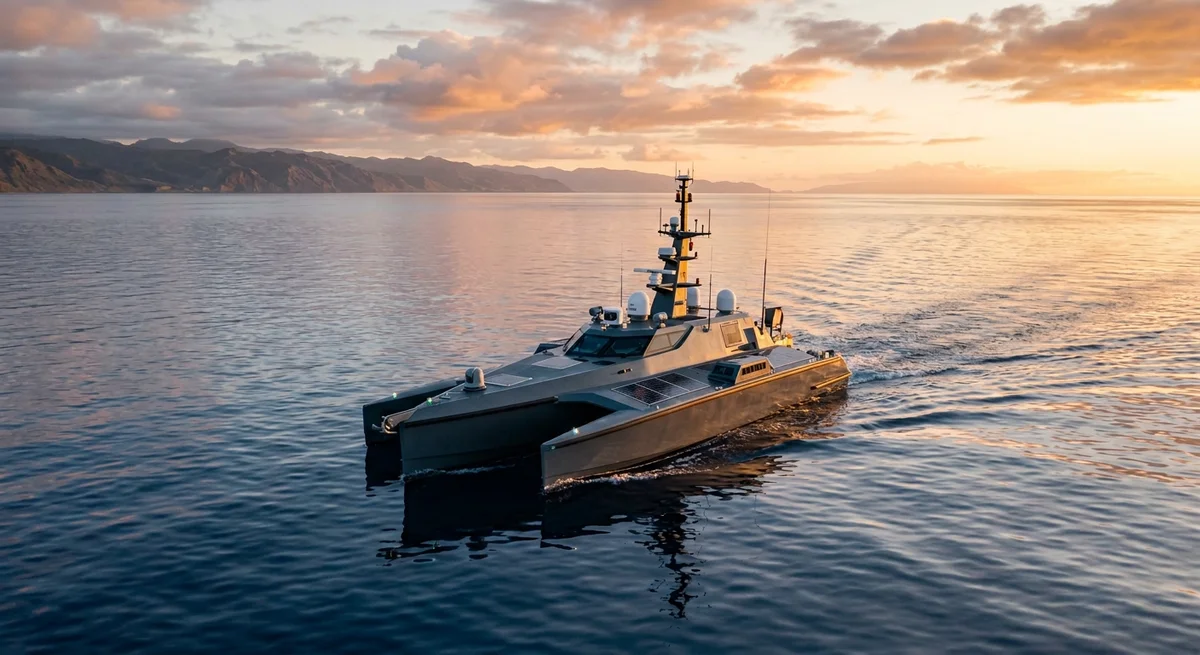
Italian startup Mirai Robotics, located in the southern region of Apulia, has raised $4.2 million in a pre-seed funding round, announcing its intention to create a fundamentally new class of autonomous vessels controlled by artificial intelligence. Behind the project stands the founder of the renowned aircraft manufacturer Blackshape, and this fact alone lends particular weight to the ambitious endeavor: a man who has already proven his ability to build next-generation aircraft is now turning his gaze to the ocean—an environment that, in his view, remains the last major physical space on the planet still not truly governed by software.
To appreciate the scope of this idea, one need only recall how rapidly automation has transformed other sectors of transportation. The automotive industry has lived under the paradigm of driverless vehicles for several years now, aviation is increasingly integrating autonomous control systems, and rail transport in a number of countries operates without drivers. Yet the maritime industry, responsible for transporting more than eighty percent of global goods, remains remarkably conservative.
Vessels continue to be operated by large crews, navigation decisions are made primarily by humans, and the digitalization of fleets is limited to scattered implementation of individual sensors and monitoring systems. Mirai Robotics is betting precisely on this gap between technological potential and the actual state of the industry, offering the concept of a "software-defined vessel"—a ship whose architecture is designed from the outset around software and artificial intelligence, rather than adapted to it after the fact.
Deserving particular attention is the ideological framework within which the startup places its activities. The founders appeal to the concept of the "blue economy"—a model of sustainable use of oceanic resources that has been gaining increasing importance in the international agenda in recent years. The world's oceans are not only transportation arteries, but also sources of food, energy, mineral resources, and climate data.
Autonomous vessels are capable of making their exploitation more efficient and environmentally friendly: unmanned ships can operate on electric propulsion, conduct extended missions to monitor ecosystems, collect oceanographic data on scales inaccessible to piloted fleets, and significantly reduce the carbon footprint of maritime transport. It is at the intersection of environmental responsibility and technological breakthrough that Mirai Robotics builds its strategic niche.
The $4.2 million attracted in the pre-seed round is, without question, a modest sum by the standards of the global maritime technology industry, where the construction of a single container ship costs tens of millions. However, for a startup at such an early stage, it is a significant signal of investor confidence.
The autonomous shipping market, by various estimates of analytical agencies, could reach a value of tens of billions of dollars by the beginning of the next decade. Competition in this segment is intensifying: the Norwegian company Kongsberg has already demonstrated a fully autonomous container ship, Yara Birkeland, Japanese and South Korean shipbuilding giants are pursuing their own developments, and Israeli and American startups are attracting considerable investment. Nevertheless, the Italian project stands out for its approach—rather than modernizing existing vessels, it proposes the creation of a new hardware-software platform from scratch, which theoretically allows avoiding the compromises inevitable when adapting traditional designs.
The consequences of the success of such projects could prove far-reaching. If autonomous vessels indeed become a mass phenomenon, this will affect not only the shipbuilding industry, but also the insurance business, port infrastructure, international maritime law, and the labor market. Hundreds of thousands of sailors around the world will face the need for retraining, and regulatory bodies will face the task of creating legal frameworks for ships with no humans on board. The European context adds another dimension: the European Union is actively promoting a strategy of digital transformation and "green transition," and projects like Mirai Robotics fit perfectly into this agenda, potentially opening up to the startup access to significant grant and investment resources.
The emergence of Mirai Robotics on the map of global maritime technologies is an event that would be a mistake to underestimate. Behind it stands not merely another attempt to automate a familiar process, but a fundamental reconsideration of what a vessel is in the twenty-first century. The ocean indeed remains one of the last frontiers into which software has not yet penetrated truly deeply, and whoever first breaks through this barrier will gain an advantage of colossal scale. Whether a small Italian startup will manage to outpace industry giants remains an open question, but the very posing of the task testifies that the era of the autonomous ocean is approaching faster than many are ready to acknowledge.
Want to stop reading about AI and start using it?
AI News is a curated feed of AI/tech news. Hamidun Academy teaches you to use AI systematically in your work.