Detention and Labor Camp Owners Strike Gold in AI Boom
Infrastructure developers for artificial intelligence have found unexpected partners. Due to relocating giant data center construction to remote regions with ac
AI-processed from TechCrunch; edited by Hamidun News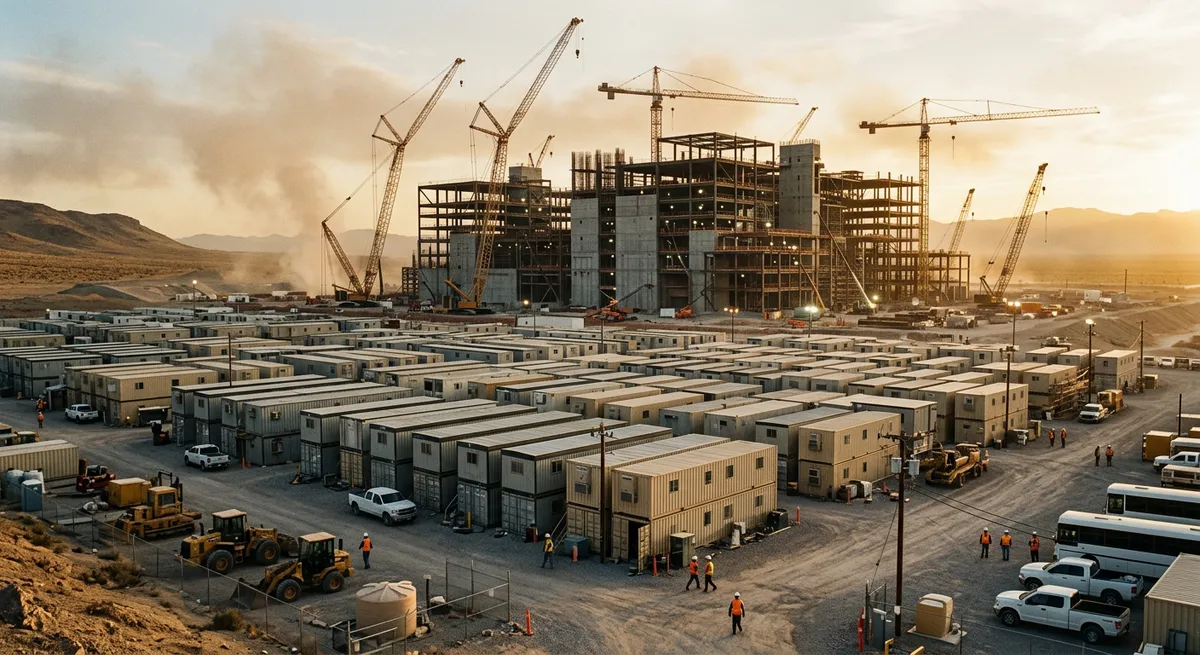
It is widely believed that the artificial intelligence industry exists somewhere in an ethereal cloud woven from complex algorithms, mathematical models, and pure code. However, the physical reality of this revolution looks far more prosaic and harsh. Behind every breakthrough in training large language models stand millions of cubic meters of concrete, thousands of kilometers of copper cable, and colossal volumes of human labor. The infrastructure boom caused by the need to build ever-larger hyperscale data centers has spawned completely unexpected business alliances and brought onto the stage players that are very difficult to associate with high technology.
Developers of artificial intelligence infrastructure increasingly turn to the expertise of companies specializing in creating temporary settlements for workers in extremely remote regions. In particular, operators of facilities historically engaged in managing immigration detention centers for the US Immigration and Customs Enforcement (ICE), as well as constructing so-called "man camps" for oil workers and miners, have discovered in the AI boom a new, incredibly massive goldmine. Their specific experience in rapidly deploying autonomous, closed-type residential complexes for thousands of people proved critically valuable to the advanced technology sector, which desperately needs workers on the periphery.
To understand the reasons for this paradoxical merger of industries, one must look at the rapidly changing geography of modern computing. Traditional data center hubs, such as the Northern Virginia region or the suburbs of Silicon Valley, today face an acute shortage of available power capacity. Local power grids are overloaded, designing and building new substations takes many years, and land costs are prohibitive, making projects unprofitable.
In search of cheap and, more importantly, abundant electrical power, technology corporations have rushed into the American hinterland. They purchase isolated plots in deserts, on abandoned industrial sites, closer to nuclear power plants or major hydroelectric dams. But erecting a technology facility costing tens of billions of dollars in the middle of nowhere requires the continuous presence of a massive army of builders.
When a division of several thousand engineers, welders, electricians, and technicians arrives in a quiet rural county with a population of a couple of thousand, the local civilian infrastructure instantly collapses. All roadside motels are purchased by corporations years in advance, the private housing rental market skyrockets, relentlessly displacing local residents, and modest food networks and narrow transportation arteries simply cannot handle the flow. It is at this point of infrastructure crisis that solutions tested over decades in the harsh realities of shale extraction and industrial booms of past centuries come to the rescue.
Autonomous closed-type work camps become the only logistically and economically justified solution for developers striving to deliver computing plants on schedule at any cost. These complexes consist of endless rows of reinforced modular dormitories, equipped with their own powerful generators, large-scale dining halls, laundries, medical facilities, and rigid perimeter security systems. Companies that have gained expertise from government contracts maintaining illegal migrants possess unique and irreplaceable expertise here. They know perfectly well how to quickly set up a camp with five thousand beds far from civilization, ensure an uninterrupted supply of provisions, manage large-scale waste removal, and maintain strict order in conditions of high density in exclusively male work crews.
This unexpected symbiosis exposes hidden ethical and reputational contradictions within the modern technology industry. Silicon Valley companies, which traditionally invest hundreds of millions of dollars in their impeccable public image, actively promote inclusivity initiatives and take pride in high corporate social responsibility standards, are forced to turn a blind eye to the origins of their major infrastructure contractors. They tacitly rely on corporations whose reputations are firmly and sometimes scandalously tied to the prison system and grueling conditions of oil extraction operations.
Nevertheless, the harsh pragmatism of capitalism and the arms race in the field of AI leave them no choice: no other sector of the economy today is capable of providing reliable infrastructure to support such rapid deployment of technology megaprojects.
The evolution of the situation around autonomous server farm construction makes starkly clear the true face of technology for the next decade. The current stage of generative artificial intelligence development is primarily a large-scale story about heavy industry, brute physical force, logistics, and classical development. The most complex virtual mind of the future is being forged right now by the calloused hands of simple technicians in spartan conditions of remote isolation camps.
And while investors on Wall Street marvel at the new intellectual capabilities of language models, the real and most profitable beneficiary of this progress could turn out to be not only an elite microchip manufacturer, but also the owner of modular barracks in the middle of a desert.
Want to stop reading about AI and start using it?
AI News is a curated feed of AI/tech news. Hamidun Academy teaches you to use AI systematically in your work.