Luma launches creative AI agents powered by Unified Intelligence models
Luma has introduced Luma Agents, a platform of creative AI agents built on its new Unified Intelligence models. The system can coordinate multiple AI models at
AI-processed from TechCrunch; edited by Hamidun News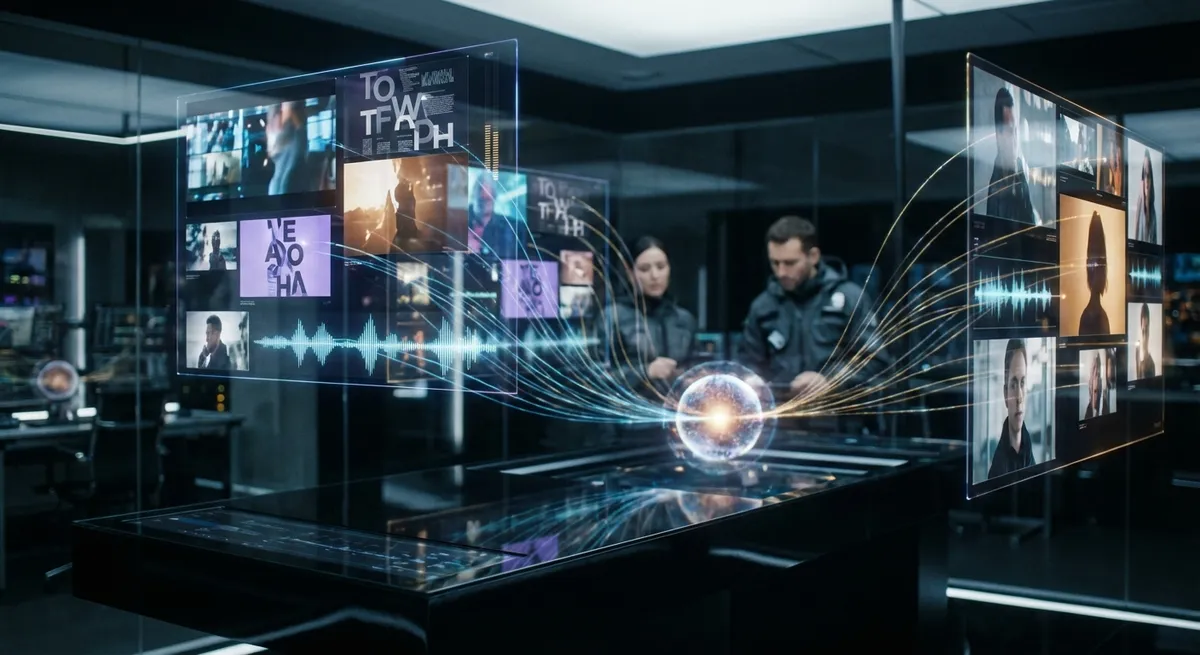
Generative AI has existed until now in a paradigm of separate tools: one model writes text, another draws pictures, a third edits video. Luma decided it was time to unite all this into a single orchestra, and introduced Luma Agents — a platform of creative AI agents built on its own family of models under the ambitious name Unified Intelligence.
The essence of the announcement is simple yet ambitious. Luma Agents is not another image generator or video editor with neural network capabilities. It is a coordination system that can manage multiple AI models simultaneously and construct from their work a single end-to-end pipeline. Input: a creative task. Output: a finished multimedia product including text, images, video, and audio. Agents take on the role of producer: they decompose the task, distribute it among specialized models, monitor the consistency of results, and assemble the final product.
To understand why this matters, it's worth recalling the context. Luma Labs is a company that initially gained fame for its Dream Machine video generation model, which quickly became one of the main competitors to OpenAI's Sora and Runway. But the generative video market is rapidly commoditizing: dozens of companies offer similar capabilities, and competing on image quality alone is becoming increasingly difficult. The logical next step is to level up and offer not a separate model, but an entire platform capable of orchestrating the work of multiple models. This is exactly what Luma is doing with its new launch.
The Unified Intelligence models underlying the platform deserve special attention. The name itself hints at the architectural philosophy: instead of a set of disparate neural networks, Luma is building a unified foundation on which different modalities — text, visuals, sound — are processed within a single representation. This approach is not new in the research world: Google with Gemini and Meta with their multimodal models are moving in the same direction. But Luma is betting that unified architecture is particularly well-suited to the agent paradigm, where coordination between modalities is critical.
The practical implications of this launch could be significant for entire sectors of the creative industry. Imagine an advertising agency that needs to create a campaign: a script, visual materials, video clips, and audio accompaniment. Today this requires working with five or six different tools, manual coordination of style and tone, and countless iterations. Luma Agents promises to reduce this process to a single request. Of course, there is always a gap between promise and reality, but the trajectory itself is telling.
It is also important to note that Luma fits into a broader 2026 trend — the transition from individual models to agent systems. OpenAI, Anthropic, Google — all major players are actively developing agent frameworks. But most of them focus on productivity and workflow automation. Luma occupies a distinctly different niche, targeting creative production specifically. This is intelligent strategic differentiation: instead of direct competition with giants, the company chooses territory where its expertise in visual content generation becomes a real advantage.
Skeptics, of course, will ask fair questions. How reliable is the coordination between agents? How does the system maintain a unified style throughout the entire project? What happens when the result of one agent does not satisfy the user — can individual elements be precisely corrected? The answers to these questions will determine whether Luma Agents becomes a real working tool or remains an impressive demonstration.
One thing can be said with confidence: the era of 'one model — one task' is coming to an end. The future of generative AI lies in systems capable of thinking in projects rather than individual prompts. Luma has made one of the first serious bets on this future in the creative space, and the results of this experiment are worth watching closely.
Want to stop reading about AI and start using it?
AI News is a curated feed of AI/tech news. Hamidun Academy teaches you to use AI systematically in your work.