TCS reshapes its business: Indian IT giant builds data centers for OpenAI and others
Tata Consultancy Services (TCS), India's largest IT company, has signed an agreement with OpenAI to build AI data centers in India and is in «advanced» talks wi
AI-processed from Bloomberg Tech; edited by Hamidun News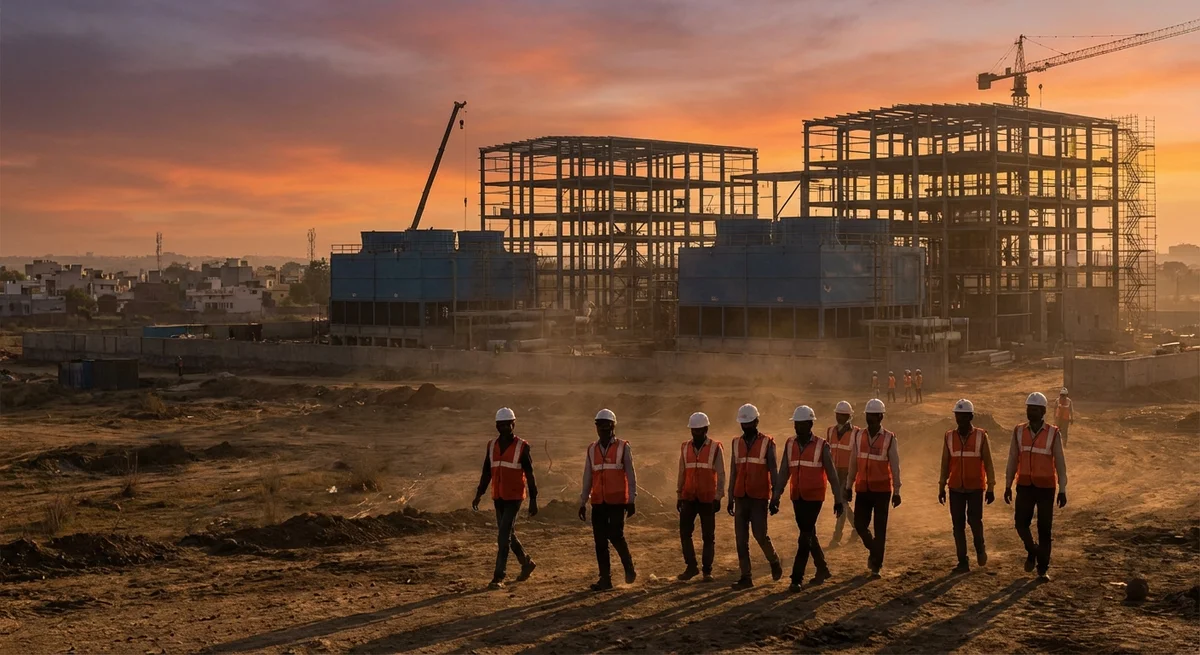
When a company with annual revenue exceeding 29 billion dollars decides to overhaul its own business model, it's not just corporate news — it's a tectonic shift for an entire industry. Tata Consultancy Services, the flagship of Indian IT outsourcing and the country's largest technology company by market capitalization, announced an agreement with OpenAI to build AI data centers in India. But, as Bloomberg reported, this is just the beginning: TCS is at an "advanced stage" of negotiations with other technology giants about similar new projects.
To understand the scale of what's happening, it's worth recalling what TCS has traditionally done. For decades, the company was synonymous with Indian IT outsourcing — hundreds of thousands of engineers wrote code, maintained corporate systems, and provided technical support to Western banks, insurance companies, and retailers. This model made Tata Group one of Asia's wealthiest conglomerates and the Indian IT industry an export engine of the national economy. But the world has changed. Generative AI began automating precisely the tasks on which outsourcers' business was built: writing boilerplate code, testing, data processing. TCS needed a new strategic direction, and now we're seeing what it will be.
Building data centers for AI is a completely different league. We're not talking about programmers at monitors, but large-scale infrastructure projects: thousands of servers with GPUs, complex cooling systems, massive power capacity. A modern AI data center can consume as much electricity as a small city. For India, which is actively developing renewable energy and has relatively cheap labor for construction, this is simultaneously a challenge and an opportunity. OpenAI, whose computing power needs grow exponentially with each new generation of models, obviously sees India as an attractive site for geographical diversification of its infrastructure.
The fact that TCS is negotiating not only with OpenAI but also with other tech giants speaks to the systemic nature of this strategy. One might assume that potential partners include companies like Google, Microsoft, Meta, or Anthropic, each of which is engaged in an unprecedented race for computing resources. The global shortage of capacity for training and inferencing AI models has become one of the industry's main bottlenecks. Construction of new data centers is underway worldwide — from Texas to Scandinavia and Southeast Asia. India, with its scalable workforce, growing energy infrastructure, and government incentives for the technology sector, logically claims a role as one of the key hubs.
For TCS itself, this pivot carries both opportunities and risks. The company is moving from a model where the main asset is people and their expertise to a model where capital investments, physical infrastructure engineering, and long-term service contracts play the key role. This requires different competencies, different risk management, and different customer relationships. However, Tata Group has one undeniable advantage — the conglomerate owns businesses in construction, energy, and telecommunications, which allows it to build vertically integrated solutions unavailable to pure IT companies.
Geopolitical context also plays a role. Against the backdrop of escalating technological confrontation between the United States and China, as well as growing restrictions on chip exports, India is positioning itself as a reliable neutral partner for Western technology companies. Prime Minister Narendra Modi has repeatedly stated his ambitions to turn the country into a global AI development center. TCS deals with OpenAI and other players are the materialization of these ambitions in concrete contracts and concrete foundations of future data centers.
The history of TCS is, in essence, the history of the entire Indian technology industry at a crossroads. The old outsourcing model won't disappear tomorrow, but its ceiling is already visible. Companies that manage to transform and become infrastructure partners in the age of AI will get a ticket to the next decade of growth. Those who remain in the paradigm of "cheap programmers for the West" risk becoming victims of the very technologies they helped create. TCS, it seems, has made its choice.
Want to stop reading about AI and start using it?
AI News is a curated feed of AI/tech news. Hamidun Academy teaches you to use AI systematically in your work.