AI code review without the cloud: how Ollama is changing the approach to local development
Developers demonstrated a working AI code review pipeline that runs entirely locally through Ollama—without the cloud or API keys. The system analyzes a git dif
AI-processed from Habr AI; edited by Hamidun News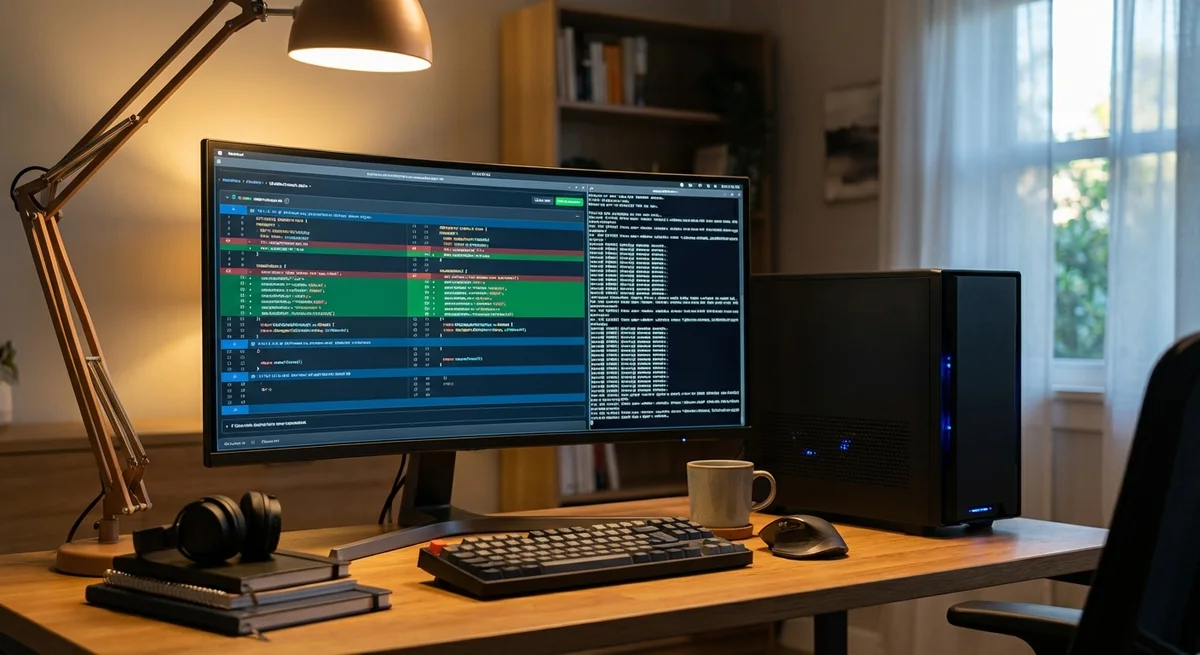
Using artificial intelligence for code review has long ceased to be exotic. GitHub Copilot, Amazon CodeWhisperer, dozens of SaaS solutions—they all offer automated pull-request analysis. But they all share one thing in common: your code goes to the cloud. For many teams—especially in fintech, healthcare, or defense—this is categorically unacceptable. A recent case from Habr shows that an alternative already exists and works right on your machine.
We're talking about a complete AI code review pipeline built on Ollama—a tool for running large language models locally. The architecture is extremely simple: the system takes a git diff from the repository, passes the changes to a locally deployed LLM, and receives a structured report with comments on code quality, potential bugs, and stylistic issues. No cloud servers, no API keys, no monthly subscriptions. Everything runs on the developer's hardware.
Over the past year, Ollama has transformed from a niche tool for enthusiasts into a serious platform for production tasks. The project allows you to run models like Llama, Mistral, CodeLlama, and dozens of others directly on a local machine with minimal setup. Installation takes one command, and interaction with models happens through a simple REST API that easily integrates into any CI/CD pipeline or script. This simplicity made possible the emergence of solutions that previously required expensive cloud infrastructure.
Technically, the approach looks as follows. A script extracts the diff between the current branch and the main one, formats it into a prompt with clear instructions for the model—what to focus on, what format to return the answer in—and sends a request to the local Ollama instance. The model analyzes the changes and returns a report that can include indications of potential bugs, style violations, performance issues, and refactoring suggestions. The entire process takes from several seconds to a couple of minutes depending on the volume of changes and hardware power. On a machine with a modern graphics card with 16 gigabytes of video memory, the results are quite acceptable in terms of speed.
It's important to understand the context in which this solution emerges. The developer tools market is experiencing a tectonic shift. On one hand, large corporations like Microsoft and Google are aggressively promoting their cloud AI assistants, tying developers to their ecosystems. On the other hand, a movement for digital sovereignty and data control is growing. The European AI Act, stricter requirements for personal data processing, corporate security policies—all of this creates demand for solutions that work without transmitting information to third parties. Local AI code review fits perfectly into this trend.
Of course, the approach has limitations. Local models still lag behind flagship cloud solutions like GPT-4o or Claude in terms of analysis quality. They may miss subtle logical errors or provide less accurate architectural recommendations. To run serious models, you need sufficiently powerful hardware—a budget laptop with integrated graphics won't cut it. But progress in the field of compact models is impressive: quantized versions with 7-13 billion parameters already show results that a year ago were only available to models ten times larger.
For the industry, this case is important not so much for the specific implementation, but for the direction it indicates. We're moving toward a world where AI developer tools will work locally by default, and the cloud will become an option, not a necessity. Ollama, llama.cpp, vLLM, and other projects create an infrastructure layer on which dozens of practical solutions are already being built—from code review to test and documentation generation. And all of this without a single request to an external server.
The main conclusion is simple: the barrier to entry for local AI in development has dropped to a minimum. If your team isn't yet experimenting with local models to automate routine tasks—now is the time to start. The technology has matured, tools are available, and the advantages in security and cost are obvious. Cloud AI giants, of course, aren't going anywhere, but they no longer have a monopoly on smart development tools.
Want to stop reading about AI and start using it?
AI News is a curated feed of AI/tech news. Hamidun Academy teaches you to use AI systematically in your work.