Altman tells employees: OpenAI does not control Pentagon decisions
OpenAI CEO Sam Altman said at an internal meeting that the company cannot and should not decide how the Pentagon uses its AI technologies. Altman also hinted th
AI-processed from Bloomberg Tech; edited by Hamidun News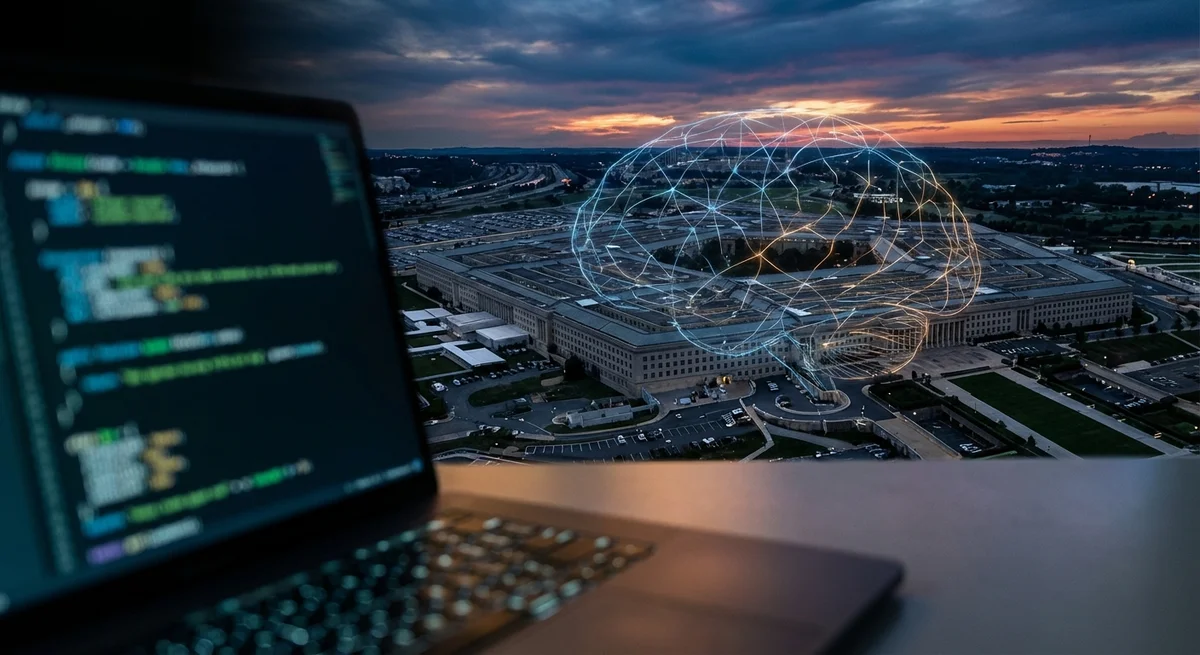
Sam Altman drew a line that many in the artificial intelligence industry have long hesitated to even outline. During an internal meeting with employees, the head of OpenAI stated bluntly: the company has no say in how the U.S. Department of Defense uses its software. Moreover, he made clear that the very desire to control the Pentagon's actions is, perhaps, a mistake that its main competitor, Anthropic, has already made.
This statement did not arise in a vacuum. Over the past two years, Silicon Valley's relationship with the U.S. military establishment has undergone a radical transformation. If in 2018 thousands of Google employees signed a petition against Project Maven — a program to analyze drone video for the Pentagon — by 2026 sentiment in the industry has changed beyond recognition. OpenAI, which had recently positioned itself as an organization with a mission of "safe AI for all humanity," has been systematically expanding cooperation with defense structures. The company lifted its ban on military applications of its technologies in early 2024, and then concluded a series of contracts with the Department of Defense.
Altman's position is remarkable for its frankness. He essentially articulated a principle that can be formulated as follows: the developer creates a tool, and the customer bears responsibility for its use. This is classic logic of weapons companies and defense contractors, but for a company that grew out of a nonprofit laboratory with an idealistic mission, such an approach marks a fundamental shift. OpenAI is no longer trying to be a moral arbiter — it is becoming a technology supplier that delegates ethical decisions to the client.
Particularly interesting is the context related to Anthropic. The company, founded by former OpenAI employees led by Dario Amodei, initially built its identity around AI safety. Anthropic developed the concept of "constitutional AI" and publicly declared a commitment to responsible technology development. However, according to Altman, it was Anthropic's attempts to maintain control over how the military uses its products that led to tension with the Pentagon. If this is indeed the case, we are witnessing an instructive story about how principaledness can turn into commercial defeat in the race for the largest government contracts.
For the Pentagon, the choice between suppliers who ask questions and those who simply provide technology is obvious. The Department of Defense is not accustomed to contractors dictating the terms of use for purchased systems. Lockheed Martin does not ask where a missile will fly. Raytheon does not care what target the operator will choose. Altman is essentially telling his employees: we play by the rules of this world, not by Silicon Valley's rules.
But behind the pragmatism of this position lies a serious problem. Artificial intelligence is not a missile or a radar. It is a general-purpose technology whose capabilities are growing rapidly and which can be applied in ways the developers did not anticipate. When OpenAI hands its models to the Pentagon and disclaims responsibility for their use, it creates a precedent whose consequences extend far beyond a single contract. What will happen when the models become even more powerful? When autonomous systems based on large language models begin making decisions on the battlefield? The question of responsibility will not disappear — it will only intensify.
Within OpenAI itself, Altman's statement certainly provoked a mixed reaction. The company has lost numerous key employees in recent years who disagreed with its strategic direction. The departure of Ilya Sutskever, then other researchers from the safety team — all these are links in one chain. Each such statement by Altman draws another line of selection: those who agree with the new reality remain; those who do not, leave — often to Anthropic itself.
What is happening reflects a broader process. The artificial intelligence industry has definitively exited the period of idealism and entered an era of real politics. Companies that want to remain at the forefront are forced to work with the state — and the state, especially in the person of the military establishment, has its own demands.
Altman has bet that OpenAI's future lies not in the role of a moral authority, but in the role of an indispensable technological partner. Whether this is the right bet — time will tell, but the very fact that the head of the company is speaking these words aloud to his own employees suggests that the point of no return has already been passed.
Want to stop reading about AI and start using it?
AI News is a curated feed of AI/tech news. Hamidun Academy teaches you to use AI systematically in your work.