AI-native investment thesis: how venture capital is betting on a new generation of companies
At Bloomberg Invest 2026 in New York, Glasswing Ventures founder and managing partner Rudina Seseri presented the concept of AI-native investing. In her view, t
AI-processed from Bloomberg Tech; edited by Hamidun News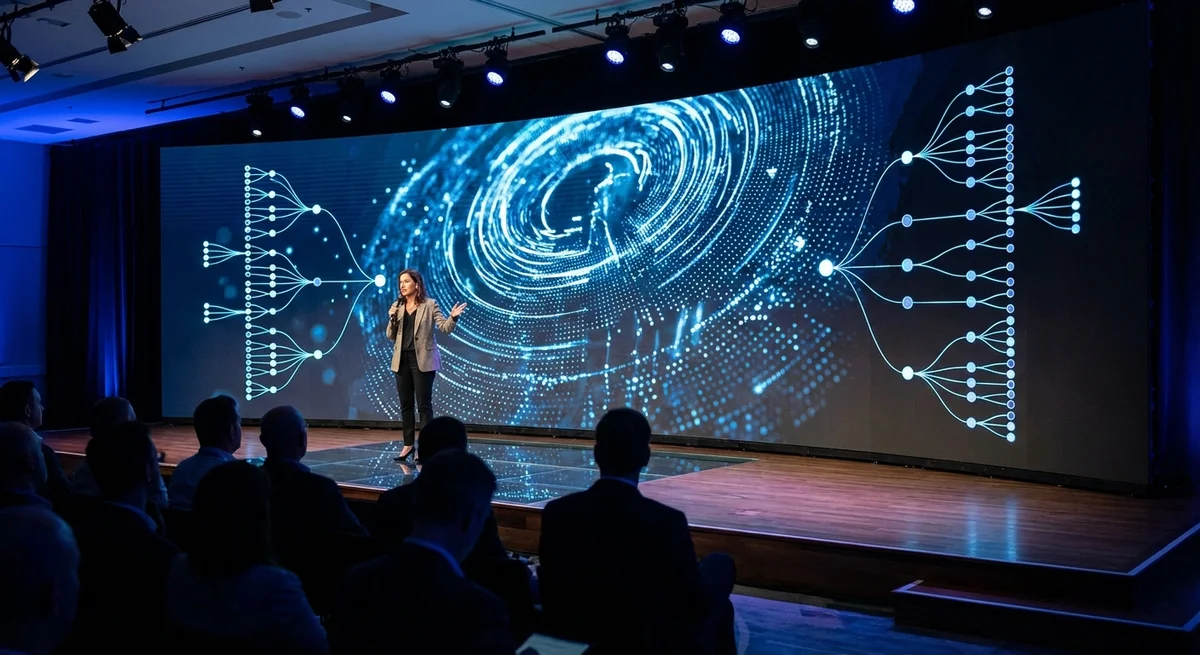
At the Bloomberg Invest 2026 conference in New York, a thesis was presented that will likely determine the direction of venture capital in the coming years. Rudina Seseri, founder and managing partner of Glasswing Ventures, formulated it with extreme clarity: the future belongs to companies where artificial intelligence is not an addition to an existing product, but its architectural foundation. It sounds obvious, but behind this formulation lies a fundamental shift in how Silicon Valley and the global venture market evaluate technology startups.
To understand the context, it's worth recalling what has happened in the industry over the past three years. Following the explosive growth of generative AI in 2023, the market experienced a wave of so-called "AI-wrappers" — thousands of startups took ready-made language models, layered an interface on top of them, and called themselves AI companies. Investors quickly became disillusioned: most such projects had neither technological moats nor sustainable competitive advantages. A single update to the base model was enough to render an entire class of products obsolete. This painful experience shaped a new approach to evaluating AI startups, which Seseri calls the AI-native investment thesis.
The essence of Glasswing Ventures' approach lies in a fundamental distinction between two types of companies. The first type comprises businesses that use artificial intelligence as a tool for optimizing existing processes. They add a chatbot to their website, automate routine operations, implement predictive analytics. This is useful, but it doesn't create a new market. The second type consists of AI-native companies, where the entire business model, product architecture, and user experience are from the outset designed around the capabilities of artificial intelligence. These, in Seseri's view, will become the corporate winners of the new generation.
What capital flows are we talking about? According to various analytical agencies, global venture investments in the AI sector continue to grow despite overall market cooling. However, the structure of these investments is changing fundamentally. While in 2023–2024 a significant portion of capital flowed into the infrastructure layer — chip manufacturers, cloud platforms, developers of foundational models — increasingly, funds are now directed to the application layer. Investors are seeking companies that solve specific industry problems, but do so in a fundamentally new way, impossible without AI. Healthcare, finance, law, industrial automation — in each of these fields, AI-native leaders are taking shape.
Seseri also addressed one of the most difficult questions for investors: how to distinguish a true AI-native company from a skillful imitation. According to her, key criteria are the possession of proprietary data and models, the ability to continuously learn from user interactions, and the so-called "flywheel effect," where the product improves with each new customer. A company that merely calls an API of someone else's model has none of these properties. A company that builds its own intelligent stack accumulates competitive advantage exponentially.
For the Russian technology market, this thesis has particular significance. The domestic AI ecosystem is developing under conditions of limited access to certain Western technologies, which paradoxically may stimulate the creation of precisely AI-native companies. When there is no possibility to simply take ready-made infrastructure and layer a wrapper on top, one must design the architecture from scratch, and if this is done with AI at its foundation — the result may be more competitive than Western counterparts built on borrowed components.
Seseri's presentation at Bloomberg Invest 2026 marks an important watershed in the history of technological investments. The era when the "AI" prefix in a company's name automatically boosted its valuation has ended. The time is coming when investors will look not at marketing, but at architecture. Not at whether a company uses artificial intelligence, but at whether it could exist without it. If the answer is "yes" — it's not an AI-native company. And in the view of a growing number of venture capitalists, it's no longer the bet worth making.
Want to stop reading about AI and start using it?
AI News is a curated feed of AI/tech news. Hamidun Academy teaches you to use AI systematically in your work.