Anthropic files bid for Pentagon drone-swarm control competition
Anthropic, known as one of the leading advocates of AI safety, has submitted a bid to take part in a Pentagon competition worth $100 million. The goal is to cre
AI-processed from Bloomberg Tech; edited by Hamidun News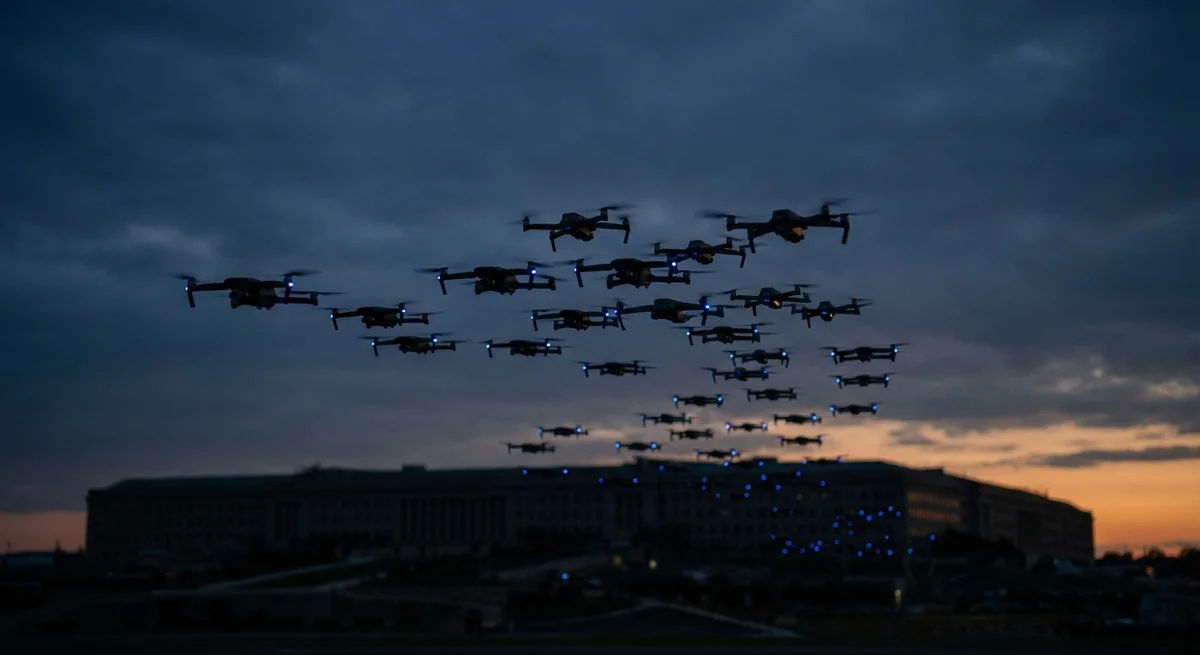
The company, which built its reputation on principles of safe and responsible artificial intelligence, quietly submitted an application for one of the Pentagon's most ambitious military projects in recent years. According to Bloomberg, Anthropic — the creator of the Claude language model — has entered the competition for a $100 million Pentagon prize. The goal of the project is to develop technology for voice control of autonomous drone swarms.
The idea of the competition itself sounds like a scenario from a science fiction film: an operator gives a voice command, and dozens or hundreds of unmanned aircraft coordinate their actions without direct control of each device. This is a fundamentally new level of autonomy, where a language model must not only understand a command, but also translate it into complex coordinated work of multiple aircraft in real time. The Pentagon clearly sees large language models as the key to an intuitive interface between humans and combat systems of the future.
For Anthropic, this step looks ambiguous at best. The company was founded in 2021 by former OpenAI employees, including Dario and Daniela Amodei, who left precisely because of disagreements over safety issues. Since then, Anthropic has consistently positioned itself as the most responsible player in the industry: publishing research on AI alignment, implementing a constitutional approach to model training, openly discussing risks. Military contracts fit poorly into this picture, and the company had long kept its distance from the defense sector.
However, the context in which the application was submitted makes the situation even more intriguing. Bloomberg indicates that this occurred against the backdrop of "hostility" between Anthropic and the Pentagon — apparently referring to disagreements related to the conditions for using the company's technologies and the boundaries of permissible military applications. Submitting an application for the competition in the midst of such a conflict could mean several things: either Anthropic is trying to restore relations with the Department of Defense, or a strategic shift has occurred within the company, or financial pressure has proven stronger than ideological commitments.
The last option cannot be ruled out. The race in AI requires colossal investments in computing power, research, and talent. Anthropic has attracted billions of dollars in investments, including from Amazon and Google, but competition with OpenAI, Google DeepMind, and other giants is only intensifying. Defense contracts are not just money; they are a stable, long-term, and generous source of funding. For comparison, the Pentagon's total budget for AI projects is measured in billions of dollars annually, and $100 million for a single competition is just the tip of the iceberg.
It is important to understand the broader context as well. The AI industry as a whole is rapidly moving toward the defense sector. OpenAI, which once prohibited military use of its models, lifted that ban in 2024. Palantir, Anduril, Shield AI, and dozens of other companies are actively working with the Pentagon. Even in Silicon Valley, where anti-war sentiment is traditionally strong, pragmatism prevails: if you don't work with the military, someone else will — possibly with a less responsible approach to safety. This argument is likely being made inside Anthropic as well: better us, with our alignment principles and constitutional AI, than a company that doesn't think about ethics at all.
Nevertheless, this is a serious test for Anthropic's reputation. The company spent years building a brand on the idea that safety is more important than profit, that there are red lines that cannot be crossed. Participation in a competition to create autonomous combat systems — even at the application stage — will inevitably raise questions among some employees, investors, and the AI safety community. Where is the line between defensive and offensive applications? Who controls how exactly autonomous drone swarms will be used? Is a voice command from one person sufficient for decisions that could cost lives?
The story of Anthropic's application for the Pentagon competition is not just corporate news. It is a marker of a fundamental shift in the entire artificial intelligence industry. The era when leading AI labs could afford the luxury of distancing themselves from the military is coming to an end. The question now is not whether AI technologies will be used in defense, but on what terms and with what restrictions. And the answer to this question will largely determine what kind of world it will be in which autonomous systems become the norm, rather than the exception.
Want to stop reading about AI and start using it?
AI News is a curated feed of AI/tech news. Hamidun Academy teaches you to use AI systematically in your work.