The economics of AGI: humans will become verifiers as machines take over labor
Researchers from MIT, Washington University, and UCLA published an analysis of the economy in the AGI era. Their core thesis: as the singularity approaches, mos
AI-processed from Import AI; edited by Hamidun News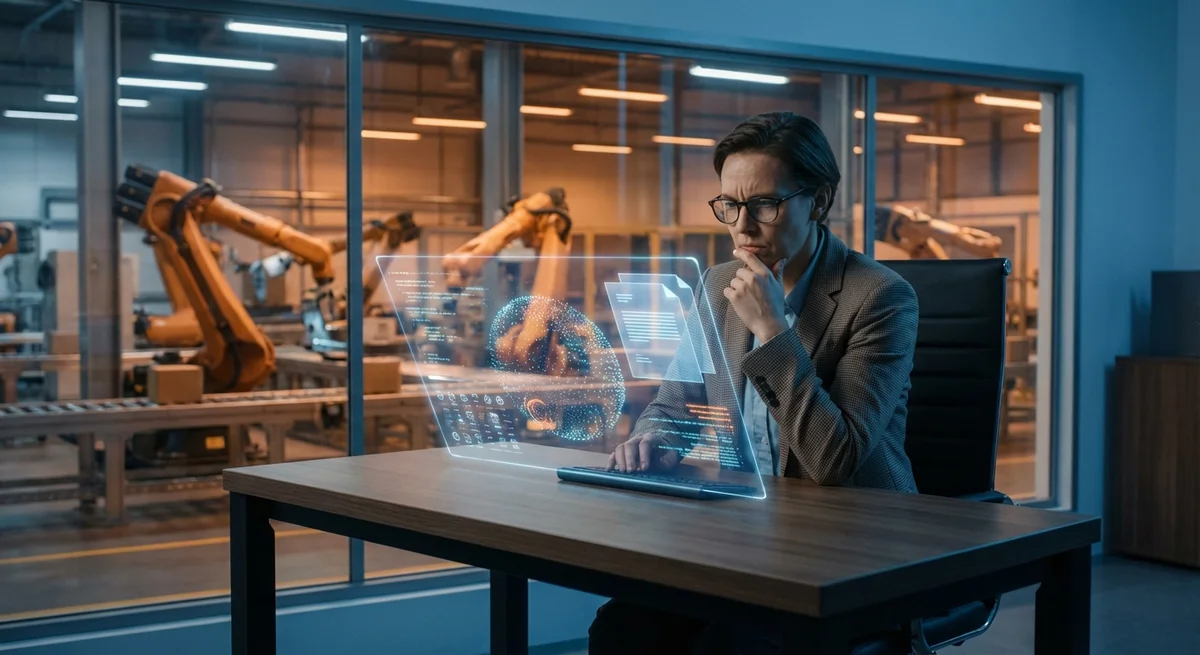
Talks about technological singularity have long ceased to be the preserve of science fiction writers and YouTube futurologists. Now they are the domain of economists from the world's leading universities — and their conclusions deserve careful attention. In a recent issue of the Import AI analytical bulletin, one of the most authoritative sources on artificial intelligence research, the central theme was the "AGI economy" model proposed by a group of researchers from the Massachusetts Institute of Technology, Washington University in St. Louis, and the University of California, Los Angeles.
The essence of their work boils down to a simple but troubling formula: in a world where artificial general intelligence becomes reality, the overwhelming majority of productive labor transfers to machines. Humans do not disappear from the economic equation, but their role undergoes fundamental transformation. Instead of creating, people begin to verify. Instead of producing, they validate. This is not simply the automation of routine — it is a restructuring of the very logic of labor division that has existed for millennia.
Why verification specifically? The answer lies in a fundamental asymmetry between creation and verification. Generating code, writing a legal document, designing a component — AI systems already do all of this at impressive speed. But ensuring that the result is correct, safe, and meets actual needs still requires human judgment. Researchers are documenting what industry practitioners already observe: engineers increasingly write less code from scratch and spend more time reviewing what Copilot or Claude proposes. Lawyers check AI-generated contract drafts rather than writing them themselves. The MIT and WashU model simply extrapolates this trend to its logical limit.
However, a paradox emerges here that the authors, judging by their work's description, recognize. Verification is a skill that develops through the practice of creation. A surgeon can assess operation quality because they have performed thousands. A programmer spots bugs in generated code because they have written code by hand for years. If new generations of specialists enter the role of verifiers immediately, skipping the stage of deep practical mastery, the quality of verification itself will inevitably degrade. This creates a peculiar competency trap that economists and policymakers should consider now.
In the same Import AI issue, two more topics are raised that organically complement the picture. The first is the use of procedurally generated game environments for testing AI systems. The idea is that static benchmarks quickly become obsolete and are "memorized" by models, while dynamically created game scenarios allow assessing genuine capacities for generalization and adaptation. This is an important methodological shift: the industry is beginning to understand that measuring machine intelligence should not be done through tests, but through the ability to handle the unexpected.
The second topic is the concept of "agent ecologies" — systems in which multiple autonomous AI agents interact with each other, compete, and cooperate. If AGI economy describes the relationship between humans and machines, then agent ecologies describe relationships between machines themselves. This is the next level of complexity, where the predictability of individual agent behavior does not guarantee the predictability of the entire system. Emergent effects in such ecologies can be both productive and dangerous — and this is a direct bridge to questions of AI safety.
All together, these three topics form a coherent and quite sobering picture. We are moving toward a world where machines produce, people verify, and between machines their own ecosystems of interaction form. This is neither utopia nor dystopia — it is a new economic reality whose contours are already becoming visible today.
The question is not whether it will arrive, but whether we will manage to prepare the institutions, education, and regulatory frameworks that will allow people to maintain not merely employment, but genuine agency in this new world. Researchers from MIT, WashU, and UCLA, at least, ask the right questions. The answers, however, we will have to find together — and preferably before AGI economics becomes an accomplished fact.
Want to stop reading about AI and start using it?
AI News is a curated feed of AI/tech news. Hamidun Academy teaches you to use AI systematically in your work.