Nvidia invests $4 billion in data center optics
Nvidia announced $4 billion in investments in two companies specializing in optical technologies for data centers. Optical interconnects are a critical…
AI-processed from Bloomberg Tech; edited by Hamidun News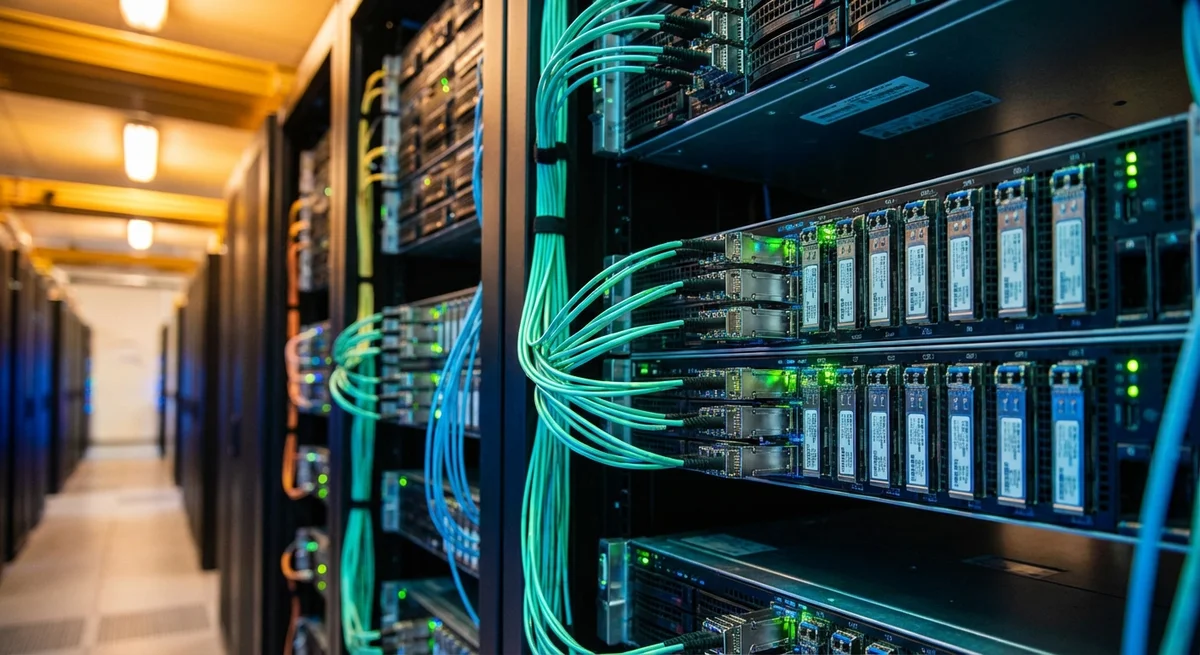
Four billion dollars — that's exactly how much Nvidia is willing to spend to make light move faster in data centers. The company has announced investments in two firms developing optical technologies for data processing centers, and this move signals something far greater than just another deal in Jensen Huang's portfolio.
At first glance, optics for data centers sounds like a niche topic, far removed from bold announcements of new GPUs and record quarterly reports. But it is precisely optical interconnects — technology that enables data transmission between thousands of graphics processors at speeds measured in terabits per second — that are becoming one of the main bottlenecks in the race to scale AI systems. When a cluster of tens of thousands of chips trains a model at the level of GPT or Gemini, it is the speed and bandwidth of the connection between these chips that determines how efficiently computational resources are utilized.
Copper cables, which have served as the standard for decades, are hitting physical limits: at distances beyond a few meters, they lose signal and consume too much energy. Optical fiber solves both problems — but the technology of optical transceivers for ultra-dense computing environments is still in active development.
This is why Nvidia is channeling $4 billion not into developing the next generation of chips, but into companies that make the connection between them possible. This is a strategically calculated move that reflects the evolution of the company's business model. Nvidia ceased to be merely a graphics processor manufacturer long ago.
In recent years, the company has been methodically building a vertically integrated ecosystem: proprietary networking solutions (following the acquisition of Mellanox in 2020 for $7 billion), software platforms for AI, cooling systems, and now — optical infrastructure. The logic is straightforward: the more elements of the stack Nvidia controls, the harder it is for clients to switch to competitors, and the higher the margin on each solution sold.
The context of this investment becomes even clearer when looking at the scale of data center construction worldwide. By various estimates, in 2025-2026, the largest technology companies — Microsoft, Google, Amazon, Meta, and Oracle — will collectively invest more than $300 billion in AI infrastructure. Each of these massive clusters requires not only tens of thousands of GPUs but also a comparable number of high-speed optical connections. The market for optical components for data centers, according to analyst forecasts, will grow from $15 billion in 2024 to more than $40 billion by 2028. By investing now, Nvidia is effectively securing privileged access to technologies that will become scarce in the coming quarters.
There is another important aspect. Co-packaged optics technology — the integration of optical modules directly into processor packages — is considered the next major breakthrough in data center architecture. It will enable a radical reduction in latency and power consumption, which is critical for real-time systems and inference of large models. By investing in optical companies, Nvidia can gain early access to these technologies and integrate them into its future platforms — whether Blackwell Ultra, Rubin, or whatever comes after. This is not merely a financial bet, but a technological one — and it could define the architecture of AI infrastructure for decades to come.
For Nvidia's competitors, this move creates additional pressure. AMD and Intel, which are attempting to reclaim market share in AI accelerators, are not yet demonstrating the same depth of vertical integration. Startups like Cerebras and Groq are focused on chips but do not control the network layer. Nvidia, however, is building a system in which GPUs, networking, optics, and software work as a single whole — and each new element in this chain reinforces the competitive moat around the company.
Four billion dollars in optics is not simply an investment in cables and transceivers. It is a claim to control the physical layer of AI infrastructure. In a world where computational power is becoming the new oil, Nvidia is building not just the drilling rigs but also the pipelines. And it is precisely the one who controls the pipelines who ultimately sets the rules of the game.
Want to stop reading about AI and start using it?
AI News is a curated feed of AI/tech news. Hamidun Academy teaches you to use AI systematically in your work.