Vibe coding: how thoughtless use of AI destroys engineering expertise
Concern is growing in the developer community: the mass adoption of AI assistants in everyday programming is leading to a decline in engineering skills. The phe
AI-processed from Habr AI; edited by Hamidun News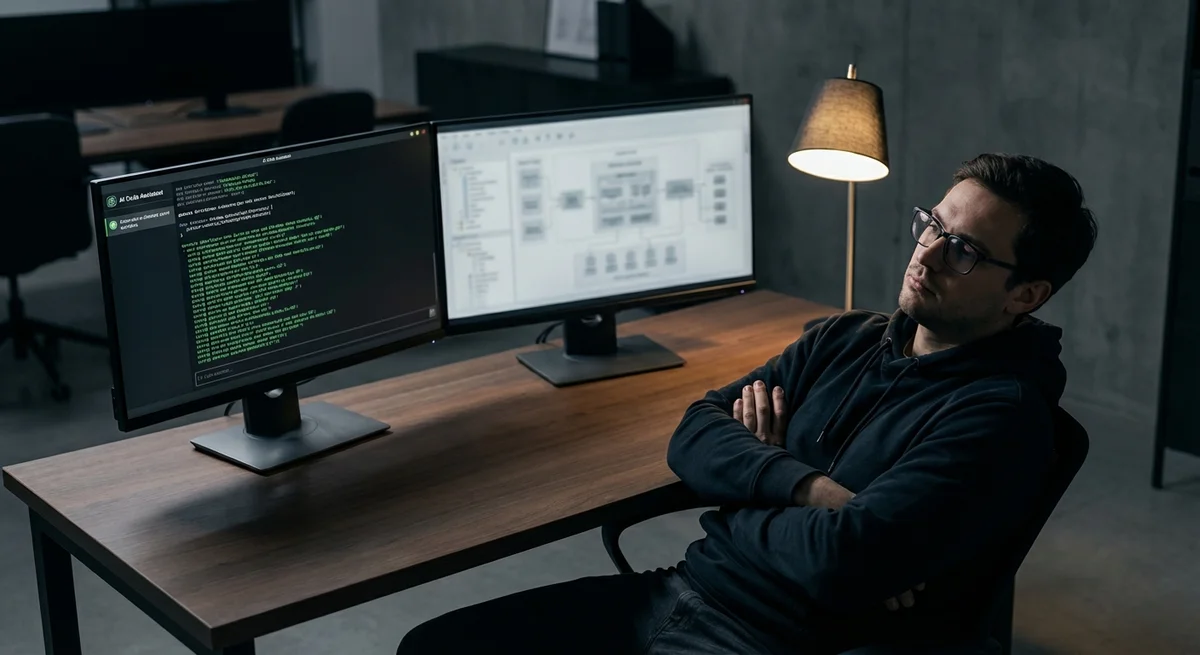
The term vibe coding sounded like a joke just a couple of years ago — an ironic description of a situation when a developer asks a language model to write code, quickly scans the result, and ships it to production without understanding the details. By March 2026, this has stopped being a joke. The phenomenon has reached a scale that forces us to reflect on the future of the entire engineering profession.
On Habr, another — and perhaps one of the most resonant — article has appeared describing how mindless integration of AI tools into development workflows gradually erodes what constitutes the very essence of the profession: deep technical expertise. The author describes observations from their own practice, but behind the personal notes emerges a systemic problem that the industry still prefers not to notice.
The mechanism of degradation looks deceptively harmless. A developer receives a task, formulates a prompt for Copilot, Cursor, or Claude, gets a working code fragment, and integrates it into the project. Task closed, sprint moving forward, manager happy. The problem is that this approach excludes a key stage from the cycle — comprehension. The programmer does not go through the path from problem statement through architectural analysis to a conscious choice of solution. They get a ready-made answer and accept it on faith. Again and again, month after month, the neural pathways responsible for engineering thinking simply fail to form — or worse, atrophy in those who previously possessed this thinking.
Junior developers are particularly vulnerable. For them, an AI assistant becomes not an amplifier of existing skills, but their replacement. A junior who has been accustomed from day one to receiving ready-made solutions from a language model risks never developing the ability for independent architectural thinking, debugging complex systems, and understanding why the code works the way it does.
After three or four years of such practice, the market receives a mid-level developer who formally has experience but actually cannot solve a non-trivial task without AI hints. This is not a hypothetical scenario — the first signs are already visible in technical interviews, where candidates demonstrate a striking gap between the speed of executing typical tasks and complete helplessness before non-standard ones.
It is important to emphasize: the problem is not with the tools themselves. AI-assisted coding — this is perhaps the most significant leap in developer productivity since the advent of IDEs with autocomplete. They brilliantly handle routine work: generating boilerplate, writing template tests, refactoring repetitive code, rapid prototyping. An experienced engineer who uses AI as an accelerator for tasks they already know how to solve gains a colossal advantage. But the same tool in the hands of someone who does not understand the fundamentals becomes a generator of technical debt — beautifully formatted, syntactically correct, but architecturally fragile code.
A parallel suggests itself naturally: the calculator did not make mathematicians stupider, but only because mathematicians were first taught to count in their heads and understand the nature of numbers. GPS did not destroy navigation skills in those who knew how to read maps — but an entire generation of drivers who grew up with GPS really does get lost without it. The question is which of these scenarios is closer to what is happening now in development. And the answer, it seems, is discouraging.
There is another dimension of the problem that is rarely discussed: the impact on team dynamics. When a significant part of the team practices vibe coding, code review loses its meaning — the reviewer likewise passes over generated code without understanding the logic. Collective expertise, which was previously formed through discussions of architectural decisions and analysis of errors, gradually evaporates. The team turns into a group of operators managing an AI conveyor, but unable to fix it when it breaks.
The solution, obviously, does not lie in rejecting AI tools — that would be Luddism. The solution lies in a conscious approach to their use. Companies should invest in a culture where AI is used as an amplifier rather than a replacement for thinking. Educational programs need to adapt: foundation first, then tools. And developers themselves would do well to occasionally solve problems intentionally without AI — the way athletes train with extra weight to move faster without it. Artificial intelligence should make strong engineers even stronger, not create the illusion of competence where none exists.
Want to stop reading about AI and start using it?
AI News is a curated feed of AI/tech news. Hamidun Academy teaches you to use AI systematically in your work.