Robot arm with puppy eyes: Lenovo presented desktop AI companions
At MWC 2026, Lenovo presented two concept desktop AI companions for office workers. AI Workmate is a robot arm on a rotating base with a screen that displays ex
AI-processed from The Verge; edited by Hamidun News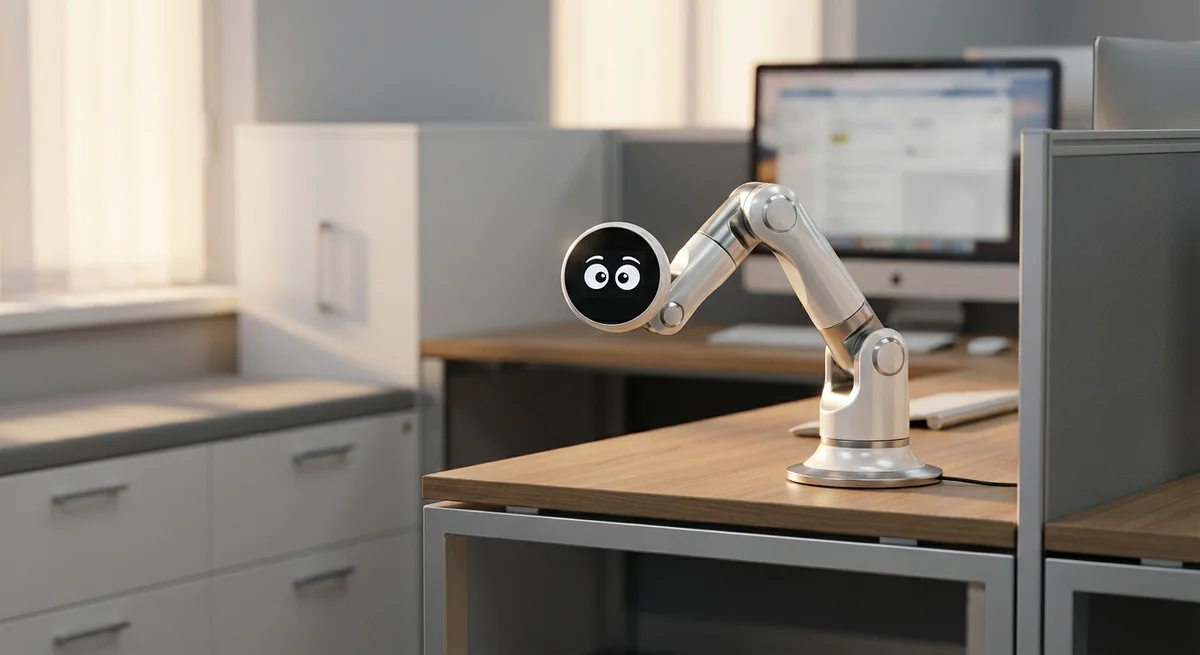
Imagine: you come to the office in the morning, sit at your desk, and a pair of large expressive eyes on a screen mounted on a small robotic arm is already looking at you. This isn't a scene from a science fiction film, but one of the concepts that Lenovo brought to Mobile World Congress 2026 in Barcelona. The company has decided that the future of office productivity isn't just software, but physical AI companions that sit next to you on your desk and attempt to replace real interaction with colleagues.
A device called AI Workmate Concept is a compact robotic arm on a rotating base, topped with a rounded screen. Animated eyes are displayed on this screen, which, according to the developers' intent, should give the gadget emotionality and make interaction with it more natural. Lenovo describes it as an "always-on desktop companion." The arm can move and rotate, performing various tasks, and thanks to local data processing using AI, the user can interact with the device as with a voice assistant. Essentially, it's an attempt to turn an abstract chatbot into something tangible, something you want to interact with not out of necessity, but out of habit — like a pet or a colleague at the next desk.
Besides AI Workmate, Lenovo also showcased a second concept — a stationary desktop device, also aimed at improving the productivity of office workers. Both gadgets are positioned as autonomous solutions, not tied to a specific laptop or smartphone. This is an important nuance: Lenovo is clearly betting that AI assistants of the future will become a separate class of devices, not just applications within existing gadgets.
The context of this announcement is much broader than it might seem at first glance. The personal computer industry is going through difficult times — the market is saturated and sales growth has slowed. Manufacturers are desperately searching for new form factors and use cases that will make consumers and corporate clients spend money again.
Artificial intelligence has become the main bet: if in 2024-2025 everyone talked about "AI notebooks" with neural processors, now the focus is shifting toward separate AI devices. Lenovo is not alone in this pursuit — just recall the failed but telling launches of Humane AI Pin and Rabbit R1. The market has yet to find a convincing form factor for a standalone AI assistant, and every major manufacturer is trying their own version.
Lenovo's choice in favor of anthropomorphic design deserves special attention. Large expressive eyes on the screen are not accidental. Decades of research in human-machine interaction show that people are significantly more willing and longer interact with devices that mimic living features. Japanese robots Pepper and Lovot, home robot Jibo — they all used the same strategy. The problem is that the line between "cute" and "creepy" is very thin. If a device looks too alive but behaves mechanically, the user quickly loses interest or, worse, experiences discomfort — the so-called uncanny valley effect. Lenovo, apparently, deliberately chose a cartoonish style for the eyes to stay on the safe side of this boundary.
There is also a deeper question raised by this concept. Lenovo itself uses the word "companionship." The company is essentially offering office workers an artificial emotional partner. In an era when remote work and hybrid formats blur social connections in teams, the idea of a desktop robot companion sounds both logical and troubling. Logical — because loneliness in the workplace has become a real problem affecting productivity and mental health. Troubling — because replacing human interaction with a robot with drawn-on eyes is hardly a healthy solution to this problem.
It is important to emphasize that both devices remain concepts for now. Lenovo has not named either release dates or price estimates. MWC traditionally serves as a platform for demonstrating bold ideas, most of which never reach mass production. However, the very fact that one of the world's largest computer manufacturers is investing resources in developing physical AI companions speaks to the direction the industry is moving.
The future of the work desk, as Lenovo sees it, is not just a monitor and keyboard. It is an ecosystem in which a small robot sits next to you, watches you with expressive eyes, and is ready to help with tasks. Whether this sounds like a productivity utopia or the first chapter of a dystopia depends on how well the industry balances usefulness and intrusiveness. For now, AI Workmate is a beautiful metaphor for where the entire market is headed: from AI as a tool to AI as presence.
Want to stop reading about AI and start using it?
AI News is a curated feed of AI/tech news. Hamidun Academy teaches you to use AI systematically in your work.