AI Penetrates Higher Mathematics: Breakthrough or Danger?
With the release of GPT 5.2, AI is actively making inroads into the field of higher mathematics. Experts debate its impact on science: acceleration of research or devaluation of fundamental knowledge?
AI-processed from TechCrunch; edited by Hamidun News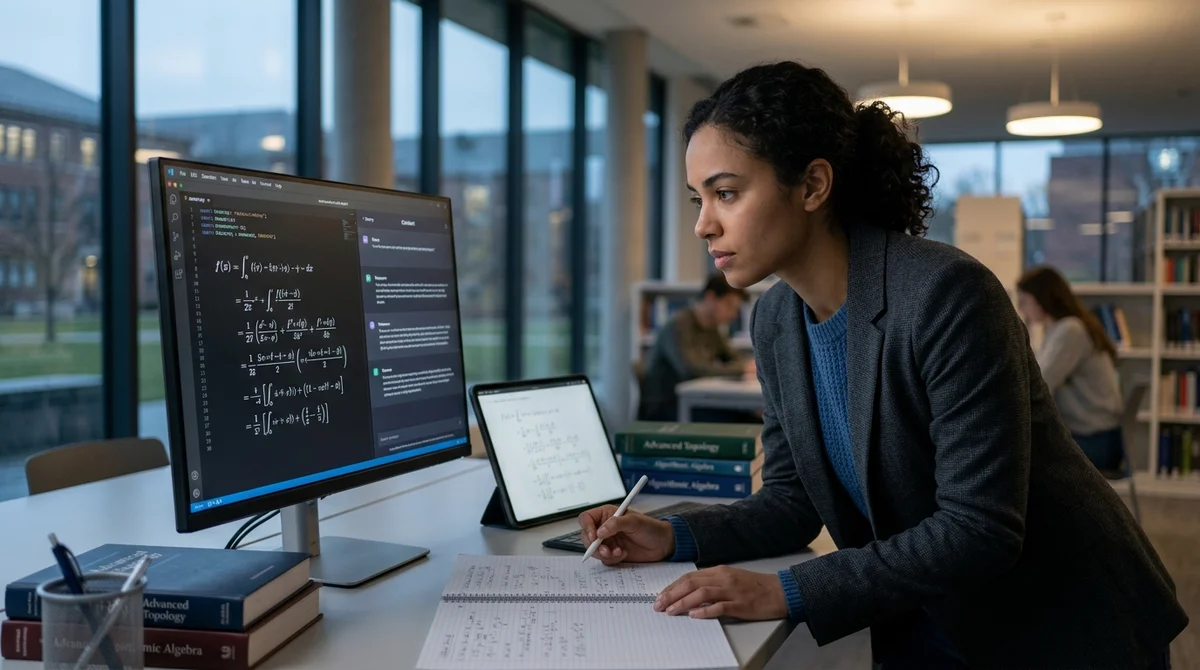
Since the release of GPT 5.2, artificial intelligence tools have become practically indispensable in the field of higher mathematics. This has sparked a wave of discussions in the scientific community: some see it as a breakthrough capable of accelerating the solution of complex problems, while others fear the devaluation of fundamental knowledge and the decline of human intellect's role.
Historically, mathematics has been considered one of the most complex and "human" areas of knowledge. For a long time, it was believed that solving complex mathematical problems required intuition, creativity, and deep understanding of fundamental principles – qualities that were assumed to be inaccessible to machines. However, recent advances in artificial intelligence, particularly the development of large language models (LLMs), such as GPT, have shown that this assumption may be incorrect.
GPT 5.2, thanks to its ability to analyze vast amounts of data, identify patterns, and generate new solutions, has proven to be an effective tool for solving a number of complex mathematical problems. It is capable not only of verifying existing proofs but also of proposing new approaches to solving problems that previously seemed unsolvable. Some researchers are already using GPT 5.2 to automate routine calculations, allowing them to focus on more creative aspects of their work.
However, the widespread adoption of AI in mathematics also raises concerns. One of the main questions is the reliability of results obtained using AI. Models like GPT are trained on large datasets that may contain errors or biases. This could lead to AI generating incorrect solutions or reinforcing existing prejudices in science. Additionally, there is the question of authorship for scientific discoveries made with the help of AI: who owns the results produced by the machine – the developers of the model, the scientists who used it, or the machine itself?
The use of AI in mathematics may also lead to changes in the role of mathematicians. If machines are able to perform most of the routine work, then mathematicians will be forced to focus on more complex and creative tasks that require critical thinking and deep understanding of fundamental principles. This will require mathematical education to review curricula and emphasize the development of skills that cannot be automated.
The impact of AI on mathematics is a complex and multifaceted process that will continue in the coming years. It is important that the scientific community actively participates in discussions of ethical and methodological issues related to the use of AI in science, to ensure its responsible and effective application. Only in this way will it be possible to take full advantage of all the benefits that AI can offer mathematics and avoid potential risks.
Want to stop reading about AI and start using it?
AI News is a curated feed of AI/tech news. Hamidun Academy teaches you to use AI systematically in your work.
The AI world, distilled — once a week
Seven stories that actually mattered, hand-picked. No noise, no reposts, no press releases.
Done! Check your inbox for a confirmation.