When machines decide what matters: AI searches for new physics in the collider data stream
Particle physics is in a quiet crisis: the Standard Model works, but it does not explain all of reality, and there are no new discoveries. Researchers connect A
AI-processed from IEEE Spectrum AI; edited by Hamidun News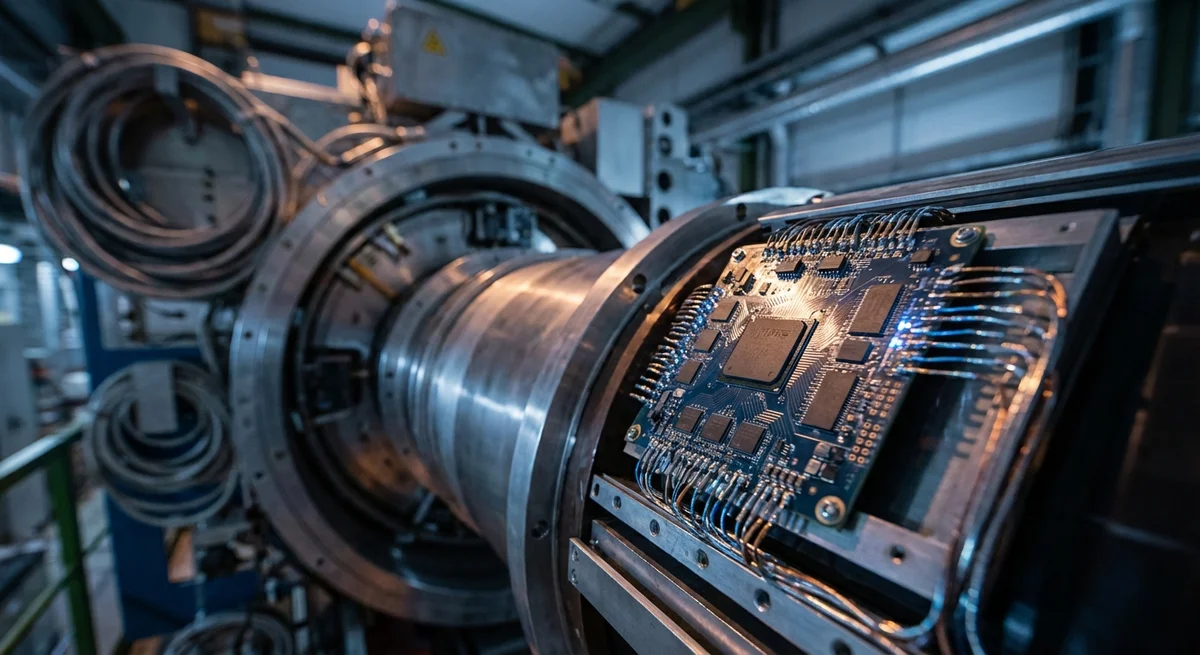
Every second inside the 27-kilometer ring of the Large Hadron Collider, 40 million particle collisions occur. The vast majority of these events will never be saved — engineers have spent decades building filters that decide what to record and what to discard forever. Now these decisions, made in fractions of a microsecond, are increasingly entrusted to neural networks. And it's not about speeding up routine work — it's about attempting to find what physicists don't even know how to look for.
Particle physics is experiencing what specialists delicately call a "quiet crisis." The Standard Model — the fundamental theory describing known particles and forces — works flawlessly. Every new collider experiment confirms its predictions with frightening accuracy. The problem is that this model is knowingly incomplete: it doesn't explain dark matter, dark energy, doesn't align with gravity. For decades, theorists have proposed extensions — supersymmetry, extra dimensions, new particles. Experimenters built giant facilities to test them. But despite petabytes of collected data, no breakthrough occurred. As journalist Matthew Hutson noted in an article for IEEE Spectrum, "there are key components of reality that we are completely missing."
This is where artificial intelligence enters the equation — but not in the way you might think. This isn't another story about "AI for everything," where technology simply accelerates data processing or automates routine work. Researchers aren't asking neural networks to verify existing hypotheses. They're asking AI to find anomalies — any deviations from the expected that might indicate "new physics" beyond the Standard Model. Essentially, this is unsupervised learning in its purest form: the algorithm doesn't know what exactly it's looking for, and that's the whole point. Instead of confirming theories born from human imagination, the machine can highlight patterns no one suspected existed.
The technical implementation of this idea is a separate engineering feat. The neural networks that analyze collider data don't run on powerful servers in data centers. They run directly on programmable logic arrays — FPGA chips connected to the detectors. These chips have limited memory and computing power, so complex models must literally be "compressed" to sizes that fit into hardware logic. Hutson quotes a telling comment from one theorist addressing an engineer: "Which of my algorithms will fit on your fucking FPGA?" Behind this phrase lies real tension between the ambitions of science and the limitations of hardware.
What's happening now at CERN fits into a centuries-old tradition. Every fundamentally new observation tool in the history of science didn't just answer existing questions — it allowed new ones to be asked. Galileo's telescope discovered Jupiter's moons, whose existence no one suspected. The first microscopes opened entire worlds of microorganisms invisible to the naked eye. By analogy, AI on collider detectors isn't just a faster filter. It's a fundamentally new way to look at data, free from the experimentalist's preconceptions and expectations. The machine doesn't know what it "should" find, and therefore can notice what a human would dismiss as noise.
The significance of this approach extends far beyond particle physics. If a neural network can detect unknown anomalies in a stream of millions of events per second, the same principle applies to astronomy, genomics, climatology — to any field where data volume has long exceeded human analytical capacity. We're used to thinking of AI as a tool that answers our questions. But it's far more interesting when AI helps formulate questions we wouldn't have thought to ask.
Of course, the approach has limitations. An anomaly in the data isn't yet a discovery. A neural network can point to a statistical deviation, but only a human can explain its physical meaning. Moreover, compressing models to the FPGA level inevitably leads to loss of precision — some subtle signals will still be missed. And yet the very formulation of the problem is impressive. If the crisis in modern physics is not so much a lack of data but a limitation of human imagination, then delegating some "observational" functions to a machine looks not like capitulation, but a rational strategy. Not AI will discover new physics — but it could well show people where to look.
Want to stop reading about AI and start using it?
AI News is a curated feed of AI/tech news. Hamidun Academy teaches you to use AI systematically in your work.