AI reshapes the thinking of top go players
MIT Technology Review has published a report from the headquarters of the Korea Baduk Association in Seoul, where professional go players are undergoing a profo
AI-processed from MIT Technology Review; edited by Hamidun News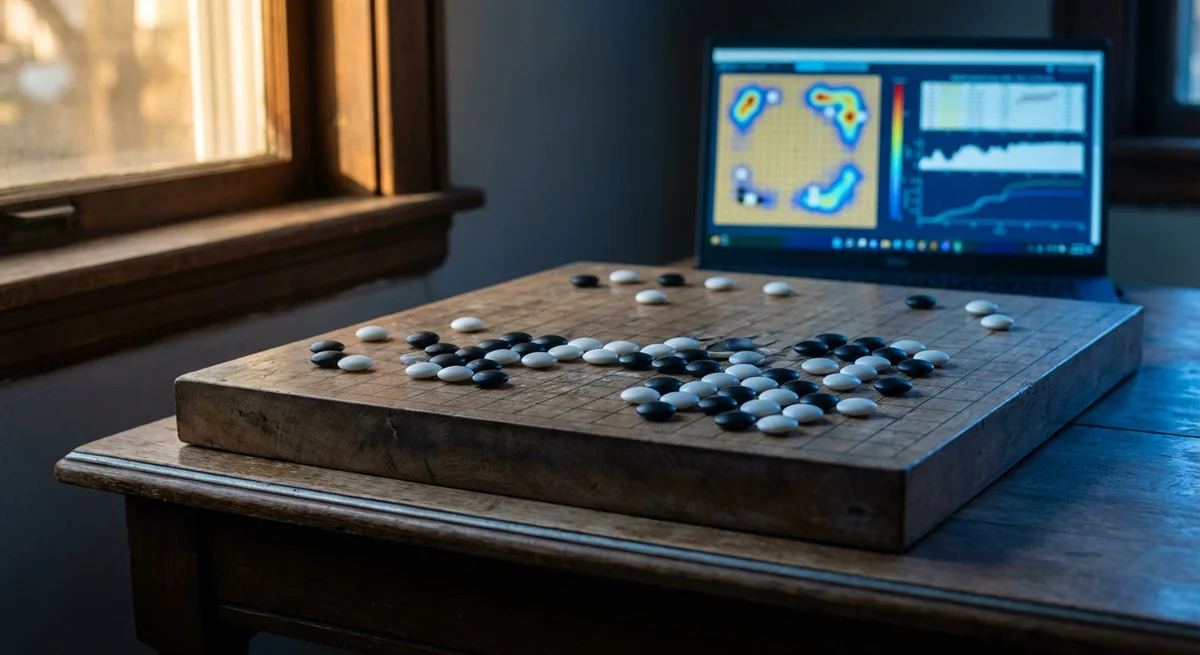
In the quiet alleys of Hongdae-dong, a calm residential area in eastern Seoul, stands an inconspicuous building with faded stone tiles and a plaque reading "Korean Baduk Association" — the governing body of professional Go in the country. The game is more than two and a half thousand years old, and in South Korea it holds an almost sacred status. But within the walls of this building, a quiet revolution is taking place that is changing not just the strategies and openings, but the very way of thinking of the strongest players on the planet.
When in March 2016 DeepMind's AlphaGo defeated the legendary Lee Sedol with a score of 4:1, the world of Go experienced an existential shock. A thousand-year-old game, which was considered the last bastion of human intellectual superiority over machines, had fallen. Many predicted the decline of professional Go: why train for decades if an algorithm running on a cluster of servers can defeat any grandmaster? Lee Sedol left professional Go in 2019, stating that AI is "an entity that cannot be defeated." It seemed the story was over. But ten years later it became clear that this was not an ending, but the beginning of an entirely new chapter.
What is happening today in the halls of the Korean Baduk Association and in training rooms throughout East Asia is far more interesting than a simple human-versus-machine rivalry. Professional players are not trying to defeat AI — they are learning from it. And in the process of this learning, the very nature of their strategic thinking is being transformed. Rooms that once only echoed with the soft tap of stones on a wooden board are now filled with the glow of laptop screens running neural network-based analytical engines. Young professionals spend hours analyzing games played by AI against itself, trying to grasp the logic of moves that ten years ago would have seemed absurd to any master.
The most striking aspect of this transformation is its depth. This is not simply about adopting specific opening variations or tactical techniques. Players describe a fundamental shift in how they perceive positions on the board.
Traditional Go education has taught for centuries to think in terms of territory, influence, and local conflicts. AI systems, from AlphaGo to modern open engines like KataGo, have demonstrated an entirely different approach: global position evaluation, willingness to sacrifice territory for non-obvious long-term advantages, moves that violate all classical principles but work with frightening effectiveness. A new generation of professionals is absorbing this logic and beginning to see the board differently — not as a battlefield with clear boundaries, but as a complex dynamic system where every stone influences the entire space simultaneously.
This process creates an unexpected paradox. On one hand, the level of play has objectively increased: modern professionals play stronger than any previous generation. Games have become more creative, unpredictable, saturated with unconventional solutions.
On the other hand, anxiety is growing in the Go community about the loss of distinctive style. If all the strongest players train on the same AI engines, won't this lead to a unification of style? Won't professionals become pale copies of the algorithms they study?
The older generation of masters, who grew up in an era when Go was an art of individual self-expression, are watching these changes with undisguised anxiety. For them, the loss of a player's unique style is not a technical problem, but a cultural tragedy.
However, reality turns out to be more complex than these fears. Observing the games of leading players in recent years, one can notice that the best among them do not blindly copy AI, but use machine ideas as a starting point for their own creative decisions. A new type of thinking emerges — hybrid, in which human intuition, emotional perception of position, and the ability to improvise are combined with the depth and unconventionality borrowed from algorithms. This is not a replacement of human thinking with machine thinking, but its expansion — something fundamentally new that existed neither before AlphaGo nor in the first years after.
The history of Go and AI is perhaps the clearest and most vivid example of what happens when artificial intelligence enters a field that human intellect has dominated for centuries. Not displacement, not destruction, but painful yet productive restructuring. Professional Go players have gone through all stages — from shock and denial to acceptance and integration.
And today, ten years after the match that changed everything, they are demonstrating a model that may prove prophetic for dozens of other professions. The question is not whether AI will replace humans. The question is how human thinking will change when an intelligence of a different kind appears nearby.
The halls of the Korean Baduk Association are already providing the answer — and it is far more interesting than a simple "yes" or "no."
Want to stop reading about AI and start using it?
AI News is a curated feed of AI/tech news. Hamidun Academy teaches you to use AI systematically in your work.