OpenAI and U.S. national lab aim to speed up bureaucracy with AI
OpenAI and the U.S. Department of Energy's Pacific Northwest National Laboratory (PNNL) have introduced DraftNEPABench, a benchmark for assessing how AI agents
AI-processed from OpenAI Blog; edited by Hamidun News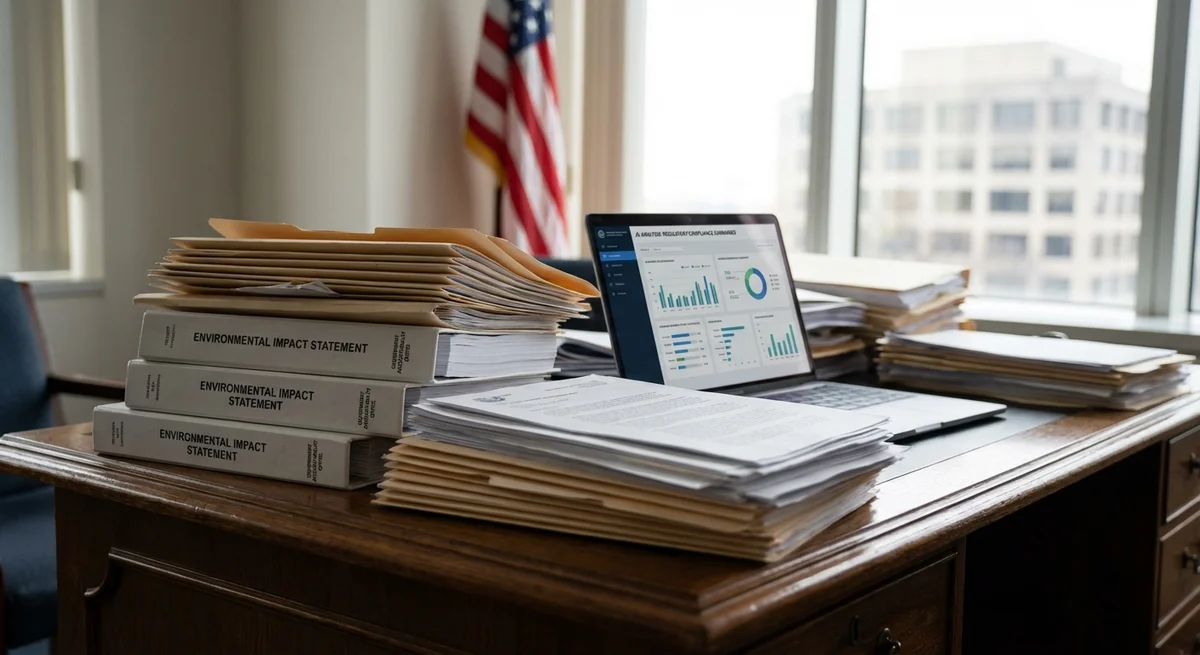
Federal environmental review in the United States is a process equally despised by developers, environmentalists, and bureaucrats alike. The NEPA law (National Environmental Policy Act), passed back in 1970, requires a comprehensive environmental impact assessment before any large-scale infrastructure project with federal involvement can begin. Preparing a single set of documentation takes an average of four to seven years. Now OpenAI and the Pacific Northwest National Laboratory (PNNL) — one of the leading research institutions of the Department of Energy — have decided to test whether artificial intelligence can cut through this Gordian knot.
The partners presented DraftNEPABench — a specialized benchmark that evaluates how effectively AI agents working with code and text handle drafting environmental impact statements according to NEPA standards. This is not an abstract academic experiment. The benchmark is built on real federal environmental review data and simulates specific tasks faced by analysts: collecting and systematizing environmental data, generating structured reports, cross-checking regulatory requirements. Initial testing results showed that AI agents can reduce the time for preliminary documentation preparation by approximately 15%.
Fifteen percent may seem like a modest figure — until you remember the scale of the problem. In the United States, the NEPA procedure has become one of the major obstacles to infrastructure modernization. Construction of new electrical transmission lines, wind and solar power plants, transportation corridors, and — particularly relevant for the technology industry — giant data centers runs into years of bureaucratic coordination. According to the Council on Environmental Quality at the White House, the average environmental impact statement (EIS) exceeds 600 pages. Some projects generate thousands of pages of supporting documentation. Even a 15-percent acceleration on such volumes means months of saved time and millions of dollars saved.
OpenAI's choice of partner is not accidental. PNNL is a laboratory with more than 60 years of history, specializing in energy, environment, and national security. It possesses unique expertise in environmental regulation and access to federal data repositories that a private company simply could not obtain independently.
For OpenAI, this project is a strategic move on several dimensions. First, the company demonstrates that its technologies are applicable far beyond chatbots and image generation. Second, it builds relationships with the federal government at a time when the administration actively seeks ways to accelerate infrastructure construction.
Third — and perhaps most intriguingly — OpenAI indirectly solves its own problem: the company desperately needs new data centers and energy capacity, and their construction is slowed by the very bureaucracy it now helps optimize.
The benchmark format itself deserves special attention. DraftNEPABench evaluates not just language models, but specifically AI agents — autonomous systems capable of executing multi-step tasks: finding relevant data, analyzing regulatory frameworks, generating structured text, and verifying compliance with requirements. This reflects the general industry trend in 2026: the transition from conversational models to agent models that take on real work processes. The benchmark effectively establishes a standard for evaluating AI in the field of government document processing — an area that has previously had virtually no tools for objective measurement.
Critics, however, have already raised legitimate questions. Environmental organizations fear that automating environmental review could lead to a decline in quality — after all, NEPA exists not to create red tape but to protect the environment and the rights of local communities. Accelerating the process should not mean simplifying it. There are also legal nuances: who is responsible for errors in documentation prepared with AI involvement? How can transparency and public oversight be ensured if a significant portion of analytical work is performed by an algorithm?
Nevertheless, the direction is set, and it appears irreversible. If DraftNEPABench confirms its effectiveness on a broader range of tasks, similar tools will inevitably spread beyond environmental review — to building permits, licensing, tax audits, and dozens of other bureaucratic procedures. For Russia, where approving major projects sometimes takes no less time than in the United States, this case is of particular interest. Not as a ready-made solution — the regulatory frameworks are too different — but as proof of principal possibility: artificial intelligence is capable of working not only on creative tasks, but also with the most routine, most regulated parts of the state apparatus. And it is precisely there that its impact could prove most tangible.
Want to stop reading about AI and start using it?
AI News is a curated feed of AI/tech news. Hamidun Academy teaches you to use AI systematically in your work.