ElevenLabs and Google Cloud Bet on NVIDIA Blackwell GPUs
ElevenLabs has signed a multiyear agreement with Google Cloud to expand its infrastructure partnership. The company will gain access to NVIDIA Blackwell-class G
AI-processed from TNW; edited by Hamidun News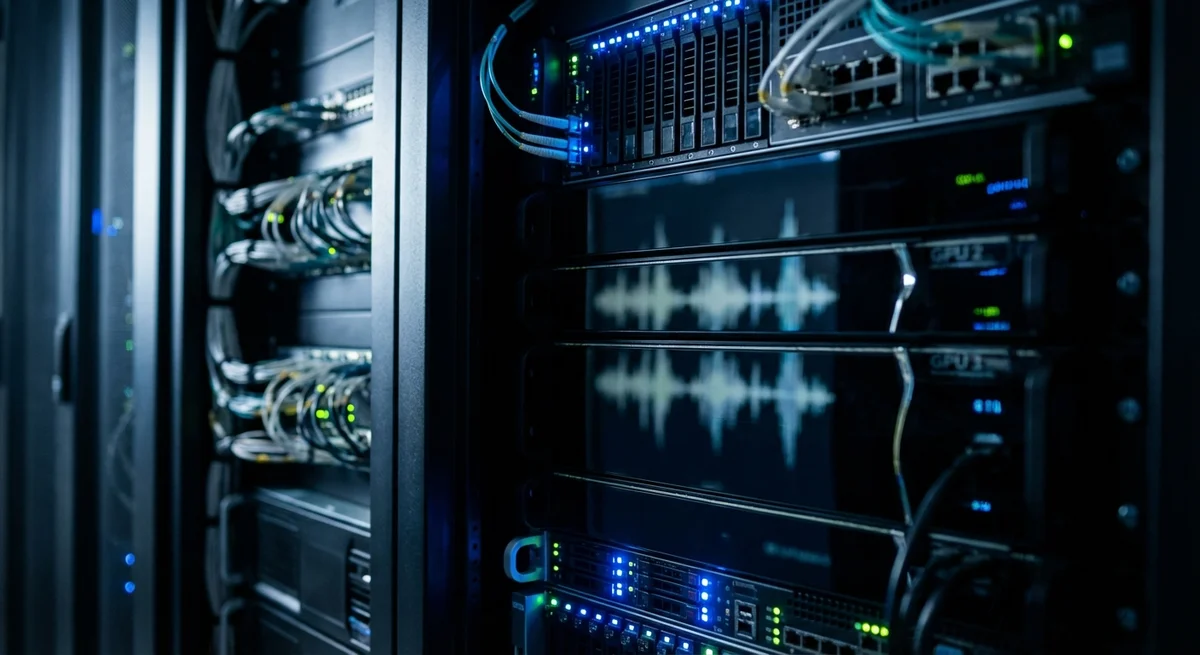
The race for voice artificial intelligence is entering a new phase, and key players are reshaping alliances. On February 26, London-based company ElevenLabs, one of the most prominent startups in voice AI, announced an expansion of its strategic partnership with Google Cloud. Under the updated multi-year agreement, ElevenLabs gains access to expanded Google cloud infrastructure and, most importantly, to the latest NVIDIA Blackwell-class graphics accelerators. This is not just another corporate deal — it's a signal of where the voice technology industry is heading.
To understand the significance of this partnership, it's worth looking back at ElevenLabs' trajectory. The company was founded in 2022 by former Google and Palantir employees and in a matter of years became one of the market leaders in voice synthesis. Its technology allows it to generate realistic speech in dozens of languages, clone voices, and create conversational AI agents capable of conducting natural dialogue. Among its clients are media companies, publishers, game developers, and major corporations. But it was precisely scaling for the enterprise segment that became the bottleneck: real-time voice processing requires enormous computational resources, and standard cloud capacities are no longer sufficient.
This is where NVIDIA Blackwell GPUs enter the scene — a next-generation architecture that replaces Hopper. Blackwell chips, including the flagship B200, promise exponential performance gains in inference tasks — precisely what's needed for real-time speech generation. While model training can be done once and take weeks, inference is a continuous process that happens every time a user requests text-to-speech or talks to an AI agent. The faster and more efficient the inference, the lower the latency, the higher the quality, and the lower the cost per request. For a company that processes millions of voice requests daily, this is critical.
The choice of Google Cloud as the infrastructure partner is no accident either. Among the three giants of the cloud market — AWS, Azure, and Google Cloud — there is fierce competition for AI startups, and each such contract becomes a reputation asset. Over the past year and a half, Google Cloud has aggressively expanded its AI portfolio: proprietary TPU chips, Gemini integration, specialized AI instances. Attracting ElevenLabs strengthens Google's position in the generative AI segment and demonstrates that the platform is capable of supporting demanding voice synthesis workloads at a level that satisfies one of the market leaders.
For ElevenLabs itself, this partnership opens the door to corporate customers on an entirely different scale. Large enterprises considering the implementation of voice AI agents in customer service, internal communications, or product interfaces impose strict requirements on reliability, response speed, and the system's ability to handle peak loads. Access to Google Cloud infrastructure with Blackwell accelerators allows ElevenLabs to guarantee a level of service that was previously only available to giants like Amazon or Microsoft with their own voice platforms.
It's worth paying attention to the broader context as well. The voice AI market is experiencing explosive growth: according to various estimates, by 2027 its volume will exceed 30 billion dollars. Competition is intensifying — OpenAI is developing voice capabilities for ChatGPT, Amazon is improving Alexa, and dozens of startups are offering specialized solutions for dubbing, podcasts, and contact centers. In these conditions, access to cutting-edge hardware becomes not just a competitive advantage, but a condition for survival. Those companies that first master Blackwell's inference capabilities will be able to offer faster, higher-quality, and cheaper services — and capture the lion's share of the growing market.
There is another aspect that cannot be ignored. The deepening dependence of AI startups on cloud giants creates an asymmetry of power. Google Cloud gains not only a customer, but also a deep understanding of how advanced voice models work, what loads they generate, and where technology is moving. For ElevenLabs, this means the need to balance the benefits of partnership with the risks of being locked into a single provider. However, the wording 'expanding the partnership' hints that the company has worked with Google Cloud before, which means this choice was conscious and proven over time.
Ultimately, the announcement from ElevenLabs and Google Cloud is less about a single deal and more an indicator of the maturity of the voice AI market. The technology has moved from the experimental stage to industrial scaling, and now the decisive factor is not only the quality of the model, but the ability to deploy it on infrastructure that can withstand real-world business loads. Whoever controls the computing controls the future of voice intelligence.
Want to stop reading about AI and start using it?
AI News is a curated feed of AI/tech news. Hamidun Academy teaches you to use AI systematically in your work.