Agentic AI is rewriting the rules of biomedical research
Agentic AI is moving beyond simple language models and beginning to influence how scientific work itself is organized. In biomedicine, where research has long b
AI-processed from Jiqizhixin (机器之心); edited by Hamidun News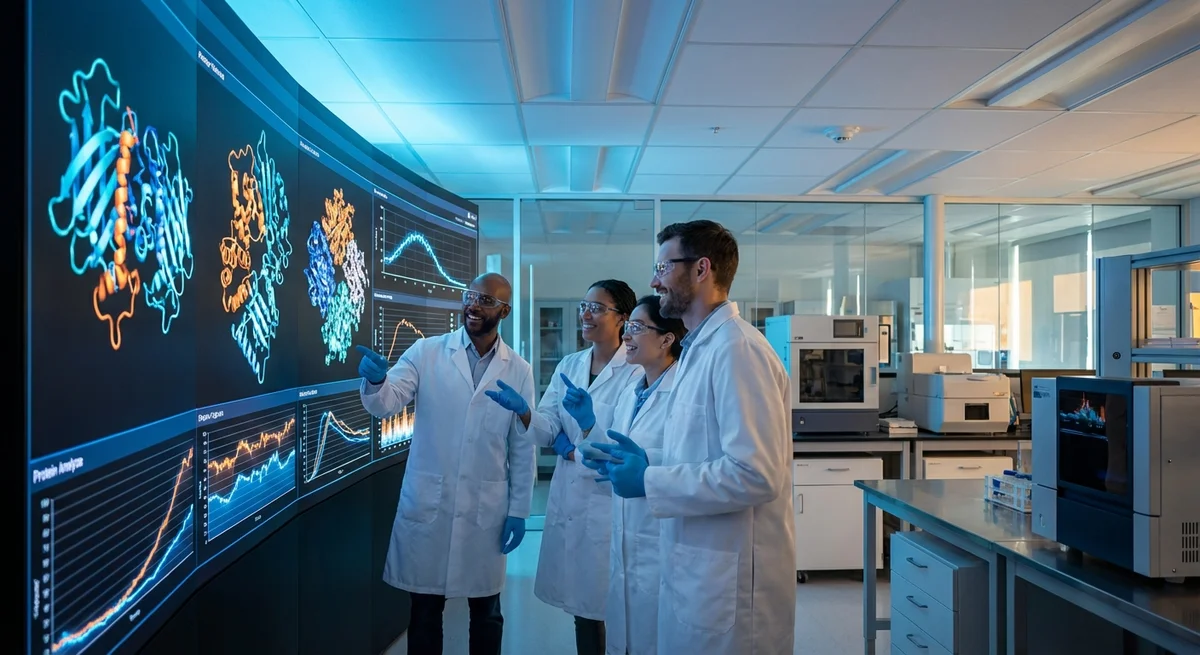
Agentic AI Rewrites the Rules of Biomedical Research
Just a few years ago, artificial intelligence in science meant one thing: a powerful tool that helps researchers handle routine work — processing data, searching literature, drafting papers. But today something fundamentally different is happening. Agentic AI — systems capable of independently setting subtasks, making intermediate decisions, and coordinating the actions of other agents — is beginning to be embedded in the very architecture of scientific work. In biomedicine, where research has long been a matter of large teams, this raises questions that go far beyond technology.
Biomedical science has historically been organized according to the principle of "team science": large laboratories, consortiums, years-long collaborations between clinicians, bioinformaticians, chemists, and epidemiologists. Each participant has a defined role, and the entire process — from hypothesis formulation to publication — is built through direct human interaction. It is into this established ecosystem that autonomous AI agents are now entering. And not as supporting assistants, but as full-fledged participants in the work process, entrusted with planning, analysis, and decision-making about the course of experiments.
The difference between a language model and agentic AI is not merely technical. A language model answers a query. An agent acts in an environment: it formulates a plan, invokes tools, receives feedback from results, and adjusts the next step. In the context of biomedical research, this means an agent can independently request data from a database, conduct preliminary statistical analysis, suggest protocol adjustments for an experiment, and pass conclusions to the next agent in the chain — or to a live scientist. Such multi-agent pipelines are already being tested in several research centers, and results show that the speed of completion for certain work stages does indeed increase.
But this is where truly complex questions begin. When a hypothesis is formulated or refined by an agent rather than a human — who is responsible for its validity? When a system automatically prioritizes experiments based on its own optimization logic — whose scientific values does it reproduce? Traditional mechanisms of accountability in science are designed for people: each line in a paper has an author, each decision bears a researcher's signature. Agentic AI blurs these boundaries in ways that journal editorial policies and ethics committees are not yet ready for.
The question of unequal access is equally acute. Deploying complex agentic systems requires infrastructure, expertise, and funding. Large laboratories at leading universities and pharmaceutical corporations gain tools that dramatically accelerate their work — while small teams, especially in resource-limited countries, fall behind. If agentic AI becomes a standard component of biomedical research, the gap between "well-equipped" and "everyone else" risks becoming structural and practically insurmountable.
At the same time, it would be inaccurate to paint an exclusively alarming picture. Agentic systems already demonstrate the ability to maintain focus on massive bodies of literature that no single human could physically manage, find non-obvious connections between data from different fields, and reduce researchers' burden in the least creative parts of the work. In oncology and genomics, where the volume of data has long exceeded human capacity for manual analysis, this gains practical significance. The question is not whether to use these tools — the question is how to integrate them into scientific culture without destroying what makes science reliable.
We will have to develop an answer to this question quickly. Agentic AI is not waiting in line for the academic community to develop a consensus. It is already inside laboratories — and is reformatting not only research tools but also the very logic of how scientific knowledge is organized. "Team science" took shape over decades: with norms of co-authorship, role distribution, and established ways of result verification. Now this team includes a participant who doesn't get tired, has no career ambitions, and bears no personal responsibility. This doesn't make it a bad participant — but it requires fundamentally new rules of the game.
Want to stop reading about AI and start using it?
AI News is a curated feed of AI/tech news. Hamidun Academy teaches you to use AI systematically in your work.