White House demands AI companies cover rising electricity rates
The White House demanded that AI companies cover electricity rate increases caused by the construction of giant data centers. Most hyperscalers — including the
AI-processed from TechCrunch; edited by Hamidun News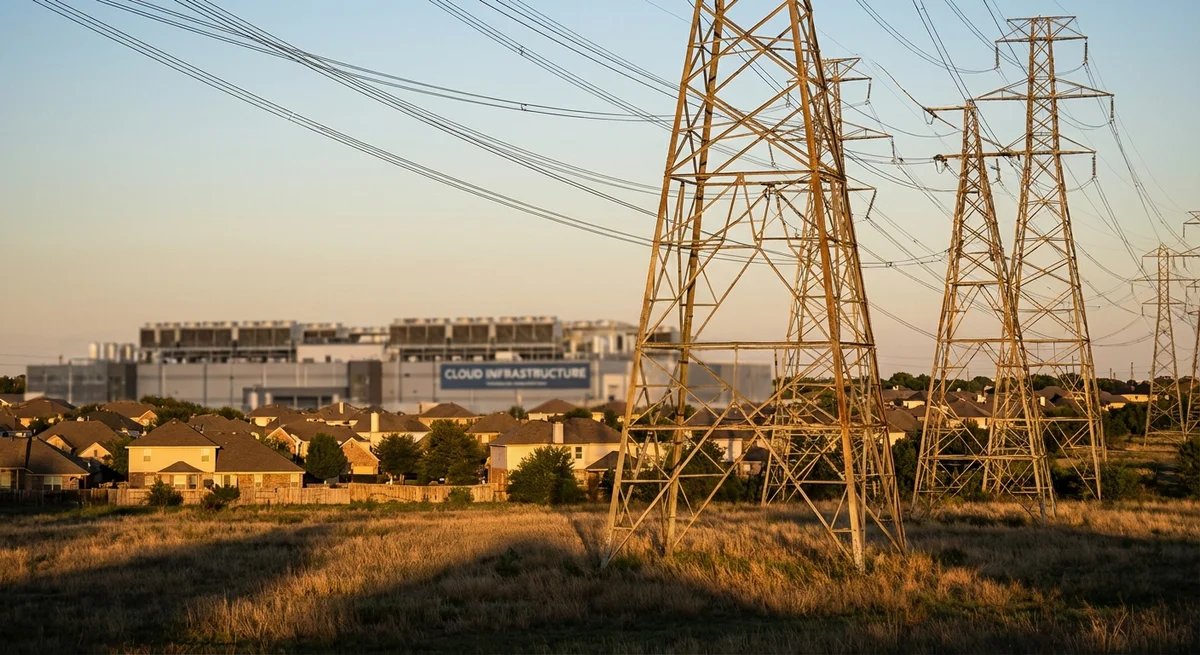
Data centers are consuming electricity at such a pace that it's starting to hit ordinary people's wallets. The White House administration for the first time openly demanded that companies working in the field of artificial intelligence take on financial responsibility for the rise in electricity tariffs provoked by their infrastructure. Most major players hastily declared that they are already ready to do this. But behind this demonstrative compliance lies a far more complex story about how the AI boom is changing the energy landscape of the world's largest economy.
To understand the scale of the problem, it is enough to look at the figures. By various estimates, by 2026, data centers in the United States consume from 4 to 6 percent of all electricity generated in the country—and this share is growing rapidly. Each new GPU cluster for training large language models requires capacity comparable to the power supply of a small city. In a number of states—especially in Virginia, Texas, and Ohio, where the largest server farms are concentrated—local power grids are experiencing unprecedented strain. The result is predictable: utility companies raise tariffs, and electricity bills rise for everyone—from small business owners to retirees.
It is this social tension that pushed the White House to act. The administration formulated an expectation—for now just an expectation, not a legal requirement—that hyperscalers should compensate for the rise in tariffs caused by their activities. In essence, this is a principle of "polluter pays," adapted to the energy reality of the AI era. If building your data center leads to neighboring households paying twenty percent more for electricity, you should cover that difference.
The industry's reaction turned out to be surprisingly unanimous. According to TechCrunch, most major cloud and AI companies have already publicly committed to compensating for the increase in energy costs. For giants with trillion-dollar valuations, this is less a financial burden than a reputational move. When public opinion begins to link your product with rising electricity bills, it's easier to pay than to explain. Especially since the compensation amounts are a drop in the bucket compared to the investments these companies are pouring into building new computing power.
However, skeptics rightly point to a number of serious gaps in this scheme. First, voluntary commitments are not law. They have no enforcement mechanism, no clear metrics, no independent audit.
How exactly will the "contribution" of a specific data center to the rise in tariffs be calculated? Who will verify this? What will happen if a company decides to abandon its promises in two years, when press attention shifts to another topic?
For now, there are no answers to these questions. Second, the problem is systemic in nature. Even if all existing players faithfully pay, new companies are constantly entering the market, new facilities are being built, and aggregate energy consumption continues to grow.
Compensating for tariffs does not solve the fundamental problem of a shortage of generating capacity.
For Russia, this situation is also instructive, though in a different context. Domestic AI infrastructure is still not comparable to the American scale, but the trend toward building large computing centers is gaining momentum. Yandex, Sber, and other players are expanding server capacity, and the question of their impact on the power system will sooner or later arise for us as well. American experience—both positive and negative—will become an important reference point for Russian regulators.
There is also a deeper context. The White House initiative is part of a broader reconsideration of relations between technology companies and society. For many years, Silicon Valley has existed in a paradigm of "move fast and break things," shifting the external costs of its growth onto others. Pollution of the information space, destruction of competition, tax evasion—the list is long. Now another item has been added to it: energy pressure on infrastructure. And for the first time in a long time, the political class is trying to establish a rule according to which technology companies should pay for the consequences of their activities in the real world.
However, for now this is rather a symbolic gesture than a systemic solution. The real test will come when voluntary promises have to be turned into concrete payments, and political rhetoric into legislative norms. The energy appetite of artificial intelligence will only grow, and corporate good intentions alone are clearly insufficient to satisfy it.
Want to stop reading about AI and start using it?
AI News is a curated feed of AI/tech news. Hamidun Academy teaches you to use AI systematically in your work.