Gemini can now hail a ride and order food on your smartphone
Google has taken a major step toward turning Gemini into a полноценный mobile agent. Starting with the Samsung Galaxy S26, the assistant can independently carry
AI-processed from Wired; edited by Hamidun News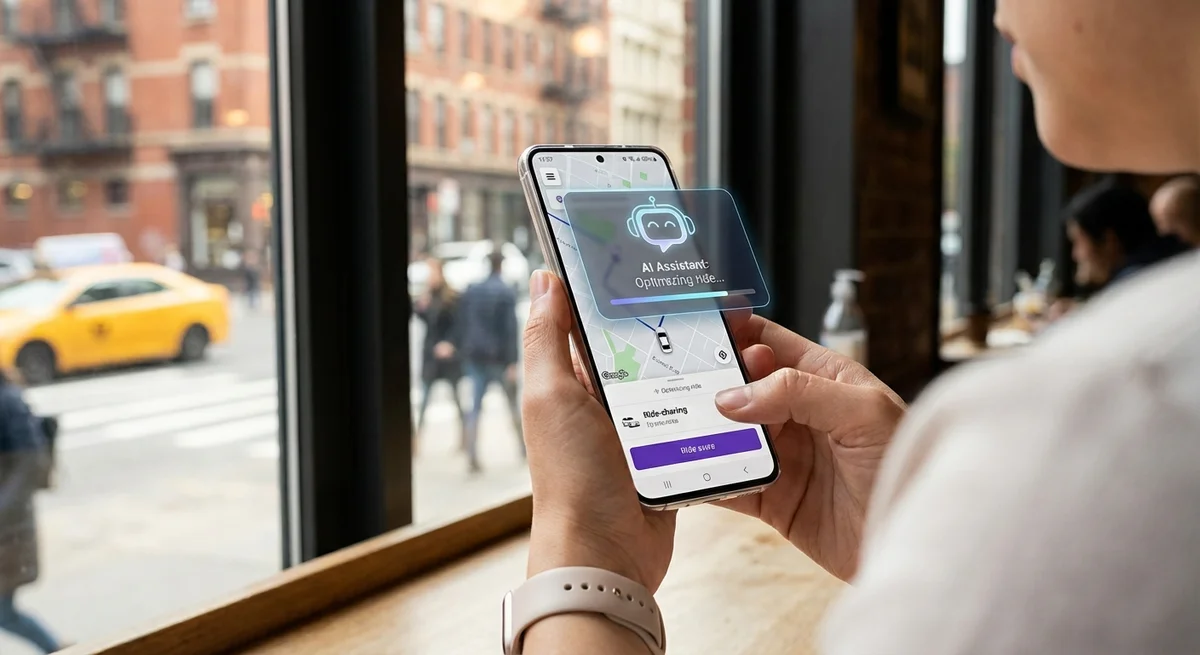
Gemini Now Will Call a Taxi and Order Food on Your Smartphone
For years, voice assistants have promised us a future where a single spoken command would have your phone do everything. In practice, this future amounted to setting a timer and checking the weather. Google appears to have finally decided to close the gap between promises and reality. The company announced that Gemini — its flagship AI assistant — is now capable of independently performing actions in third-party mobile applications. Call an Uber, order food through DoorDash, make a purchase — all without a single touch from the user. The first device to support the new feature is the Samsung Galaxy S26.
To understand the scale of this announcement, we need to recall the context. Over the past year and a half, the industry has been obsessed with the concept of "AI agents" — systems that not only generate text or answer questions, but take actions in the real world on behalf of the user. OpenAI is experimenting with Operator, Anthropic is testing Computer Use for Claude, Apple is expanding Siri's capabilities through Apple Intelligence. But Google found itself in a unique position: the company controls Android — an operating system installed on billions of devices — and can integrate agent capabilities at the platform level, rather than on top of it.
Technically, Gemini uses a combination of several approaches. The assistant "sees" application interfaces through special API bridges and Android's accessibility system, understands screen structure, and can navigate through them the way a human would — clicking buttons, filling in fields, confirming orders. In a live demonstration shown to Wired journalists, the process looked impressively smooth: a user would say something like "call me an Uber to the airport," and Gemini would open the app, select a route, choose a ride type, and bring the order to the confirmation stage. The final confirmation — clicking the payment button — remains with the human for now, which looks like a reasonable security measure at this early stage.
The choice of Samsung Galaxy S26 as the launch platform is no accident. Google and Samsung have been deepening their partnership for several years: Galaxy AI, joint developments in generative capabilities, privileged access to the latest Android features. For Samsung, this is a competitive advantage over other Android manufacturers. For Google, it's an opportunity to test agent functionality with a premium audience that is very likely using exactly the applications that Gemini is integrated with. It's likely that over the course of several months, the feature will spread to other flagships, and then to a wider range of devices.
But the main question is not technical, but ecosystem-related. For an agent to be truly useful, it needs access to dozens and hundreds of applications, and the developers of those applications need to be ready for such interaction. Uber and DoorDash are showcase partners, demonstration cases.
Real value will come when Gemini can work with banking apps, messengers, booking services, and marketplaces. Here there is a delicate balance of interests: app developers have spent years building their interfaces to maximize user time, show ads, and encourage impulse purchases. An AI agent that skips through all these layers in seconds threatens their business models.
Google will either have to negotiate with each major service, or create such an attractive platform for developers that they themselves want to integrate.
And there's the question of trust. Giving an AI the ability to spend your money is a fundamentally different level of interaction compared to asking it to write a letter or find information. A mistake in text generation costs a few seconds. A mistake in ordering a taxi or paying for dinner costs real money. Google, based on the demonstration, understands this — hence the requirement for manual transaction confirmation. But as users become more comfortable with agents, pressure toward full automation will mount.
This announcement marks an important shift in the mobile technology industry. The smartphone is ceasing to be a device that you control, and is starting to become a device that manages tasks for you. Google has taken the first public step in this direction in the mass market. Now all eyes are on Apple and its WWDC: will Siri be able to respond with something comparable, or will the gap between the two ecosystems become even more noticeable? One thing is clear already — the era of AI assistants that only talk is coming to an end. The era of assistants that act is beginning.
Want to stop reading about AI and start using it?
AI News is a curated feed of AI/tech news. Hamidun Academy teaches you to use AI systematically in your work.