How QA Engineers Are Reshaping Their Work with Cursor, n8n, and LLMs
The QA engineer’s role is evolving: instead of testing completed features, specialists are going deeper into architecture and data flow analysis. One engineer r
AI-processed from Habr AI; edited by Hamidun News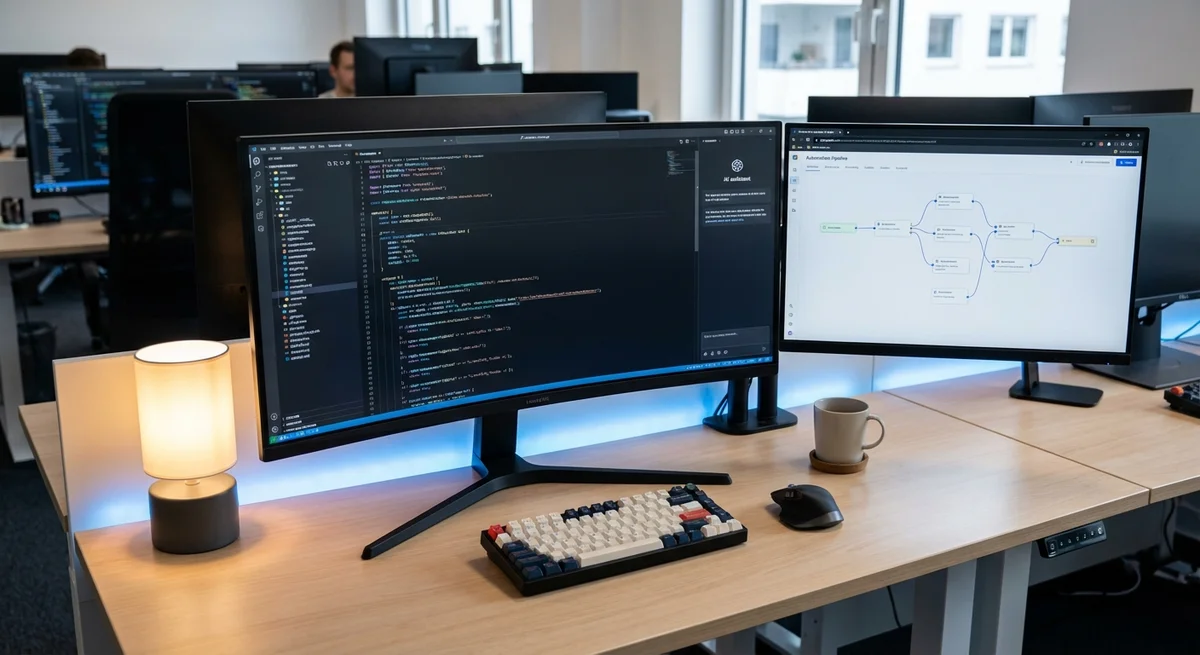
A tester who is responsible for forty microservices and doesn't drown in chaos sounds like fantasy. Yet this is precisely what the new wave of AI tools is pushing the industry toward—tools that are transforming from experimental toys into working instruments for quality engineers.
A story published on Habr is notable not so much for specific solutions as for the scale of the shift happening in the QA profession right now. The author is an engineer who, after a team restructuring, found himself responsible for about forty services. The classical approach, where a tester studies documentation, writes test cases, and methodically checks functionality, simply doesn't work here. Documentation is incomplete or outdated, regulations can't keep pace with changes, and the volume of the codebase makes manual exploration of each service physically impossible. A different approach was needed, and AI tools turned out to be not a fashionable addition but a forced necessity.
The first element of the new stack is Cursor—an AI code editor built on top of VS Code and integrated with language models. For a QA engineer who needs to quickly understand an unfamiliar service, this proved critically useful. Cursor allows you to ask questions directly to the codebase: how a specific endpoint is structured, what data it accepts, where validation happens. Instead of spending hours reading someone else's code, the engineer engages in dialogue with it. This isn't a replacement for deep architectural understanding—rather, it's an accelerator that reduces initial onboarding time from days to hours.
The second component is n8n, an open-source visual workflow automation platform. In the QA context, it solves a problem that traditionally consumes enormous amounts of time: orchestrating routine operations. Service monitoring, log collection, alerts for anomalies, test data preparation—all of this can be assembled into visual pipelines without deep programming expertise. For a tester already overwhelmed with analytical work, the ability to automate infrastructure routine through a drag-and-drop interface isn't a luxury but a lifesaver.
The third layer is direct use of language models for analysis. When you need to understand business logic, compare the behavior of several services, or generate a set of boundary test cases for a complex API, LLMs work as a second brain. The author describes an approach where models are used not to generate a final artifact but as a thinking tool—a way to quickly test a hypothesis, get an alternative interpretation of requirements, or find non-obvious dependencies between system components.
It's important to understand the context in which such stories emerge. The software development industry is going through a period when the number of services and system complexity are growing faster than teams. Microservices architecture, which promised simplification through decomposition, has in practice created a new class of problems—problems of interaction, data flows, and implicit dependencies. QA engineers found themselves at the forefront of this complexity because they must understand the system as a whole, not just their piece of code.
The transformation of the tester's role that we're observing is happening in two directions simultaneously. On one hand, QA engineers are becoming closer to systems analysts—they need to understand architecture, data flows, contracts between services. On the other hand, AI tools allow one person to cover the volume of work that previously required an entire team. This creates a paradoxical situation: the profession is simultaneously becoming more complex and more accessible. The barrier to entry for routine tasks is lowering, but demands for analytical thinking and systems understanding are growing.
For companies, this means rethinking approaches to building QA teams. If one engineer with the right set of AI tools can effectively work with dozens of services, then investments in training and tooling may prove more cost-effective than expanding headcount. But there's a trap here: AI assistants amplify a competent specialist rather than replacing them. Without deep understanding of testing principles, architecture, and business logic, even the most advanced tools will remain just pretty interfaces.
The experience described in this case is not a revolution but an evolution. But it's a rapid evolution. In a couple of years, a QA engineer without AI tools in their arsenal will look as archaic as a developer who refuses to use version control. The question is no longer whether to use language models and automation in testing, but how to integrate them into your workflow without losing critical thinking—the primary asset of any good tester.
Want to stop reading about AI and start using it?
AI News is a curated feed of AI/tech news. Hamidun Academy teaches you to use AI systematically in your work.