Ailias creates holograms of historical figures for one-on-one conversations
Ailias introduced a holographic avatar technology for historical figures that enables full conversations with them. The platform combines large language models
AI-processed from Wired; edited by Hamidun News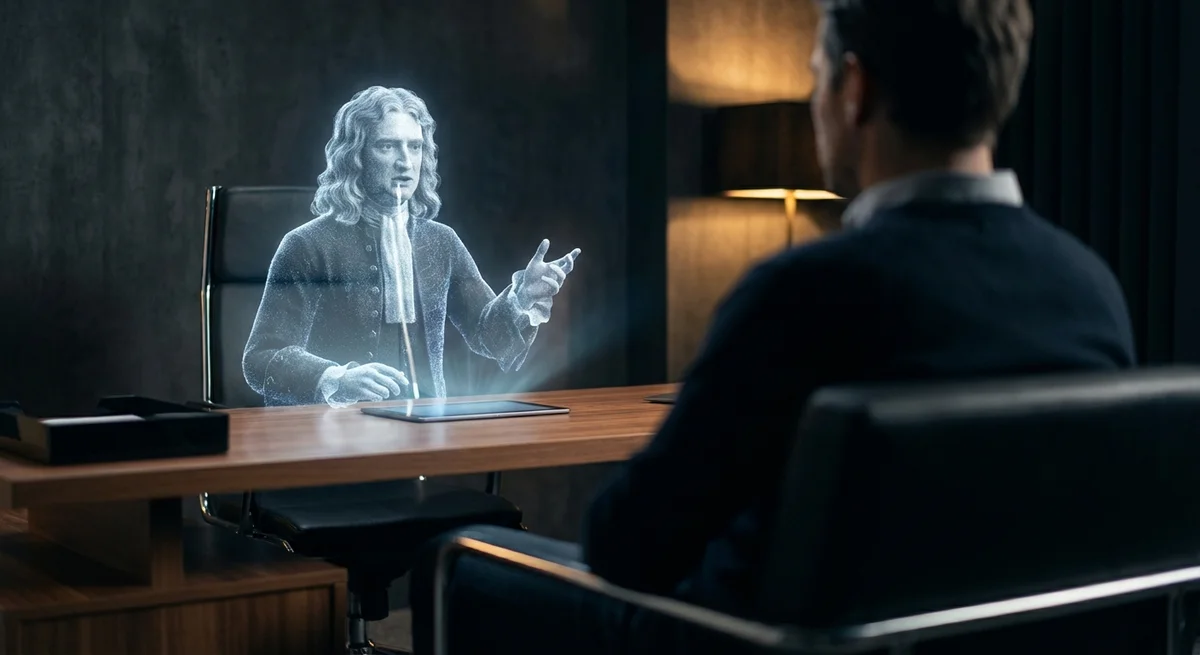
Imagine sitting across from Isaac Newton and asking him what he thinks about quantum mechanics. Not metaphorically, not in a text chat format—but looking at a three-dimensional holographic figure that gestures, turns its head, and responds to you in a voice reconstructed from historical descriptions. This is exactly the experience promised by startup Ailias, which has unveiled its platform of holographic avatars of historical figures.
Ailias operates at the intersection of several technologies, each of which has made significant leaps in recent years. At its core are large language models, finely tuned on corpora of texts by specific historical figures: their scientific works, letters, notebooks, documented dialogues, and biographical materials. Layered on top of the language model is a voice generation system and, most impressively, a holographic projection module that creates a three-dimensional image of your interlocutor in real time.
The company claims that their avatars are capable not merely of reproducing well-known quotations, but of generating original responses, stylistically and intellectually consistent with their prototype's persona. Want to discuss Newton's views on alchemy? Or ask Leonardo da Vinci how he would design a modern drone?
Ailias promises that the avatar will respond not with a boilerplate Wikipedia phrase, but with a developed thought, constructed on a deep understanding of the historical figure's worldview.
The context in which this product emerges is important for understanding its potential. The market for so-called "AI companions" is growing rapidly—from Character.AI to custom GPT characters, millions of people are already accustomed to conversing with language models playing certain roles. Yet until now, this interaction has remained textual or, at best, voice-based. Ailias takes the next logical step by adding physical presence. Holographic technologies, which long remained expensive niche exotica, have become noticeably more accessible over the past two years thanks to progress in lightweight projection systems and spatial displays. Ailias appears to have managed to combine these two trends into a single consumer product.
The primary use cases the company envisions lie in the realm of education and culture. Museums, universities, scientific centers—anywhere that a living dialogue with a historical figure could transform passive information consumption into active intellectual engagement. For a schoolboy dozing over a chapter on the laws of mechanics, a conversation with a holographic Newton represents a fundamentally different level of engagement. Ailias also targets individual users: entrepreneurs who want to "consult" with historical strategists, or writers seeking inspiration in conversation with great literary figures of the past.
But this is precisely where the territory of serious questions begins. The digital resurrection of historical figures is an ethical minefield that the industry is still navigating without a map. Who bears responsibility for the words that the AI puts into Newton's mouth?
What if a holographic Einstein expresses a political position that the real Einstein never held? The problem is compounded by the fact that the more convincing the technology—and a hologram is orders of magnitude more convincing than text—the higher the risk that users will begin to perceive the generated responses as genuine views of historical figures. For an educational context, this is particularly dangerous: the line between "what Newton might have said" and "what Newton said" blurs with each improvement in generation quality.
There is also a legal dimension. While Ailias operates with figures who died centuries ago, questions of copyright and the right to one's likeness remain in a gray zone. But the technology is obviously scalable to more recent periods, and sooner or later someone will want to create a holographic avatar of a person whose heirs may have a very different view of the matter. Precedents with deepfakes of celebrities have already created a tense legal backdrop, and holographic avatars will only sharpen it.
Nevertheless, it is difficult to deny that Ailias has stumbled upon something genuinely captivating. Humanity has dreamed for millennia of the possibility to speak with the great minds of the past—from Victorian spiritualist séances to science fiction holodeck fantasies. For the first time, this dream is taking on a technologically plausible form.
The question is not whether holographic AI interlocutors will become a mass phenomenon—they likely will. The question is whether we will manage to build a culture of honest use around this technology, where virtual Newton serves as a tool for knowledge, not a source of historical myths. The answer to this question will determine whether Ailias goes down in history as a revolution in education or as yet another example of technology outpacing ethical reflection.
Want to stop reading about AI and start using it?
AI News is a curated feed of AI/tech news. Hamidun Academy teaches you to use AI systematically in your work.