Isomorphic Labs develops a next-generation AI engine for drug design
Isomorphic Labs, a Google DeepMind subsidiary, unveiled a new specialized AI engine for drug development. The technology is described as an evolution of AlphaFo
AI-processed from Jiqizhixin (机器之心); edited by Hamidun News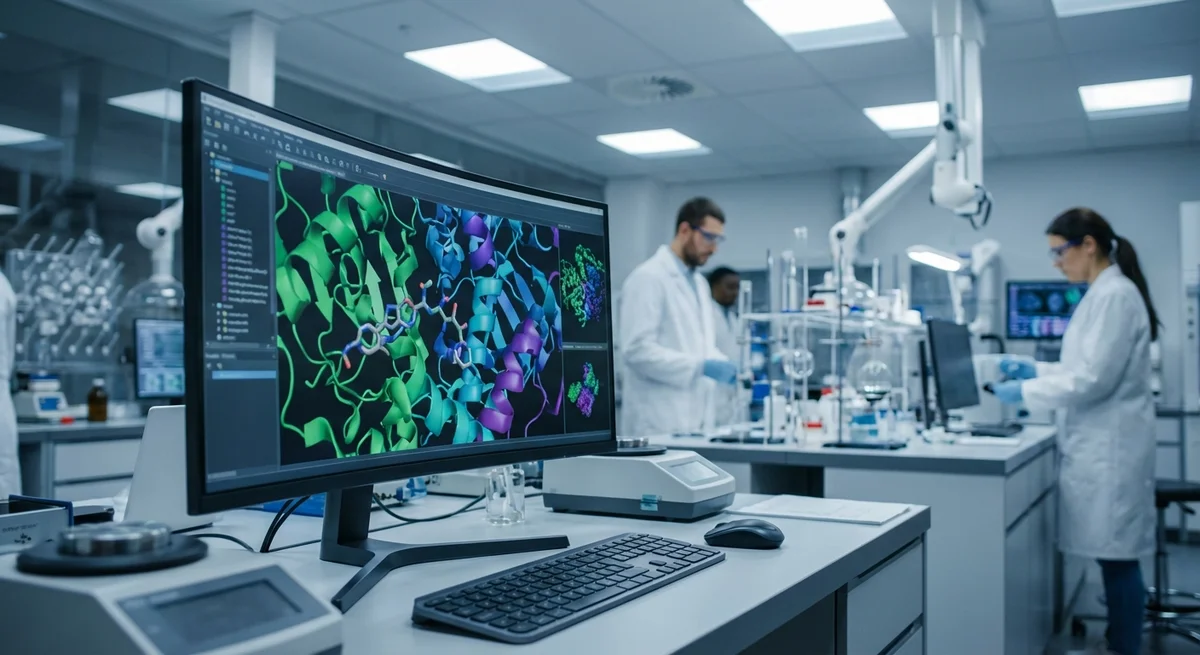
Isomorphic Labs, a subsidiary of Google DeepMind, has announced the creation of a specialized AI engine for drug development—a system that experts are already comparing to what AlphaFold became for structural biology. The new tool is positioned as a proprietary development at the AlphaFold 4 level, but geared not toward predicting protein structures but toward searching for and optimizing therapeutic molecules. If the company's promises pan out in practice, the pharmaceutical industry stands on the brink of one of the most significant technological shifts in recent decades.
To understand the scale of the event, we need to recall where exactly in the drug development process the main risk lies. The path from target discovery to drug approval typically takes 10-15 years and costs billions of dollars. The most unpredictable stage is early development: the moment when scientists try to find a molecule that will bind precisely to the target protein, do no harm to the rest of the organism, and maintain activity under real biological conditions. This is where most hopes are dashed and enormous resources are spent. Isomorphic Labs' new engine is aimed directly at this bottleneck.
At the heart of the technology is the simulation of interactions between proteins and ligands—small molecules capable of binding to a protein and altering its behavior. Ligands form the basis of most modern drugs. The problem is that predicting how a specific molecule will behave when bound to a specific protein is incredibly complex: it involves dynamic three-dimensional structures with thousands of possible configurations. Traditional methods—physical simulations and laboratory screening—require months of work even for relatively small compound libraries. According to available information, Isomorphic Labs' new system is capable of performing this work with unprecedented accuracy and several orders of magnitude faster.
The connection to AlphaFold's legacy is neither coincidental nor metaphorical. AlphaFold 2, introduced in 2020, solved a problem that biology had struggled with for half a century: predicting the three-dimensional structure of a protein from its amino acid sequence. This opened the way to understanding millions of proteins whose structure had previously remained unknown. Isomorphic Labs' new engine takes the next logical step: knowing the structure of the target protein, the system learns not merely to describe it, but to actively seek molecules capable of interacting with it in the desired manner. In essence, this is a transition from mapping the molecular world to its deliberate engineering.
For the pharmaceutical industry, the consequences could be quite tangible. Major players—Eli Lilly, Novartis, Roche—have already invested significant resources in partnerships with companies using AI to accelerate development. Isomorphic Labs, in turn, concluded contracts with several pharmaceutical giants in 2023 totaling over a billion dollars. The new engine is meant to become the technological foundation for these partnerships, turning abstract promises of AI-pharma into concrete candidate molecules. It is also telling that the company deliberately keeps the technology proprietary—unlike AlphaFold, which was made open to the scientific community. This signals that DeepMind sees this tool as genuine commercial ammunition, not merely an academic contribution.
At the same time, the expert community has lingering questions. The gap between laboratory performance metrics of AI systems and their real effectiveness in clinical trials remains large. Pharmaceutical history has many cases where promising candidate molecules failed at late stages due to unforeseen side effects or insufficient bioavailability. How well the new engine can account for all this biological complexity is a question that only practice will answer.
Nevertheless, the direction of movement itself is not in doubt. Isomorphic Labs is betting that future pharmaceuticals are fundamentally a computational problem, and that a properly trained neural network is capable of discovering patterns in molecular interactions where human intuition has long hit a dead end. If the new engine truly cuts the development cycle in half, the economic and humanitarian impact would be enormous: dozens of diseases for which no effective treatments currently exist could receive therapies far sooner than current projections suggest.
Want to stop reading about AI and start using it?
AI News is a curated feed of AI/tech news. Hamidun Academy teaches you to use AI systematically in your work.