AI-designed proteins could detect cancer through urine analysis
Scientists at MIT and Microsoft developed an AI model that designs short peptides that respond to proteases—enzymes that are overactive in cancer cells. Nanopar
AI-processed from MIT Technology Review; edited by Hamidun News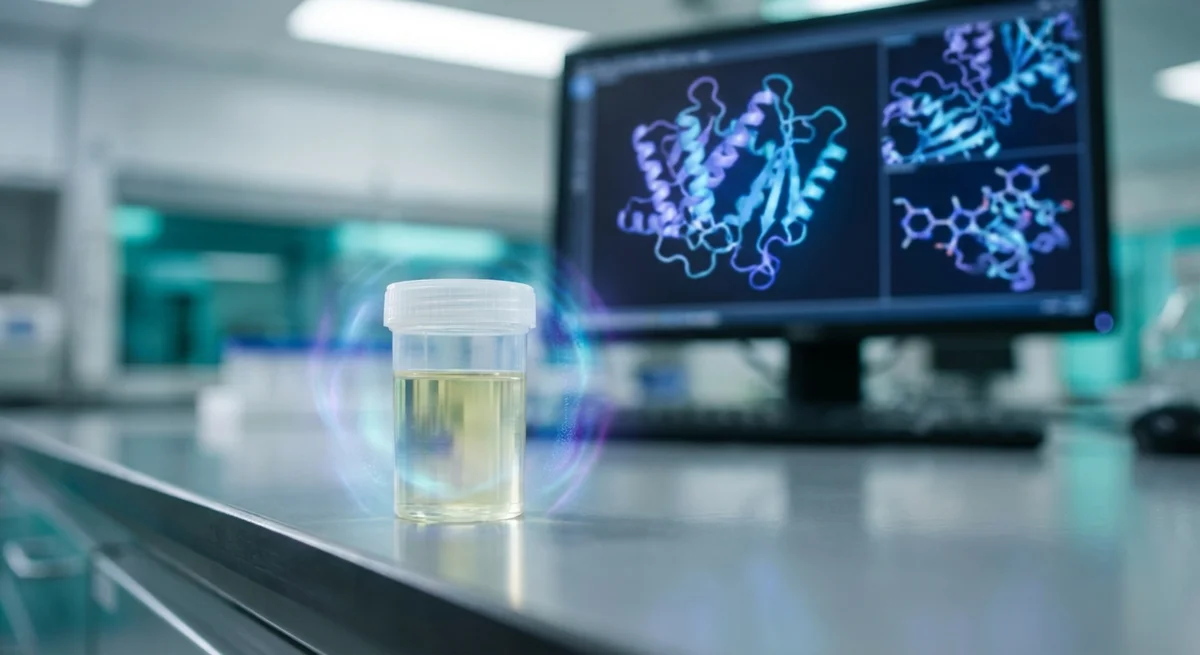
Imagine a world where early cancer detection requires only a urine test. No painful biopsy, no waiting weeks for MRI results, no paying thousands of dollars for PET scanning — just collect a sample in a plastic container. This is the future researchers at the Massachusetts Institute of Technology and Microsoft are bringing us, having taught artificial intelligence to design molecular cancer sensors from scratch.
The essence of the development lies in an elegant biological mechanism. Cancer cells differ from healthy cells by many characteristics, and one of them is the increased activity of enzymes called proteases. These molecular "scissors" cut proteins and play a key role in the processes that allow tumors to grow, invade surrounding tissues, and form metastases. Researchers decided to use this feature against cancer itself: they created an AI model capable of designing short protein chains — peptides — that become targets specifically for tumor proteases.
The technology works as follows. AI-designed peptides are applied to the surface of nanoparticles, which are then introduced into the body. When these nanoparticles reach tumor tissue, the active proteases of cancer cells "cut" the peptides, releasing tiny molecular marker fragments. These fragments are so small that they freely pass through the kidney filter and enter the urine, where they can be detected using standard laboratory methods. In essence, the nanoparticles act as scouts sent to search for the enemy and send a signal if they find it.
The key innovation here is precisely the role of artificial intelligence in the peptide design process. A traditional approach to creating such molecular sensors would require years of trial-and-error experiments. The space of possible amino acid sequences is astronomically large: even for a short peptide of ten amino acids, there are trillions of possible combinations. The AI model developed by the MIT and Microsoft team can navigate this space, predicting which sequences will be most effectively recognized and cut by specific tumor proteases while remaining resistant to enzymes of healthy tissues. This is fundamentally important for reducing the number of false positives — a scourge of modern cancer diagnostics.
To appreciate the significance of this work, it's worth looking at the context. Early diagnosis remains one of the main unsolved problems in oncology. According to the World Health Organization, more than a third of cancer deaths could be prevented with timely detection. However, existing screening methods are either too expensive for mass application, insufficiently sensitive, or invasive and unpleasant for patients. Mammography misses a significant proportion of breast tumors, colonoscopy requires complex preparation, and liquid biopsy — one of the most promising modern approaches — currently costs hundreds of dollars per test and doesn't always catch cancer at the earliest stages.
The MIT and Microsoft development fits into a broader trend of using AI to design biological molecules. After the 2024 Nobel Prize in Chemistry was awarded for work in protein structure prediction, this field is experiencing a real boom. DeepMind with AlphaFold, David Baker's Institute for Protein Design startup, dozens of biotech companies — they all use machine learning to create proteins with specified properties. But while most projects focus on therapeutic molecules — new drugs and antibodies — the MIT and Microsoft team applied the same approach to diagnostics, opening an entirely different horizon of possibilities.
Of course, from laboratory demonstration to clinical practice is a distance of enormous magnitude. Safety of nanoparticles for humans must be proven, clinical trials conducted, regulatory approval obtained, and production established. This could take years. Moreover, open questions remain: how universal is the approach for different types of cancer, what is the real sensitivity of the method in vivo, won't nanoparticles cause an immune response with repeated use.
Nevertheless, the very concept — using AI to design molecular "spies" that transform the complex task of early cancer diagnosis into a routine urine test — looks truly breakthrough. If the technology proves its effectiveness in clinical conditions, it could democratize access to early cancer detection worldwide, including regions that have neither MRI machines nor oncology centers. And in this, perhaps, lies the main strength of the union of artificial intelligence and biology: not simply accelerating existing processes, but creating fundamentally new solutions to problems that seemed insurmountable.
Want to stop reading about AI and start using it?
AI News is a curated feed of AI/tech news. Hamidun Academy teaches you to use AI systematically in your work.