U.S. data centers face protests, power shortages, and bubble fears
A growing wave of cancellations and delays is hitting data center construction in the U.S. — key infrastructure for the AI boom. The reasons include electricity
AI-processed from Guardian; edited by Hamidun News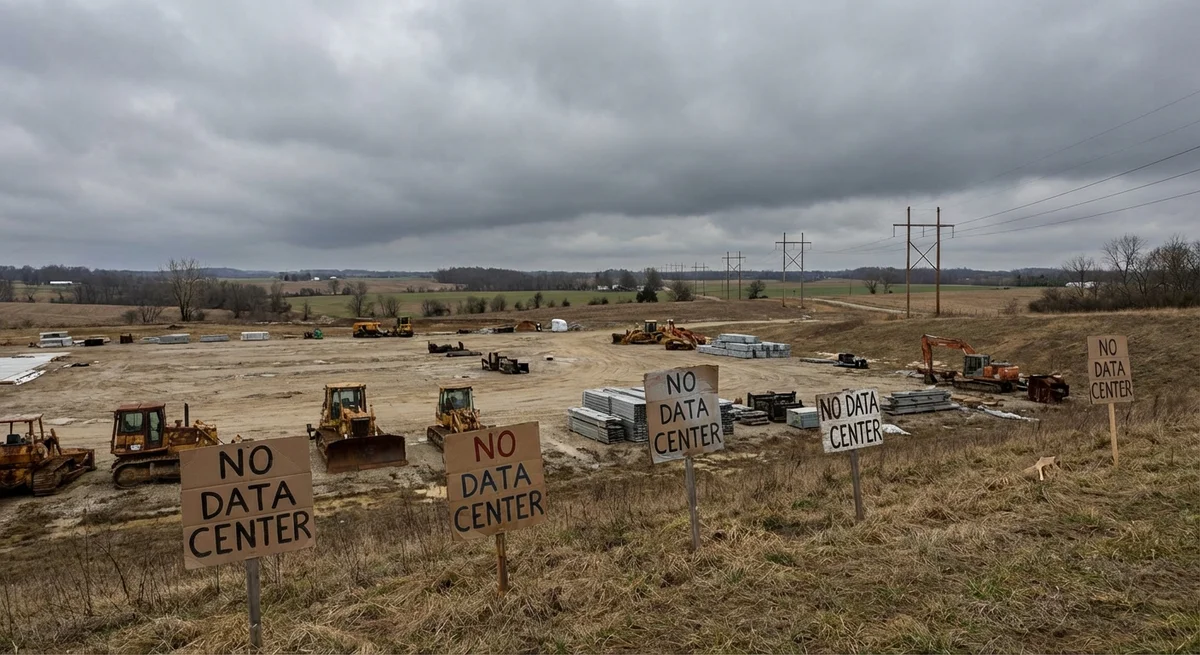
The United States has grown accustomed to thinking of itself as the undisputed leader of the technological race. But while Washington draws ambitious plans for dominance in artificial intelligence, something very different is happening on the ground — literally. The construction of new data centers across the country is facing a barrage of problems: from protests by local residents to a simple lack of electricity. The infrastructural foundation of the AI revolution has proven far more fragile than technology giants anticipated.
Recent months have brought a whole series of cancellations and freezes on major projects. New data centers, which were supposed to provide the computing power for training and running next-generation AI models, are being postponed indefinitely. The reasons combine into a perfect storm, where each factor amplifies the others. Supply chains, still not recovered from the shocks of the pandemic era, are experiencing additional pressure due to tariff policy. Import duties on equipment and components, introduced by the administration, are driving up construction costs and making project economics less attractive. Servers, cooling systems, transformers — all of this costs more and is delivered more slowly.
But perhaps the most unexpected obstacle has been resistance from below. Across America — from rural counties in Virginia to the suburbs of Texas — local communities are coming together against the construction of giant computing complexes. Their arguments are hard to call unfounded.
A modern data center consumes electricity like a small city, generates constant low-frequency noise, requires enormous volumes of water for cooling, and dramatically changes the landscape. Residents rightly point out that the benefits from these facilities go to Silicon Valley and Wall Street, while the costs — noise, infrastructure strain, falling property values — remain in place. Grassroots protest movements, which seemed marginal just a couple of years ago, have turned into a serious political force capable of blocking projects at the local government level.
The energy question deserves special attention. The American power grid, already operating at the limit in many regions, is physically unable to provide the explosive growth in consumption that the AI industry requires. According to various estimates, by the end of the decade, data centers could consume up to 10-12 percent of all electricity in the country. Energy companies are not keeping pace with building new capacity — whether gas plants, solar farms, or nuclear reactors. Queues for grid connections in some states stretch out for years. This creates a paradoxical situation: a technology of the future is hitting infrastructure designed for a completely different era.
To this cocktail of problems is added growing investor skepticism. After several years of unbridled optimism, when almost any project with the "AI" label got funding almost automatically, caution has come to the market. Discussions about a bubble in artificial intelligence, which recently sounded like heresy, are now being conducted openly — including in the pages of leading business publications and in analytical notes from major investment banks. Some funds are already reviewing their portfolios, reducing exposure to AI infrastructure projects. The logic is simple: if a data center's profitability depends on computational demand growing exponentially for the next ten years, then any slowdown turns a multi-billion dollar investment into a loss.
The consequences of this situation extend far beyond the construction industry. If America cannot build up computational infrastructure to the necessary scale, it will directly hit the pace of AI model development. Training systems at the scale of GPT-5 or Gemini Ultra requires massive clusters, and every postponed data center is a potential delay in research. Competitors — primarily China and Middle Eastern countries — are not standing still. Saudi Arabia and the UAE are investing tens of billions in their own computing capabilities, while Beijing, despite sanctions restrictions, continues to build data centers with the speed characteristic of the Chinese system.
All of this puts an uncomfortable question before America's technology industry and political establishment. One can talk as much as one likes about AI leadership, sign executive orders, and allocate budgets for research. But if there is no physical infrastructure — servers, electricity, land for construction, and the consent of people living nearby — all these plans remain on paper. The AI boom has for the first time truly collided with reality, and this reality has proven far more stubborn than even the most advanced language models predicted.
Want to stop reading about AI and start using it?
AI News is a curated feed of AI/tech news. Hamidun Academy teaches you to use AI systematically in your work.