Meta to spend billions on AMD processors, challenging Nvidia's monopoly
Meta Platforms has signed a major deal with AMD to deploy 6 gigawatts of data center capacity based on AMD processors. The company will also acquire shares in t
AI-processed from Bloomberg Tech; edited by Hamidun News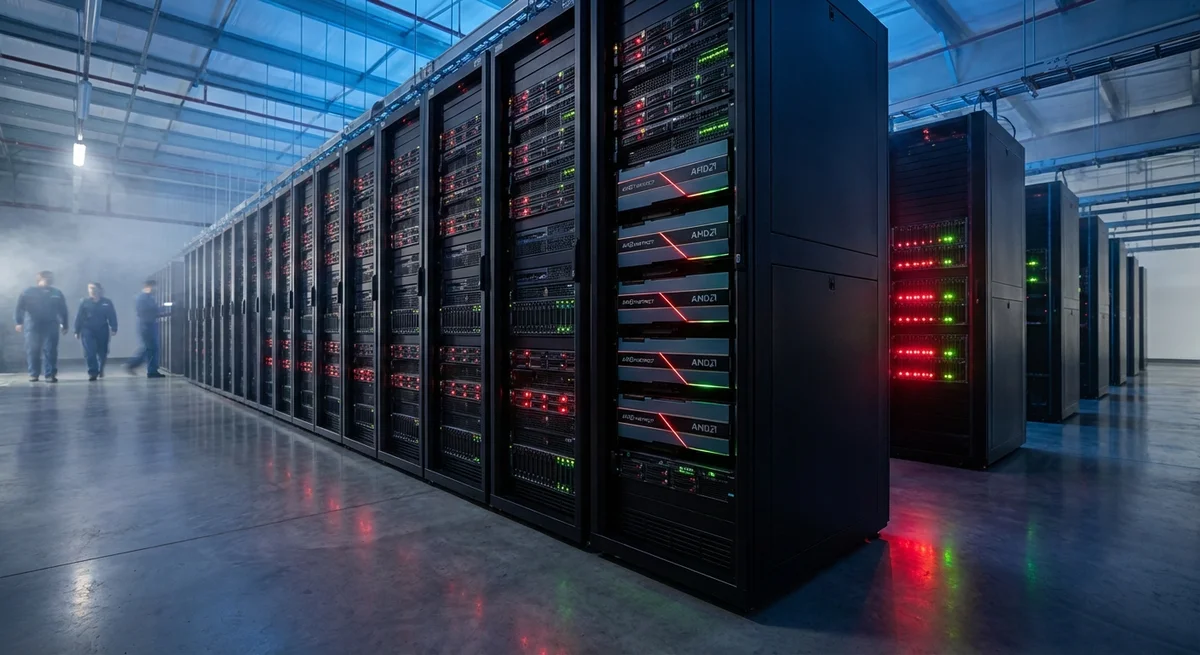
Six gigawatts. To put this in perspective, that's roughly as much electricity as consumed by several million households. That's the volume of server capacity Meta Platforms intends to deploy based on AMD processors, concluding a deal with the chipmaker that could become a turning point in the struggle for the AI infrastructure market. Beyond purchasing equipment, Meta will also acquire AMD stock — a gesture that goes far beyond ordinary commercial relationships and more resembles a strategic alliance.
To understand the significance of this news, we need to recall the context of the past two years. Since the explosive growth of generative AI, Nvidia has transformed into an absolute monopolist in the market for accelerators for training and inference of neural networks. Its H100 series graphics processors, and then the latest Blackwell, became the de facto industry standard.
Nvidia's market capitalization at times exceeded three trillion dollars, and queues for its chip deliveries stretched out for months. AMD, historically the second player in the GPU market, desperately tried to catch up to its competitor with its Instinct MI300 lineup and subsequent models, but its share of the AI accelerator market remained disproportionately modest — by various estimates, from five to ten percent.
That's precisely why the Meta contract is not just a large order. It's the legitimization of AMD as a serious alternative to Nvidia in the eyes of the entire industry. Meta is one of the world's largest consumers of computing power for AI. The company trains its own models in the Llama family, processes recommendation algorithms for billions of Facebook, Instagram and WhatsApp users, and is actively investing in the metaverse and wearable devices with AI capabilities. When a customer of such scale bets on AMD, it sends a powerful signal to the rest of the market.
Technically, Meta's decision makes profound sense. Dependence on a single supplier is one of the major headaches for any large technology business. Nvidia, aware of its dominant position, sets corresponding prices. Supplier diversification gives Meta not only a backup in case of supply disruptions, but also a powerful lever for price negotiations with both manufacturers. Furthermore, AMD processors in a number of scenarios demonstrate competitive performance at a more attractive price-to-energy-efficiency ratio — a critical parameter when six gigawatts of power consumption is involved.
Meta's decision to purchase AMD stock deserves special attention. Such practice is not new in the technology industry — one need only recall Microsoft's investments in OpenAI or Amazon in Anthropic. Buying supplier stock creates additional financial ties and mutual interest in success. For AMD, this means not only an influx of capital, but also long-term confidence that the key client won't go anywhere. For Meta — a potential financial gain if AMD stock rises thanks to an expanded customer base.
The consequences of this deal extend far beyond the two companies. For Nvidia, this is the first truly alarming wake-up call. Yes, Jensen Huang's company still controls the lion's share of the market, and its CUDA software ecosystem remains practically the only option for many developers. But if other hyperscalers — Google, Amazon, Microsoft — follow Meta's example and begin actively purchasing AMD equipment, price pressure on Nvidia will increase. For the entire AI industry, this is a positive signal: competition in the chip market means lower computing costs, which ultimately accelerates the development and democratization of artificial intelligence technologies.
For AMD, the Meta deal is the moment the company has been waiting for for years. Under Lisa Su's leadership, the chipmaker has methodically built a lineup of AI accelerators, invested in ROCm software as an alternative to CUDA, and established partnerships with cloud providers. Now these efforts are beginning to bear fruit at a scale capable of changing the company's financial profile. Billions of dollars in guaranteed revenue from one client — that's a foundation on which to build further expansion.
The AI infrastructure market is entering a new phase. The era of one supplier's uncontested dominance appears to be coming to an end — not because Nvidia became worse, but because the stakes have become too high for dependence on a single source. Meta's six gigawatts on AMD processors is not just a commercial deal. It's a statement about what AI infrastructure will look like in the coming five years: more competitive, more diversified, and possibly more accessible to everyone.
Want to stop reading about AI and start using it?
AI News is a curated feed of AI/tech news. Hamidun Academy teaches you to use AI systematically in your work.