From aesthetics to practice: MIT makes generative 3D design fit for manufacturing
A team of scientists at the Massachusetts Institute of Technology (MIT) has developed an innovative approach to generative 3D design that combines neural networ
AI-processed from Jiqizhixin (机器之心); edited by Hamidun News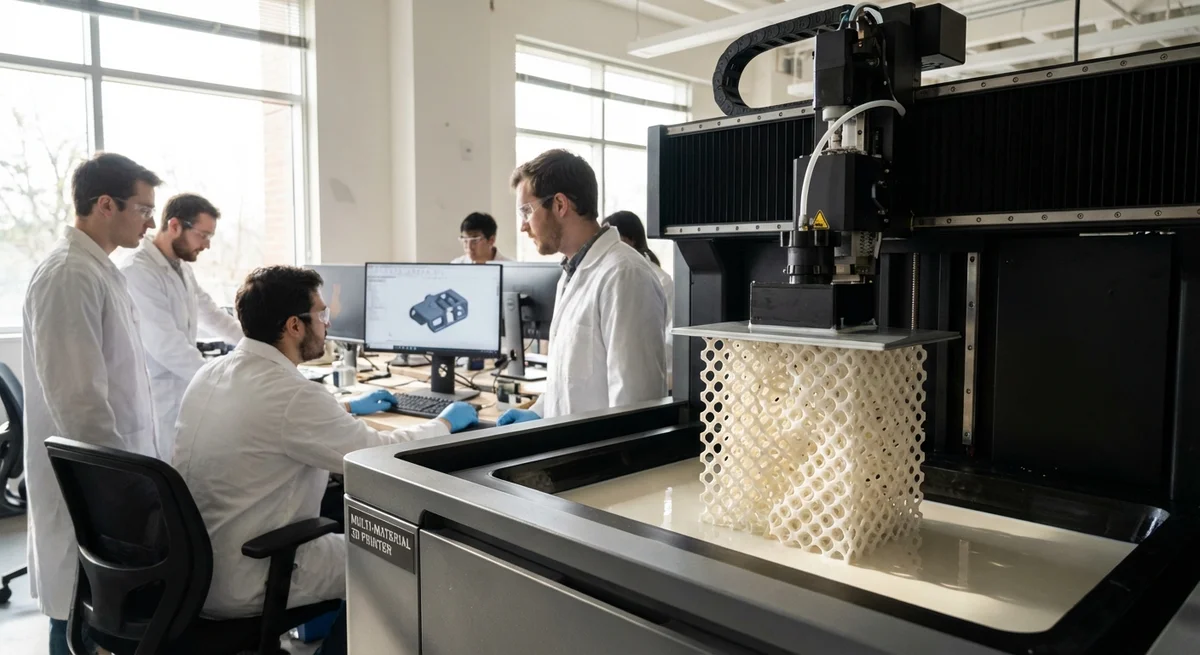
From Aesthetics to Practice: MIT Makes Generative 3D Design Suitable for Manufacturing
Artificial intelligence has learned to draw, write poetry, and compose music — and for a long time it seemed that three-dimensional design would be the next conquest. Generative models have indeed learned to create impressive 3D objects: smooth organic forms, complex lattice structures, details that look as though created by an experienced engineer. But as soon as such a detail was sent to a 3D printer and attempts were made to use it in real conditions, the illusion dissolved. The object broke under load, deformed, or proved entirely unsuitable for printing. A team of researchers from the Massachusetts Institute of Technology took on solving precisely this problem — and judging by the results, they managed to find an answer.
The gap between visual convincingness and physical viability is one of the main unsolved tasks in the field of generative design. Most neural networks trained on 3D models optimize geometry for appearance or conformity to the training set, but not for the laws of physics. They do not know where a detail will break under bending, do not understand how stresses are distributed within a structure, and do not account for manufacturing process constraints. The result is digital sculptures — beautiful in rendering, but useless in the workshop. This gap is precisely what MIT sought to overcome by embedding physics directly into the generation process.
The key technical solution became differentiable physical optimization — an approach that allows integrating equations of mechanics directly into the neural network training cycle. To explain without technical jargon: the system does not simply generate a form and then check its strength, but corrects the structure of the object in real time, guided by physical constraints as part of the objective function. The neural network receives "feedback" not only from data about form, but also from simulated physical loads — and learns to design so that the detail withstands the specified operating conditions. This is a fundamentally different architecture of thinking compared to what previous generative approaches offered.
The practical significance of the development is difficult to overstate. Industrial design is an area where every engineering solution must pass multi-stage verification: load calculations, simulation in finite element environments, prototyping, and field testing. This cycle takes weeks and costs significant resources. Generative tools promised to accelerate it, but without guarantees of physical correctness remained merely a tool for quickly creating "rough" sketches requiring subsequent manual refinement. The MIT system potentially reduces this cycle to a minimum: the output is a model that has already undergone load simulation and is ready for printing without additional engineering verification.
For the additive manufacturing industry — 3D printing at industrial scales — this opens new horizons. Aerospace companies, manufacturers of medical implants, automakers have long sought ways to automate the design of lightweight yet durable parts of complex geometry. Topological optimization — a method that allows "removing" excess material from a part while preserving its strength — has existed for several decades, but requires significant computational resources and specialist involvement. The MIT approach combines the capabilities of generative neural networks with the logic of physical simulation, making this process accessible and significantly faster.
At the same time, questions remain whose answers will determine the real scale of technology application. How well does the system generalize knowledge to new materials and manufacturing processes — beyond those it was trained on? How does it handle multifactorial constraints, when a part must simultaneously withstand thermal loads, vibration, and contact with aggressive environments? Are existing manufacturing chains ready to integrate such a tool without significant restructuring of work processes? MIT researchers have not yet provided exhaustive answers to these questions, and the path from academic publication to serial industrial application is traditionally lengthy.
Nevertheless, the direction itself raises no doubts. Generative design, embedded in the reality of physical constraints, is not simply a convenient tool for engineers, but a potential shift in how humanity designs objects of the material world. If a neural network is capable not only of inventing a form but also of guaranteeing its functionality, the boundary between conception and finished product becomes thinner. MIT has taken an important step toward making AI in design stop being a source of beautiful pictures and become a full-fledged engineering partner.
Want to stop reading about AI and start using it?
AI News is a curated feed of AI/tech news. Hamidun Academy teaches you to use AI systematically in your work.