Nuclear LLMs, Chinese benchmarks, and the politics of measurement: highlights from Import AI 446
Import AI 446 touches on three of the industry's most important areas. First, the growing interest in nuclear energy as a power source for energy-intensive lang
AI-processed from Import AI; edited by Hamidun News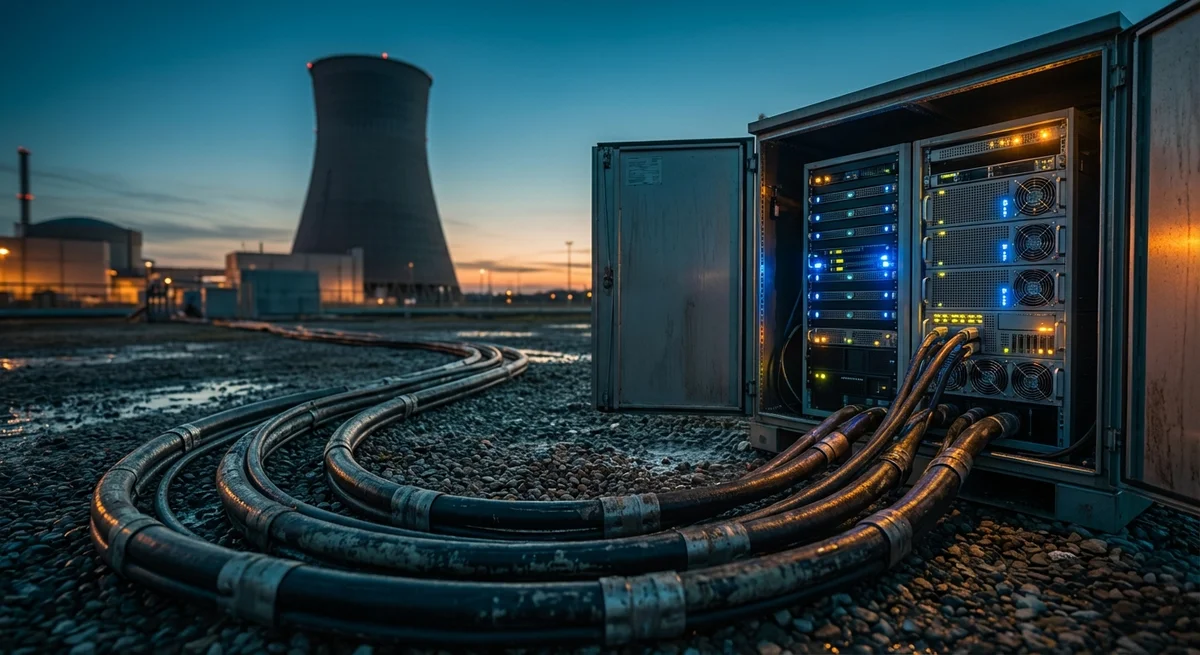
The energy hunger of language models, China's benchmarking ambitions, and an unexpectedly simple recipe for regulators — the latest issue of one of the world's most influential AI digests, Import AI number 446, turned out to be surprisingly concentrated. Three topics, each deserving separate discussion, form a single picture: the AI industry is entering a phase where key constraints are ceasing to be purely algorithmic.
Let's start with the most physically tangible trend — nuclear energy for data centers. The term "Nuclear LLMs" sounds like science fiction, but behind it lies pragmatic logic. Training and inference of the largest language models require enormous amounts of electrical power, and this demand is growing exponentially.
By various estimates, data centers could consume up to 4-6 percent of all electricity in the United States by 2027. Renewable sources cannot handle the baseline load, gas power plants create a carbon footprint, and nuclear energy — stable, powerful, and relatively clean — appears to be the only realistic option for scaling. Microsoft has already concluded an agreement to restart the Three Mile Island reactor, Amazon is investing in small modular reactors, and Google signed a contract with Kairos Power.
This is no longer a marginal idea — it's a mainstream direction, and Import AI is capturing the moment when energy becomes as strategic a resource for AI as data and computing.
The second topic of the issue is a new large-scale Chinese benchmark for evaluating artificial intelligence systems. China is consistently building its own AI evaluation ecosystem, and this has far-reaching consequences. Benchmarks are not just technical tools.
They determine what is considered progress, which model capabilities are recognized as important, and which are ignored. When China creates its own measurement standards, it is effectively forming an alternative coordinate system for the entire industry. If Western benchmarks traditionally focus on tasks relevant to the English-speaking world — from text understanding to solving mathematical olympiads — Chinese counterparts might place emphasis differently, including tasks specific to Asian markets, languages, and cultural contexts.
This is not just technical competition, but a struggle to define the very concept of "intelligent AI."
The third and perhaps most provocative topic concerns the work of Jacob Steinhardt, a professor at the University of California, Berkeley, and one of the most cited researchers in the field of AI safety. Steinhardt formulates a deceptively simple idea: before regulating artificial intelligence, we need to learn how to measure it. This sounds like a platitude, but in practice, it is precisely the absence of reliable metrics that turns any discussion of AI regulation into a dialogue of the deaf.
Legislators cannot set threshold values for dangerous systems if there are no agreed-upon ways to determine that a system is dangerous. Companies cannot prove the safety of their products if there are no objective safety criteria. Steinhardt proposes concrete political intervention: invest in the creation of standardized tools for measuring the capabilities of AI systems.
Not to prohibit, not to restrict, but first — to measure. This is an approach that can find support across the political spectrum, as it requires no ideological compromises.
All three topics of the issue are connected by a common thread that is easy to miss among technical details. The AI industry is experiencing a moment of maturation. The era when progress was determined exclusively by model size and data volume is giving way to an era where infrastructure, geopolitical, and institutional factors become decisive. Who will provide energy for the next generation of models? Who will set the standards for their evaluation? Who will create the tools that allow society to control this technology?
Import AI, edited by Jack Clark — former director of policy at OpenAI and co-founder of Anthropic — remains one of the few sources capable of seeing these connections and presenting them in context. Issue 446 is a reminder that the future of AI is decided not only in laboratories, but also at power plants, in standardization offices, and in the corridors of power. And those who understand this gain a strategic advantage.
Want to stop reading about AI and start using it?
AI News is a curated feed of AI/tech news. Hamidun Academy teaches you to use AI systematically in your work.