Hitachi bets on industrial expertise in the physical AI race
In the physical AI race — technologies for controlling robots and industrial equipment — an unexpected hierarchy is taking shape. OpenAI and Google are working
AI-processed from AI News; edited by Hamidun News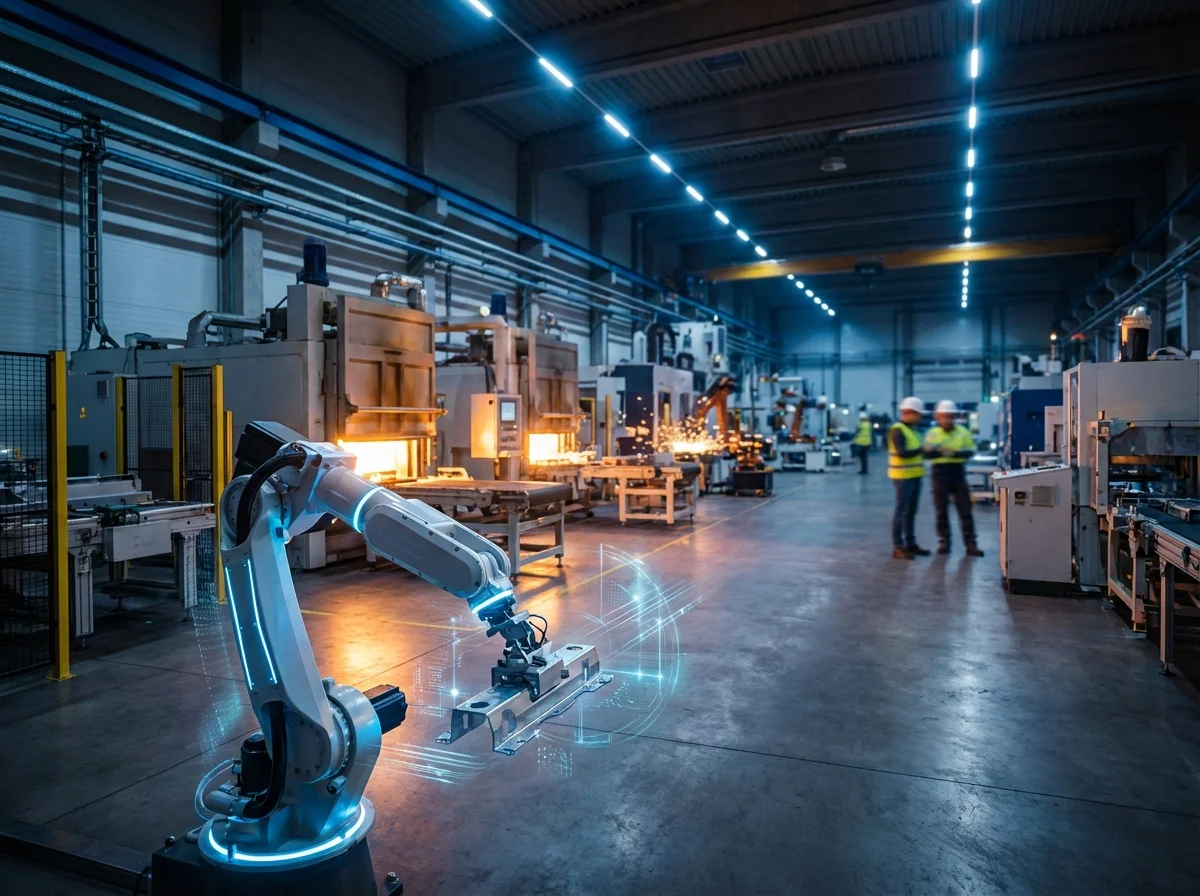
In the world of artificial intelligence, it is commonly believed that the future belongs to those who build the largest language models and possess the most powerful computing clusters. But when it comes to physical AI — technologies that control robots, conveyors, and industrial systems in the real world — the rules of the game may be entirely different. This is precisely what Hitachi, one of Japan's largest industrial conglomerates, is betting on.
Physical AI is not a chatbot that generates text, nor is it a neural network that draws pictures from descriptions. It is an intelligence that must understand physics, inertia, friction, temperature, pressure — everything that determines how objects behave in the real world. An error in a language model leads to an inaccurate answer. An error in physical AI can lead to an industrial accident, a power plant shutdown, or a collision involving an autonomous system. The stakes here are fundamentally different, and this changes the balance of power.
Today, a distinctive three-tier hierarchy has formed in this field. At the top are companies like OpenAI and Google, which are scaling multimodal foundation models capable of processing text, images, video, and sensor data simultaneously. Their approach is to create universal intelligence that can then be adapted to any task, including the control of physical systems. At the middle level operates Nvidia, which builds platforms and tools for developing physical AI — from simulators like Omniverse to specialized chips for robotics. Nvidia does not create end solutions, but provides the infrastructure without which they are impossible.
And there is a third camp — industrial manufacturers like Hitachi, which have worked with physical systems for decades and accumulated enormous amounts of knowledge about how the real world works. Hitachi produces everything — from trains and power generation equipment to medical devices and construction machinery. The company has managed complex industrial processes for over a hundred years. And it is precisely this experience that, in the view of Hitachi's leadership, represents the competitive advantage that cannot be replicated by simply training a neural network on large volumes of data.
The logic here is simple yet profound. Foundation models from OpenAI or Google can be as powerful as you like, but they are trained primarily on texts and images from the internet. They know what a turbine looks like in a photograph, but they don't know how it vibrates under a certain load, what wear patterns are characteristic of a particular type of bearing, or how the behavior of a cooling system changes at anomalous temperatures.
This knowledge lives in engineering journals, in proprietary databases, in the minds of thousands of specialists — and it is precisely this knowledge that Hitachi possesses. Converting this experience into training data for AI is a non-trivial task, but whoever manages it will obtain models that truly understand the physical world, rather than simply imitating that understanding.
It is important to understand the context in which this strategic maneuver is taking place. The industrial AI market is growing rapidly: by various estimates, by 2030 its volume will exceed 200 billion dollars. Moreover, most industrial enterprises in the world still use AI only fragmentarily — for predictive maintenance or optimization of individual processes. Full implementation of physical AI that autonomously manages production systems remains more of a horizon than a reality. Hitachi expects to capture this niche before the technology giants from Silicon Valley get there.
Hitachi's strategy is also interesting in that it challenges the dominant paradigm in the AI industry, according to which victory goes to those with more computing power and general-purpose data. In physical AI, this formula may not work. Here, domain expertise is critical, access to real industrial data is essential, and, equally importantly, client trust. No nuclear power plant operator will entrust system control to a model created by a startup without experience in the energy sector, however impressive its architecture may be. Hitachi, on the other hand, has been working with such clients for decades.
Of course, Hitachi's bet is not without risks. Companies with a rich industrial heritage often lose to technology upstarts precisely because their inertia and bureaucracy slow down innovation. Moreover, OpenAI and Google are actively moving toward multimodality and robotics, while Nvidia offers increasingly mature tools for physical AI with each passing year. The window of opportunity for Hitachi is not infinite.
Nevertheless, the very fact that an industrial giant from Japan openly declares its intention to compete with Silicon Valley in the field of AI speaks to an important shift. The era when artificial intelligence existed exclusively in digital space is coming to an end. The next chapter is AI in the physical world, and here the advantage may belong to those who understand that world best of all.
Want to stop reading about AI and start using it?
AI News is a curated feed of AI/tech news. Hamidun Academy teaches you to use AI systematically in your work.