Altman proposed counting the cost of intelligence differently: 20 years of food versus one data center
Sam Altman joined the debate over AI energy use, arguing that comparing the brain and a neural network is misleading without accounting for the full cost of hum
AI-processed from 3DNews AI; edited by Hamidun News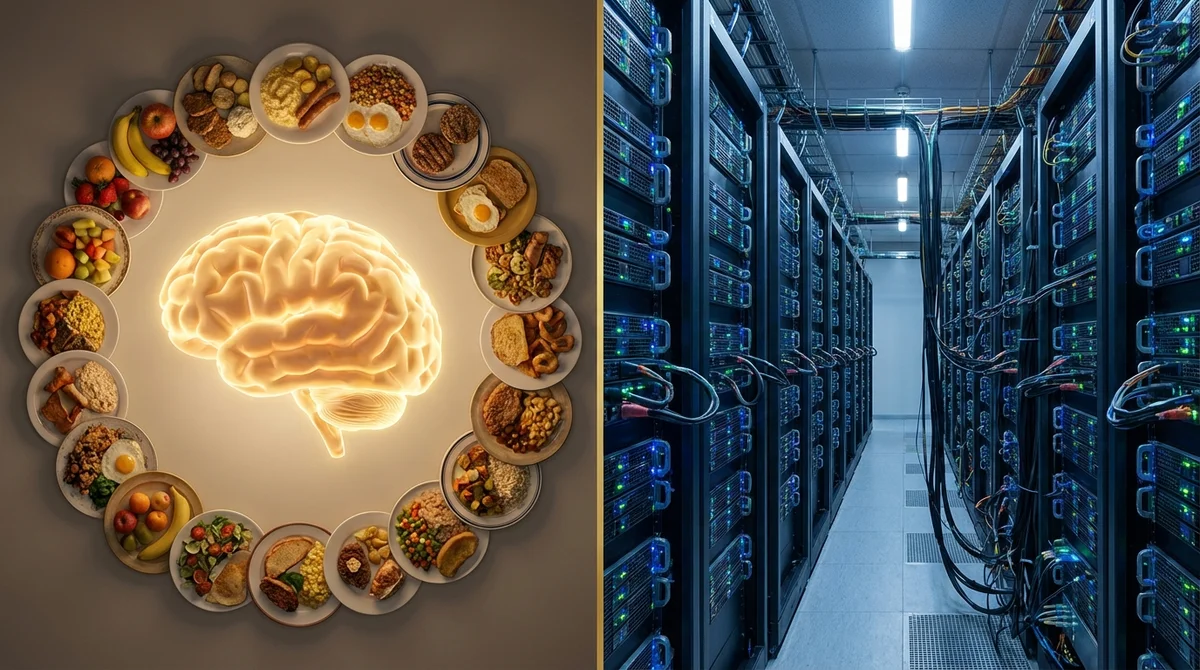
Twenty watts. That's how much the human brain consumes during active work — less than a dim incandescent lightbulb. For decades, this fact has served as the trump card in debates about AI inefficiency: why build data centers the size of a small city when nature solved the same problem with a kilogram and a half of neural tissue and a handful of glucose? Sam Altman has decided it's time to reconsider the terms of this comparison.
The OpenAI chief put forward a provocative thesis: comparing the energy consumption of a working brain and a working neural network is intellectual cheating. The correct calculation, according to Altman, should include all the energy expended on creating intelligence, not just operating it. For humans, this means roughly twenty years of continuous feeding, sleeping, learning — thousands and thousands of calories transformed into synaptic connections. If we go further, we need to account for millions of years of evolution, during which countless organisms were born, consumed resources, and died, so that natural selection would eventually produce a creature capable of reasoning about abstractions.
The argument is not new in academic circles, but from the mouth of the head of the world's largest AI company, it sounded different — as a strategic narrative. The context here is critically important. OpenAI and its competitors face mounting pressure over the energy footprint of large language models.
By various estimates, training a single large model at the level of GPT-4 consumed energy comparable to the annual consumption of several thousand households. Each request to a chatbot uses many times more electricity than a typical search query. Building new data centers for AI workloads has become one of the hottest topics in energy policy — from Texas to Scandinavia.
In these conditions, any argument capable of reformatting the discussion acquires not only philosophical but also entirely practical significance.
From a scientific standpoint, Altman's position contains a rational kernel, but also notable stretches. Indeed, if we view the brain as a product of learning, its "training budget" is colossal. A child consumes an average of 1000 to 2500 kilocalories per day, and a significant portion of this energy in the first years of life goes precisely toward nervous system development.
Over twenty years, this amounts to approximately 15–18 million kilocalories — roughly 17–21 megawatt-hours when converted to electrical energy. The figure is impressive, but still orders of magnitude less than what is spent on training cutting-edge models when accounting for cooling losses, data transmission, and infrastructure. As for evolution — including it in the calculation is technically possible, but then for AI we would need to account for the entire history of computing, from the first vacuum tube machines to modern GPU clusters, which makes the comparison meaningless.
Altman's critics were not slow to respond. Many researchers pointed out a fundamental difference: the brain is a universal system that simultaneously manages the body, processes sensory information, sustains emotional life, and solves intellectual tasks. A large language model does exactly one thing — generates text (or, in the multimodal variant, also images). Comparing their "training costs" is like comparing the cost of building an entire city with the cost of building one, albeit very impressive, skyscraper. Other commentators were harsher, calling Altman's statement an attempt to normalize unlimited AI industry energy consumption at a moment when society is beginning to ask uncomfortable questions.
However, there is a deeper layer to this discussion. The very fact that the OpenAI chief is publicly reasoning about the price of intelligence signals a shift in industrial thinking. A couple of years ago, companies preferred not to discuss energy at all, hoping that progress in chip and algorithm efficiency would solve the problem on its own. Now the strategy is changing: instead of denying the scale of consumption, industry leaders are trying to redefine the coordinate system in which this consumption is evaluated. If intelligence is an expensive product by definition, then high energy costs cease to be a bug and become a feature.
This narrative maneuver will have consequences far beyond social media. Regulators in Europe and the US are already developing energy efficiency standards for AI systems. How the industry defines the baseline comparison — whether it's the cost of a single query, the cost of training a model, or the full cost of creating intelligence "from scratch" — will directly impact the stringency of future regulations. Altman, whether consciously or not, is setting the frame for these debates.
One thing can be said for certain: the era when AI companies could simply ignore the question of resources has ended. Now they must not only build models but also construct arguments for why these models are worth the energy spent. And the persuasiveness of these arguments will determine not only OpenAI's reputation but also the pace of development of the entire industry in the coming years.
Want to stop reading about AI and start using it?
AI News is a curated feed of AI/tech news. Hamidun Academy teaches you to use AI systematically in your work.