SK Hynix ramps up production of AI memory chips amid the global data-center boom
SK Group chairman Chey Tae-won announced plans to significantly expand production of AI memory chips. The decision is driven by explosive growth in demand…
AI-processed from Bloomberg Tech; edited by Hamidun News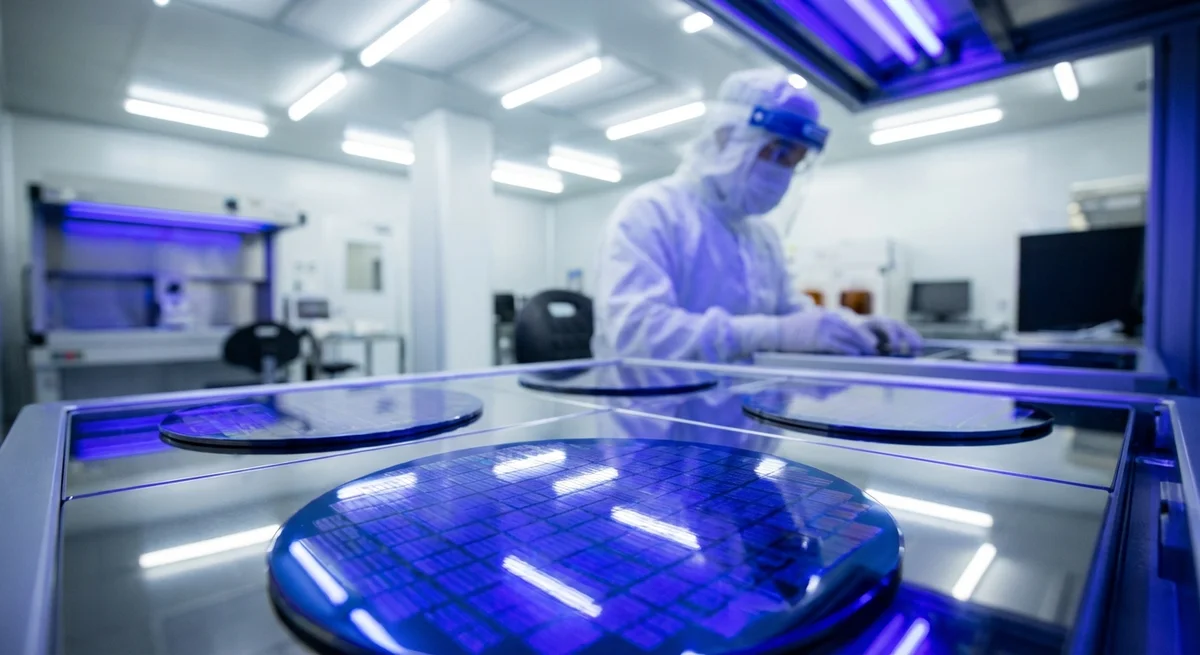
When the head of one of the world's largest semiconductor manufacturers publicly commits to increasing production output, it's far more than corporate rhetoric. It's a market signal that demand has reached a level where even maximum capacity utilization of existing facilities is no longer sufficient. This is precisely what happened when SK Group Chairman Choi Tae-won announced plans for significant increases in the production of memory chips for artificial intelligence.
SK Hynix — a subsidiary of SK Group — holds a unique position in the global AI equipment supply chain. The company is the world's leading producer of HBM (High Bandwidth Memory) — the very component without which no modern AI accelerator can function. HBM chips are installed in NVIDIA's H100, H200, and newest Blackwell accelerators, as well as AMD Instinct solutions, and it's these chips that largely determine the performance of systems on which large language models are trained and run. Without SK Hynix's HBM, global AI infrastructure in its current form simply would not exist.
Choi Tae-won's statement cannot be understood without grasping the scale of the data center construction boom underway. By various estimates, global investments in data center infrastructure in 2025-2026 will exceed 300 billion dollars. Microsoft, Google, Amazon, Meta, and dozens of other companies are engaged in an unprecedented race for computing power. Each new data center represents thousands of server racks, each equipped with accelerators requiring high-speed memory. Demand for HBM is growing exponentially, and until recently, manufacturers have barely kept pace with orders.
This very shortage has become one of the primary constraints on the pace of AI infrastructure deployment worldwide. NVIDIA has repeatedly cited component shortages, including memory, as a factor limiting supplies of its accelerators. Samsung, the second major player in the HBM market, has encountered technical difficulties in manufacturing the latest generations of memory, which has further intensified industry dependence on SK Hynix. In these circumstances, the promise to increase output is not philanthropy but a strategic move allowing the company to strengthen its position in a market with multi-billion-dollar potential.
Technically, scaling HBM production is a non-trivial task. Unlike conventional RAM, HBM is a stack of several DRAM dies interconnected using TSV (Through-Silicon Via) technology — through-silicon interconnects. Production requires not only advanced lithographic processes but also complex assembly and testing stages. Each new generation — HBM3, HBM3E, and prospectively HBM4 — increases the number of layers and packaging density, making scaling even more challenging. You cannot increase output by simply pushing a button: new production lines are needed, trained personnel, and refined quality control processes.
For the global AI market, the implications of this decision could be quite significant. If SK Hynix truly manages to substantially increase volumes, it could ease the accelerator shortage and reduce computing costs for companies developing AI services. More accessible infrastructure means a lower entry barrier for startups, research laboratories, and companies outside the 'Big Five' of technology giants. However, there is a flip side: increasing capacity requires enormous capital investments, and in the event of demand slowdown — a scenario that currently seems unlikely but not impossible — the company risks facing excess capacity.
It's worth noting the geopolitical dimension as well. South Korea, alongside Taiwan, remains one of two key hubs of global advanced semiconductor manufacturing. Strengthening SK Hynix's position reinforces Seoul's role in the global technology supply chain and makes the country an even more significant player in an era when control over chip manufacturing becomes a matter of national security for the world's largest economies.
Choi Tae-won's statement is more than a corporate promise. It's an indicator that the semiconductor industry views the current AI boom not as a temporary spike but as a fundamental shift warranting a restructuring of production strategies for years to come. The question now is not whether demand for AI memory will grow, but whether the industry can keep pace with that growth.
Want to stop reading about AI and start using it?
AI News is a curated feed of AI/tech news. Hamidun Academy teaches you to use AI systematically in your work.