How Claude Code solved in 40 minutes a task a programmer failed to solve five years ago
A telling story from Russian industrial IoT: five years ago, a team tried to implement video motion detection to control industrial lighting, but the developer
AI-processed from Habr AI; edited by Hamidun News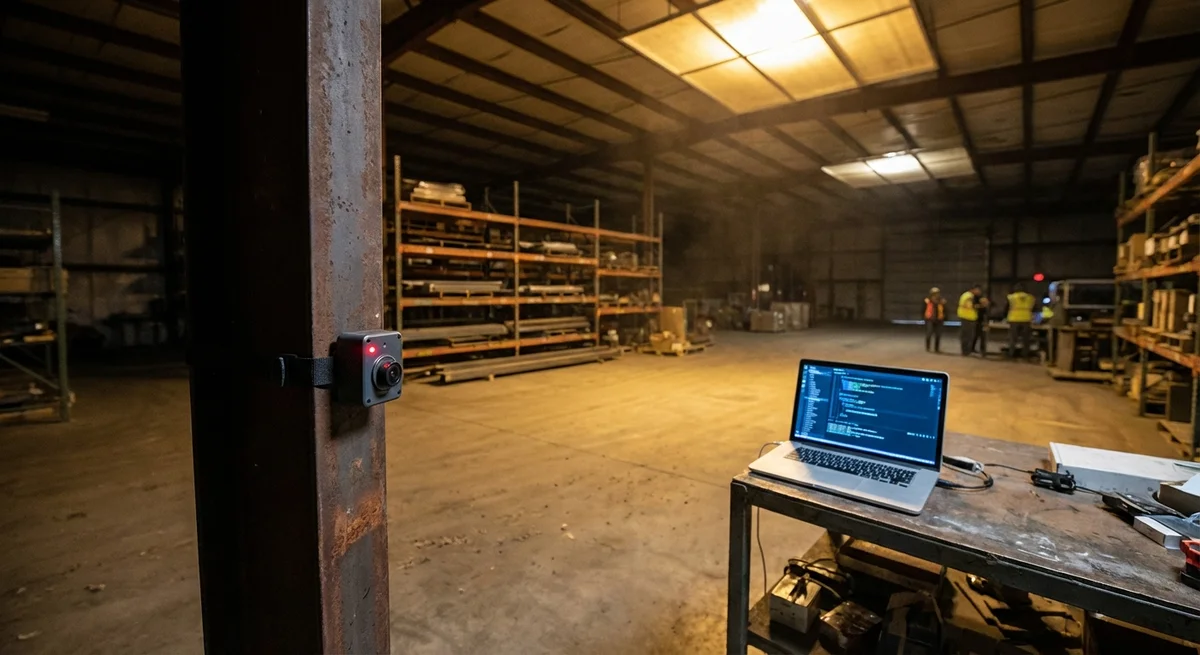
Five years — that's exactly how long an industrial video motion detection project sat literally in a desk drawer. Not due to lack of budget or client interest, but because the only programmer assigned to the task couldn't solve it. In January 2026, an engineer without the necessary programming skillset took the project out of the archive, opened Claude Code, and got a working prototype in 40 minutes. This story, told on Habr, sounds almost anecdotal, but behind it lies a tectonic shift in how software is created for industry.
The context of the task is simple and understandable to anyone who has dealt with industrial automation. It was necessary to implement video motion detection for lighting control at a production facility — a classic IoT scenario where a camera analyzes an image and sends a signal to turn lights on or off depending on the presence of people. The task doesn't require breakthrough computer vision algorithms or training neural networks from scratch.
Technically, this is relatively standard engineering work: video stream capture, frame processing, change detection, control signal. But "standard" doesn't mean "simple" — you need a developer who simultaneously understands video processing, camera operation, IoT protocols, and is capable of assembling all of this into a single product. Five years ago, such a specialist wasn't found in the team.
What happened in January 2026 is instructive not so much by its speed — 40 minutes for an MVP delivering 15 frames per second — but by the profile of the person who did it. The author of the story directly points out: there wasn't a single programmer in the team with the required skillset. Claude Code acted not simply as a development accelerator, but essentially replaced the missing expertise. The engineer formulated the task in natural language, the AI assistant generated code, the human tested the result on real equipment. The iterative cycle that previously required weeks of qualified developer work compressed into minutes.
It's important here not to fall into euphoria and honestly mark the boundaries. An MVP is not a finished product. Fifteen frames per second is sufficient for lighting control, but insufficient for tasks requiring precise video analytics. The prototype needs further development: ensuring stability in industrial conditions, handling edge cases, integration with existing building management systems, security. All of this still requires engineering qualification. But the principal difference is that now the team has a working reference point, not an empty desk drawer with a technical specification.
This story fits into a large-scale trend that is gaining momentum in 2026. AI coding assistants — Claude Code, GitHub Copilot, Cursor, and their counterparts — are consistently lowering the barrier to entry in software development. Previously, industrial companies faced a rigid bottleneck: there are plenty of ideas and tasks, but developers with the required specialization are catastrophically scarce. This especially applies to niches like industrial IoT, which requires a rare combination of knowledge in embedded systems, computer vision, and industrial protocols. Now a domain expert — an engineer who understands the task, knows the equipment, and can evaluate the result — is able to independently create the first working version of a product.
The consequences for the labor market are ambiguous. On one hand, this is the democratization of development: more projects will be implemented, more ideas will have a chance at life. Industrial companies that have put off digitalization for years due to programmer shortages will be able to move projects from a dead stop. On the other hand, the role of the developer itself is changing. Value increasingly shifts from writing code to architectural thinking, system integration, and ensuring reliability. A programmer who could only write code based on a technical specification is indeed coming under pressure. But an engineer who understands the subject matter and can properly formulate a task for AI becomes significantly more productive.
Forty minutes instead of five years — the figures are, of course, misleading. The project lay in a drawer not because it required five years of continuous work, but because no suitable executor was found. But that's precisely what the main conclusion is: AI coding assistants solve not so much the problem of speed as the problem of accessibility. They turn frozen projects into working prototypes and allow teams to move forward where the path was previously closed by personnel shortages. Industrial IoT is just one of many areas where this effect will manifest particularly vividly in the coming years.
Want to stop reading about AI and start using it?
AI News is a curated feed of AI/tech news. Hamidun Academy teaches you to use AI systematically in your work.