Agentation: the tool changing the way developers communicate with AI agents
Agentation has surpassed 120,000 downloads on npm in a couple of months, offering a solution to one of the main pain points of vibe coding: imprecise communicat
AI-processed from Habr AI; edited by Hamidun News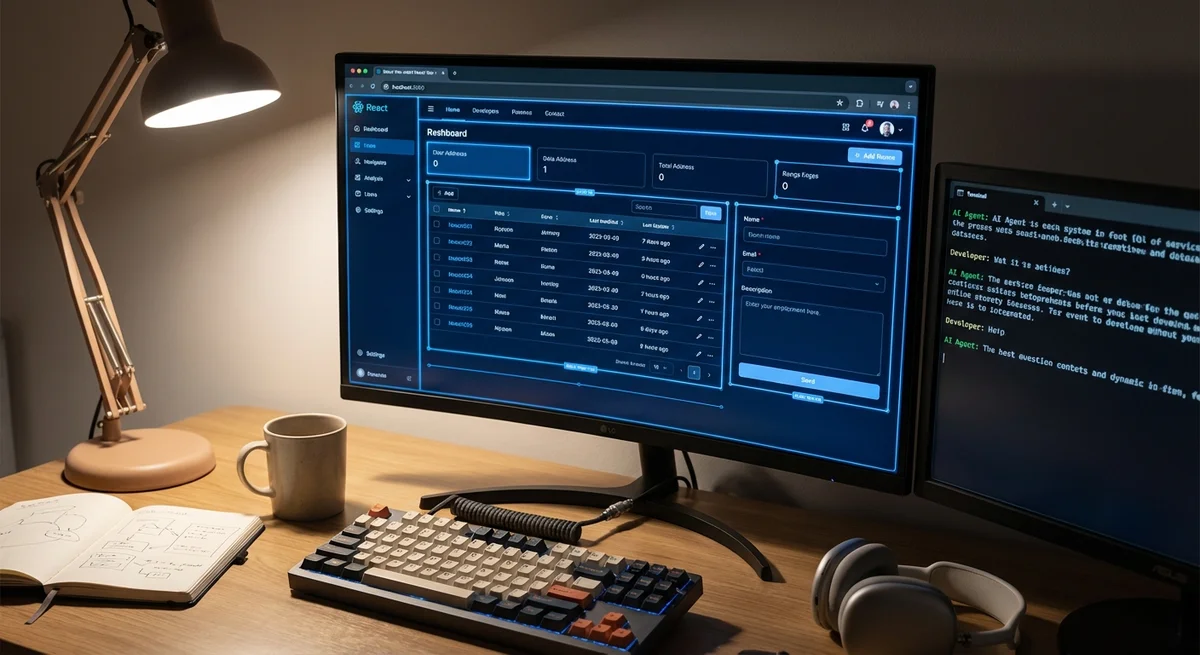
Everyone who has ever tried to explain to an AI agent exactly which interface element needs to be fixed knows this feeling. "Make the button darker." Which button? "The one in the sidebar." There are three of them. "The second from the top, with an icon." The agent edits the first one. You write a detailed description with CSS classes, coordinates, and neighboring elements — and the result is still unpredictable. This is exactly the problem that the Agentation project is trying to solve, which in just a few weeks has transformed from a niche utility into a tool that a significant portion of the developer community practicing so-called "vibcoding" is talking about.
The problem that Agentation solves seems trivial at first glance, but in practice consumes an enormous amount of time. Modern AI agents like Claude Code excel at code generation, refactoring, and even architectural decisions. However, when it comes to fine-tuning a user interface, communication between human and machine turns into a game of "guess what I mean." A developer sees the screen and intuitively understands what needs to change, but translating this visual understanding into a text description precise enough for AI is a non-trivial task. Especially when it comes to complex interfaces with dozens of nested components.
Agentation proposes a fundamentally different approach to this communication. Instead of describing an element in words, the tool allows the developer to precisely point to the needed component, providing the agent with all necessary contextual information — from DOM hierarchy to applied styles and component state. Essentially, it's a bridge between human visual perception and AI agent's text perception. The tool integrates into a React developer's workflow and acts as a layer enriching requests to the agent with structured context about the interface.
The numbers speak for themselves: over 120,000 downloads on npm in two months — this is a serious indicator for a tool that has no major corporation or large-scale marketing campaign behind it. The growth is primarily due to the fact that Agentation hit a real pain point. Vibcoding — an approach in which a developer describes the desired result in natural language and AI generates code — is rapidly gaining popularity. By various estimates, by early 2026, 30 to 40 percent of frontend developers regularly use AI agents in their daily work. But the quality of this interaction still depends heavily on the ability to formulate requests — a skill that has nothing to do with programming itself.
Special attention deserves version 2.0, which introduced support for the MCP protocol — Model Context Protocol. This is an open standard that allows AI models to gain structured access to external tools and data sources. Integration with MCP means that Agentation stops being merely a utility for one specific agent and becomes a universal bridge between any compatible AI tool and the user interface of a React application. This is a strategically important step: as the ecosystem of AI agents becomes increasingly diverse, tools that work according to open protocols gain a clear advantage over proprietary solutions.
However, the project has obvious limitations. Currently, Agentation is oriented exclusively toward the React ecosystem, leaving out developers using Vue, Svelte, Angular, or other frameworks. Additionally, the promotional tone surrounding the project invites healthy skepticism: the promise to "speed up work by twice" is a marketing claim that is difficult to verify in the general case. The real benefit depends heavily on the type of tasks, the complexity of the interface, and how well the developer already knows how to formulate requests for AI.
Nevertheless, Agentation points to an important trend in the development of development tools. We are witnessing the formation of a new class of software — not IDEs, not plugins, not linters, but rather "translators" between human intention and machine understanding. As AI agents take on more routine work, the bottleneck becomes not the speed of code generation, but the accuracy of context transmission. Tools that solve this problem will determine developer productivity in the coming years.
For React developers actively using Claude Code or similar tools, Agentation definitely deserves attention. Not as a silver bullet, but as another element in a growing arsenal of tools making interaction with AI agents less frustrating and more predictable. And predictability in development — that's real productivity.
Want to stop reading about AI and start using it?
AI News is a curated feed of AI/tech news. Hamidun Academy teaches you to use AI systematically in your work.