Microsoft bets on superconductors to power AI data centers
Microsoft invested $75 million in Veir, a company developing high-temperature superconductors (HTS) for data centers. The technology virtually eliminates…
AI-processed from IEEE Spectrum AI; edited by Hamidun News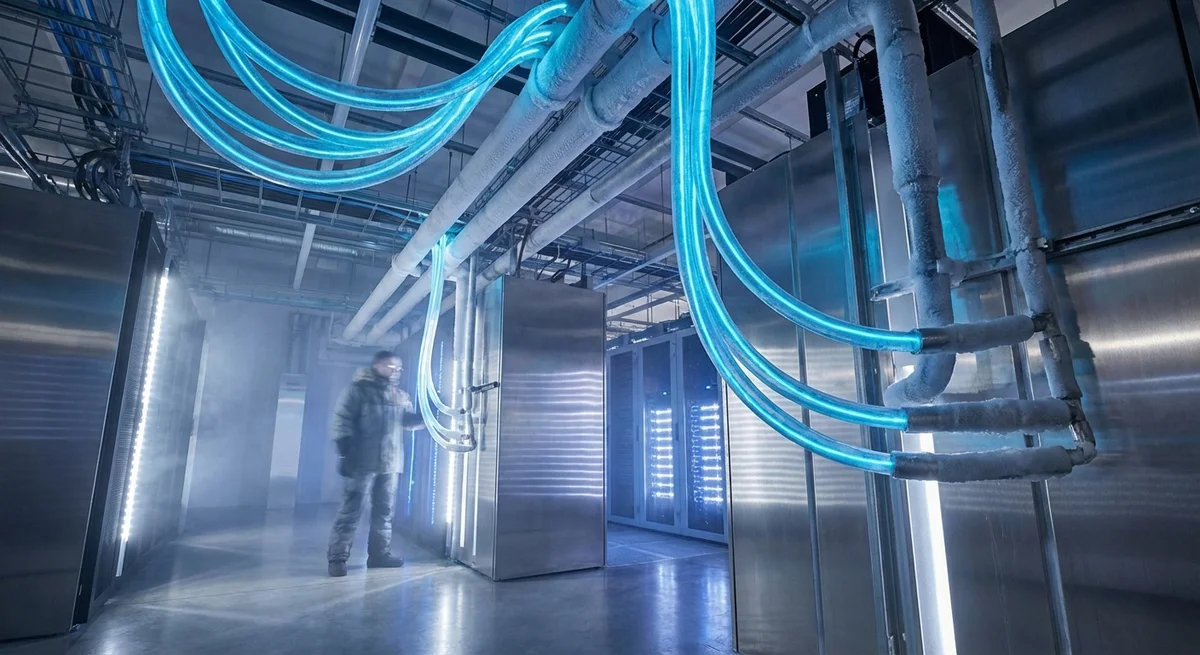
The energy hunger of artificial intelligence is forcing technology giants to seek solutions where, until recently, no one would have looked — in the field of superconductivity. Microsoft has announced a strategic bet on high-temperature superconductors as a replacement for traditional copper wiring in data centers. The company has already invested 75 million dollars in the startup Veir and built the world's first prototype of a server rack powered by a superconducting cable.
To understand the scale of the problem, one figure is enough: according to the U.S. Energy Information Administration, average losses in electricity transmission and distribution amount to about five percent.
In a number of countries, this figure is significantly higher. Five percent might seem like a tolerable amount. But when it comes to data centers consuming hundreds of megawatts, every lost percentage point turns into tens of millions of dollars in annual expenses and thousands of tons of carbon emissions.
And more data centers are being built — and the capacity of power grids is already critically insufficient. Hyperscalers like Amazon Web Services, Google Cloud, and Microsoft Azure are literally exploring every opportunity to obtain additional energy and increase the efficiency of its use.
It was against this backdrop that Microsoft turned its attention to high-temperature superconductors. Despite the encouraging name, "high-temperature" is only relative — traditional superconductors require cooling to nearly absolute zero, whereas HTS operate at the temperature of liquid nitrogen, that is, around minus 196 degrees Celsius. This is still extreme cold, but technologically far more achievable and cheaper to maintain.
The physics of the process is elegant in its simplicity. Copper is a good conductor, but electric current passing through a copper cable inevitably encounters resistance. This resistance generates heat, reduces efficiency, and limits the amount of current that can pass through a wire of a given cross-section.
Superconducting materials at cryogenic temperatures virtually eliminate electrical resistance. The result — cables that are smaller and lighter than copper counterparts, do not cause voltage drop in current transmission, and do not generate heat. According to Alastair Spears, General Manager of Global Infrastructure at Microsoft, the new generation of superconducting lines provide throughput an order of magnitude higher than ordinary lines at the same voltage level.
An order of magnitude — this is not marketing exaggeration, but literally ten times more energy through a cable of comparable size.
The key technology partner for Microsoft became Veir, a company founded by Tim Heidel. Its conductors use superconducting tape based on barium copper oxide with rare earth elements, known by the abbreviation REBCO. This is a ceramic superconducting layer applied as a thin film on a metal substrate and then formed into a durable conductor suitable for assembling power cables. "The key difference from copper or aluminum is that at operating temperature, the superconducting layer carries current with virtually no electrical resistance, providing very high current density in a much more compact form factor," explains Heidel.
Of course, cryogenic cooling is not simply "pour in nitrogen and forget." Veir has developed a closed-loop cooling system in which liquid nitrogen circulates along the entire length of the cable, exits at the far end, is re-cooled, and returns back. Liquid nitrogen is an available, inexpensive, and safe material widely used in industry, which reduces implementation risks. Microsoft has already demonstrated a working prototype of a server rack powered by a superconducting cable — the first of its kind in the world.
For the industry, this is a signal of principal importance. The energy crisis of data centers is not an abstract threat, but a real brake on the development of AI infrastructure. In 2025, many data center construction projects faced the inability to obtain sufficient electricity from existing power grids. Superconductors do not solve the generation problem — electricity still needs to come from somewhere — but they radically change the delivery equation. Less loss, fewer substations, less space for cable infrastructure, less heat generation. For compact urban data centers, where every square meter is precious, and thermal constraints dictate maximum power, this could be a turning point.
However, from prototype to mass deployment is a distance that should not be underestimated. The cost of REBCO tape is still high, cryogenic cooling infrastructure requires specialized maintenance, and industry standards for superconducting cable systems in data centers are still being formed. However, when Microsoft invests tens of millions of dollars and builds working prototypes, this is no longer science fiction, but an engineering challenge with a clear horizon for solution. The energy architecture of data centers, unchanged for decades, stands on the threshold of fundamental transformation.
Want to stop reading about AI and start using it?
AI News is a curated feed of AI/tech news. Hamidun Academy teaches you to use AI systematically in your work.