How MCP servers are turning IDEs into smart developer assistants
A developer ran into a typical problem: language models generate attractive but already taken domain names. Instead of manually checking each option, the develo
AI-processed from Habr AI; edited by Hamidun News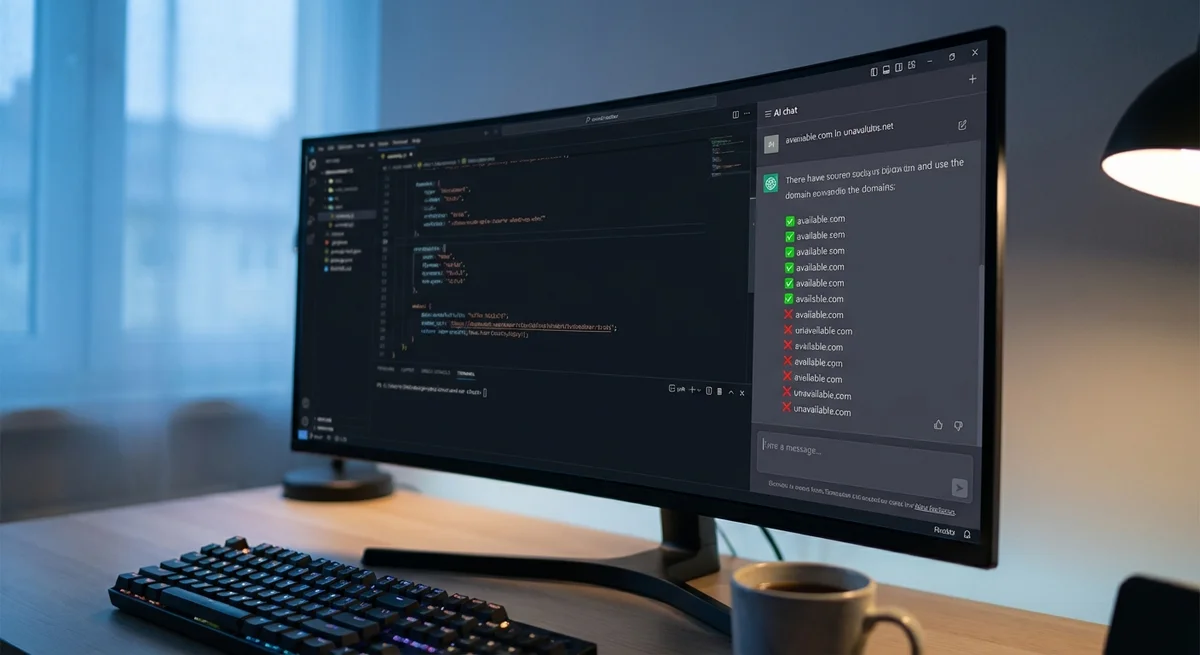
Every developer who has asked ChatGPT or Claude to come up with a domain name knows this vicious cycle: the model spits out a dozen brilliant options, you get excited, open the registrar — and discover they're all taken. You ask again, check again, get disappointed again. A developer on Habr found a way to break this cycle, and his solution turned out to be far more interesting than just a convenient domain-checking script.
The story began prosaically: the author launched a joke service that unexpectedly gained an audience. Deciding to scale to the global market, he went looking for a .com domain and ran into that classic pain point. Language models are excellent at generating creative names, but have no idea whether they're available. The model works with frozen data and can't check the WHOIS server in real time. Checking each variant manually is the kind of task that kills any enthusiasm.
The solution the developer found relies on a technology that everyone has been talking about more and more in the past year: Model Context Protocol, or MCP. This is an open standard proposed by Anthropic that allows language models to interact with external tools and data sources through a unified interface. Previously, to give a model access to a service, you had to write complex integrations with function calling and plan the entire call chain. MCP turns this into connecting a ready-made "plugin." The author wrote his own MCP server that takes a domain name and returns the result of a WHOIS query, then connected it to Cursor — a popular IDE with a built-in AI assistant.
The result looks deceptively simple. The developer asks the AI agent inside Cursor to come up with a domain for a project on a specific topic. The agent generates options, but instead of simply handing over a list and washing its hands of it, immediately calls the MCP server, checks the availability of each name through WHOIS, and returns only free variants. The entire cycle — from creative brainstorming to verified result — happens in one window, without switching context. According to the author, setup takes about five minutes: you just need to write the MCP server configuration in Cursor's settings.
But the significance of this case extends far beyond domain checking. It clearly demonstrates a fundamental shift in how we use language models. Before MCP and similar protocols, an AI assistant in an IDE was essentially very smart autocomplete — it could generate code, explain it, refactor it, but remained confined within its linguistic competence. Now the model becomes an orchestrator: it doesn't just think, it acts, calling external APIs, databases, file systems, and any other services the developer decides to connect.
The ecosystem of MCP servers is growing rapidly. There are already ready-made servers for working with GitHub, Slack, databases, file storage, browsers, and dozens of other tools. Cursor, Claude Desktop, and several other clients support the protocol natively. In essence, a new infrastructure layer is forming — a kind of "app store" for language models, where each MCP server extends the AI agent's capabilities with a specific skill.
For developers, this means a fundamental change in workflow. Instead of keeping ten tabs open with documentation, terminal, domain registrar, and server dashboard, you can delegate routine checks to the agent. Instead of copying data between tools, you can let the model reach out to the needed source itself. This is not replacement for the developer, but augmentation of capabilities — exactly what the "copilot" concept promised from the start, now realized not just for code writing.
It should be noted, however, that there are limitations. MCP servers currently require local execution or self-hosting, security questions about giving models access to external services remain open, and the standard continues to evolve. But the direction is clear: the future of AI assistants is not in isolated text generation, but in the ability to act in the real world through tools. And a little MCP server for checking domains is a perfect illustration of how this future is already arriving.
Want to stop reading about AI and start using it?
AI News is a curated feed of AI/tech news. Hamidun Academy teaches you to use AI systematically in your work.