Sending AI Data Centers Into Space. Is It Realistic?
Power consumption by data centers for generative AI is rising rapidly, putting serious pressure on power grids and the climate. Engineers and entrepreneurs are
AI-processed from Wired; edited by Hamidun News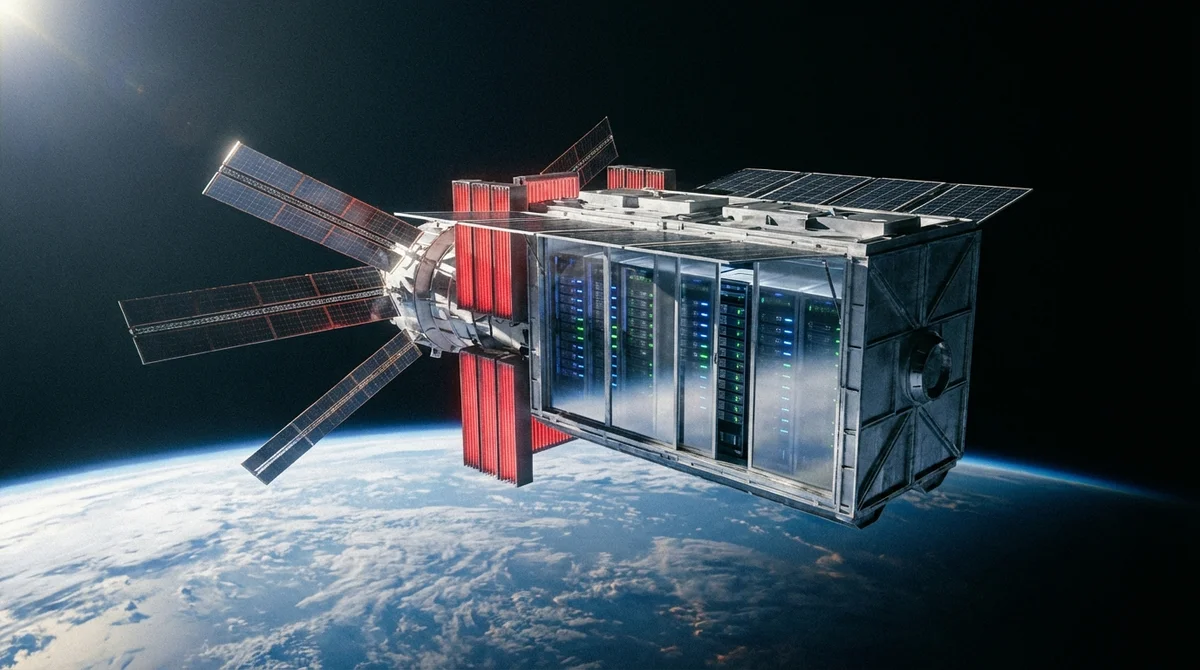
Each time you ask a language model to write a letter or generate an image, somewhere on Earth a massive server cluster is running, consuming electricity equal to that of a small city. The generative AI industry is growing at such a pace that the question of powering data centers has transformed from an engineering challenge into a geopolitical problem. And now an idea that seemed like pure science fiction not long ago is appearing on the horizon: what if we moved data centers to space?
To understand the scale of the problem, a few figures suffice. According to estimates from the International Energy Agency, by 2026 global data centers will consume over 1000 terawatt-hours of electricity per year — comparable to Japan's energy consumption. A significant portion of this growth comes from infrastructure for training and inference of large language models.
Companies like Microsoft, Google, and Amazon are buying up nuclear power station capacity, building their own energy facilities, and negotiating supply contracts with nuclear reactor operators. But even this may not be enough. Meanwhile, pressure from environmental organizations and regulators is mounting: data centers not only consume electricity but also emit enormous amounts of heat, and cooling them requires millions of liters of water.
It is in this context that the idea of orbital data centers stops looking absurd. The logic of its supporters is simple and elegant. In orbit, solar energy is available virtually around the clock — no clouds, no night in the conventional sense, and the intensity of solar radiation is approximately 40 percent higher than on Earth's surface. Server cooling, which terrestrial data centers spend up to 40 percent of their energy on, is solved fundamentally differently in space: radiators dump heat into the cold of open space. Finally, an orbital data center occupies no precious land, makes no noise, and does not compete with residential areas for water resources.
Several companies have already moved from theoretical discussions to concrete projects. European startup Lumen Orbit attracted funding to develop a prototype orbital computing module. American company Axiom Space, known for its commercial missions to the ISS, is exploring the possibility of placing server racks in space station modules.
Even defense agencies are showing interest: the Pentagon is funding research into distributed computing in orbit for processing data from observation satellites. The key factor that shifted this idea from the realm of fiction to engineering calculations was the radical reduction in the cost of space launches. SpaceX reduced the cost of lifting a kilogram to low Earth orbit by approximately ten times compared to the Space Shuttle era, and the reusable Starship system promises to reduce this figure several times more.
However, between a beautiful concept and working infrastructure lies a gulf of technical problems. The first and most obvious is signal latency. Even in low orbit at 500–600 kilometers, latency is tens of milliseconds, which is acceptable for batch data processing or model training, but critical for real-time applications.
The second problem is radiation. Cosmic rays and charged particles from the solar wind cause what are called single-event upsets in microchips, flipping bits in memory. Server equipment will either need to be shielded, which dramatically increases mass, or be designed from scratch with radiation resistance in mind.
The third complication is maintenance. When a hard drive fails on Earth, a technician replaces it in minutes. In orbit, replacing a component is a separate space operation costing millions of dollars.
Finally, the growing problem of space debris makes any large-scale orbital infrastructure vulnerable: a collision with a fragment just a centimeter in size can disable an entire module.
There is also an economic paradox. Supporters of orbital data centers emphasize environmental benefits, but the process of launching rockets is far from harmless to the atmosphere. Each Falcon 9 launch expels hundreds of tons of carbon dioxide and soot into the upper atmosphere, where their impact on the ozone layer and climate is insufficiently understood. If creating an orbital computing network requires hundreds of launches, the environmental balance may turn out to be far less clear-cut than presented in startup pitches.
Nevertheless, it would be a mistake to dismiss this idea as yet another hype cycle. The history of technology shows that the most radical concepts often find their niche — even if not in the form they were initially envisioned. Orbital data centers are unlikely to replace terrestrial ones in the foreseeable future, but could become an important supplement for specific tasks: training exceptionally large models, processing satellite data, providing computing resources to remote regions. A realistic horizon for the first pilot projects is the end of this decade. In the meantime, the AI industry will continue searching for energy on Earth, increasingly glancing upward — to where the sun never sets.
Want to stop reading about AI and start using it?
AI News is a curated feed of AI/tech news. Hamidun Academy teaches you to use AI systematically in your work.