When Neural Networks Litigate: How Multi-Agent Systems Are Changing Legal AI
Tsinghua University showed that classic RAG pipelines in legal tasks suffer from confirmation bias. The solution is adversarial simulations, where an AI prosecu
AI-processed from Habr AI; edited by Hamidun News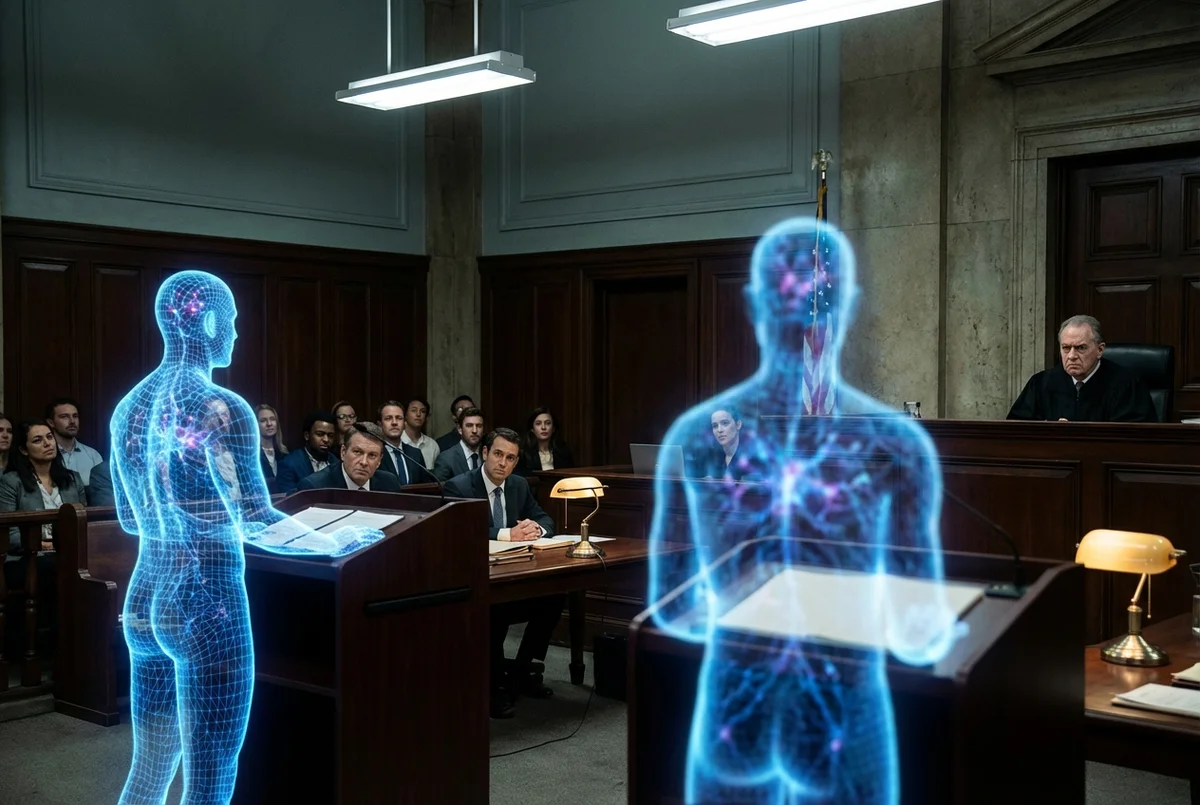
One of the most persistent problems with language models in professional tasks is their tendency toward confident falsehoods. In jurisprudence, where every reference to law must be precise and the logic of argumentation must be flawless, this weakness becomes critical. Researchers from Tsinghua University and Russian company AiJurist independently found the same answer: to prevent a neural network from hallucinating, it needs an opponent.
At the end of 2025, a team from Tsinghua published a preprint titled "Chinese Court Simulation with LLM-Based Agent System," which systematically analyzed a fundamental weakness of the conventional approach to legal AI. The classical scheme — user asks a question, system searches for relevant documents in a database, model generates an answer — looks logical, but in practice breaks down due to confirmation bias. The neural network finds the first suitable argument and begins building all its logic around it, ignoring contradictory facts. It has no internal critic to say: "Wait, this article of law says the exact opposite."
The solution proved elegant and, if you think about it, obvious. Chinese researchers applied the principle of adversariality — the very principle on which the entire judicial system is built. They created two AI agents: a prosecutor and a lawyer, each based on a large language model. The agents didn't simply generate arguments — they actively attacked their opponent's position. When the lawyer cited a non-existent regulation, the prosecutor immediately refuted it. The result was impressive: the number of hallucinations dropped sharply, and the quality of legal argumentation improved. Truth, as in real court, was born in dispute.
However, between an academic experiment and a working product lies a gulf well understood by practitioners. Russian company AiJurist, which was simultaneously building a multi-agent system for arbitration courts based on its own open model Ken1.0, attempted to transfer the Chinese colleagues' findings into a real business environment — and encountered the problem that the architecture completely fell apart upon contact with reality. The academic approach, which worked excellently on controlled datasets, couldn't withstand collision with the chaos of real court cases, where documents arrive in different formats, legal norms contradict each other, and case context can change dramatically from one paragraph to the next.
The AiJurist team went further and built what they call Russia's first system of judicial simulations. Instead of two agents — ten, each with its own role and area of responsibility. This architecture is closer to how a real court process is structured: here there are not only opposing sides, but also a judge, experts, analysts who verify facts and assess evidence. Scaling up the number of agents solves another important problem — it prevents the system from becoming stuck in opposition between two positions and creates space for nuanced analysis.
It's important to understand the context in which such systems emerge. The legal profession is one of the most conservative, and at the same time one of the most burdened by routine. Corporate lawyers spend dozens of hours analyzing case law, forecasting outcomes, and preparing arguments. Multi-agent simulations don't replace lawyers — they give them a tool for stress-testing their own position before filing a suit. This is a fundamentally different level of case preparation.
This case is indicative in a broader sense as well. It demonstrates a general trend in AI system development: the transition from monolithic models that solve a task in a single pass to orchestrated ensembles of specialized agents. The same principle already works in programming, where an AI reviewer checks code written by an AI developer, and in medicine, where diagnostic models verify each other. Jurisprudence is the next frontier, and the stakes are particularly high here: an error in code leads to a bug, an error in court leads to real financial losses.
The main conclusion from the Tsinghua and AiJurist story is simple but important. Multi-agency is not an academic toy but an architectural pattern that will define the next generation of professional AI tools. But the path from a research preprint to a product that corporate clients pay for requires not merely scaling — it requires rethinking the architecture itself in light of the real conditions of a specific legal system.
Want to stop reading about AI and start using it?
AI News is a curated feed of AI/tech news. Hamidun Academy teaches you to use AI systematically in your work.