Anthropic vs. the war machine: principles at the cost of a billion-dollar contract
Anthropic is facing a choice: principles or money. The company insists on banning the use of Claude in autonomous weapons and government surveillance, which cou
AI-processed from Wired; edited by Hamidun News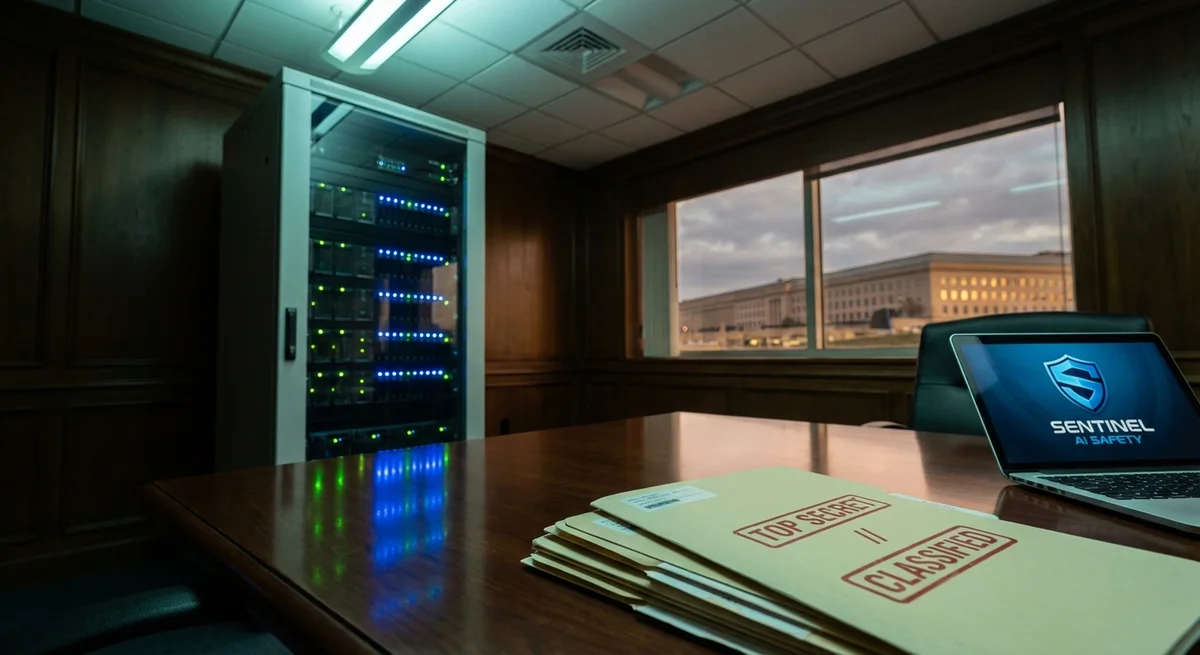
In the world of large language models, it's common to talk about AI safety as a priority. But when billion-dollar military contracts are at stake, beautiful declarations face a reality check. Anthropic — a company that has built its reputation on a responsible approach to artificial intelligence — has encountered a situation in which its principles could cost it a very specific sum of money.
According to Wired, Anthropic is firmly insisting on two limitations for the use of its Claude model: no application in autonomous weapons systems and no integration into government surveillance tools. These "red lines" are not just terms in a user agreement. They are embedded in the very architecture of the company's relationships with potential government customers. And according to the publication, these are precisely what could cost Anthropic a major contract with an American military department.
To understand the scale of what's happening, one needs to look at the context. Over the past two years, the Pentagon and other U.S.
defense structures have sharply increased their interest in generative AI. The Department of Defense has launched a series of programs to integrate large language models into logistics, intelligence analysis, operational planning, and — most sensitively — into decision-making systems on the battlefield. OpenAI, which as recently as 2023 declared a refusal to work with the military, by 2025 has quietly reconsidered its position and begun working with defense contractors.
Google, through its Google Public Sector division, is actively promoting Gemini for government purposes. Microsoft, OpenAI's strategic partner, has long been deeply integrated into defense infrastructure through Azure Government contracts. Against this backdrop, Anthropic remains perhaps the only major player that publicly draws a clear line between permissible and impermissible military applications.
Anthropics's principled stance has roots in the company's very DNA. Its founders — Dario and Daniela Amodei — left OpenAI precisely because they believed the approach to safety was insufficiently serious. Anthropic positions itself as a "safety-first" company, and its research in constitutional AI, model interpretability, and alignment mechanisms is genuinely at the forefront of the industry. But it's one thing to publish scientific papers about safety, and quite another to turn down contracts that could be worth hundreds of millions of dollars. Especially when you're a private company burning enormous sums on model training and needing stable sources of revenue.
Technically, the ban on autonomous weapons and surveillance sounds simple, but in practice the line is blurred beyond recognition. What counts as autonomous weapons — a drone that independently selects a target, or a system that analyzes satellite imagery and proposes a list of priority targets to an operator? Where does "intelligence analysis" end and "government surveillance" begin? Military customers typically want the widest possible licenses and minimal restrictions. A company that comes with a long list of caveats automatically loses to a competitor willing to be more flexible. This, apparently, is precisely what's happening: the Pentagon is considering alternative suppliers not burdened by such ethical frameworks.
This situation exposes a fundamental rift in the AI industry. For several years, leading laboratories have rushed to sign voluntary safety commitments, publish manifestos, and create internal ethics committees. But voluntary restrictions work only until they start costing real money.
OpenAI has already shown how quickly you can change course: less than two years passed from categorical "we don't work with the military" to partnership with defense structures. If Anthropic loses a major contract because of its principles, it will send a powerful signal to the entire market — and that signal will be two-edged. On one hand, it will show that ethical restrictions have a real price.
On the other, it will demonstrate that the market punishes principled stands.
For Anthropic, the stakes extend far beyond a single contract. The company has attracted billions of dollars in investments, including from Amazon and Google, and its valuation approaches the $60 billion mark. Investors expect revenue growth, and the government sector is one of the most promising and stable monetization channels for AI companies. If Anthropic systematically loses government contracts due to ethical restrictions, pressure from shareholders will inevitably intensify. The history of the technology industry contains plenty of examples of when noble principles gave way to pragmatism as companies grew and took on greater financial obligations.
And yet Anthropic's decision deserves attention not only as a business case. It raises a question for the entire industry that will eventually need to be answered at the regulatory level: should there be mandatory, rather than voluntary, restrictions on military applications of generative AI? Until this question is answered, the fate of ethical standards in AI will depend on the willingness of individual companies to pay for their beliefs. Anthropic is paying for now. The question is how long it will be able to afford to do so.
Want to stop reading about AI and start using it?
AI News is a curated feed of AI/tech news. Hamidun Academy teaches you to use AI systematically in your work.